Scramble for Africa refers to the late 19th and early 20th centuries when European powers colonised and divided the African continent, seeking political, economic, and strategic dominance. Africa was mercilessly exploited, and to date, the scars remain. With its rich resources and sizable population, Nigeria became a prime target of British colonial authorities, a historical fact that underscores its continued strategic importance on the continent. Fast forward to the 21st century, and a new scramble for Africa is underway. This time, global powers compete for influence, resources, and markets rather than territories. Once again, Nigeria plays a central role in these geopolitical and economic dynamics.
A Different Global Dynamics
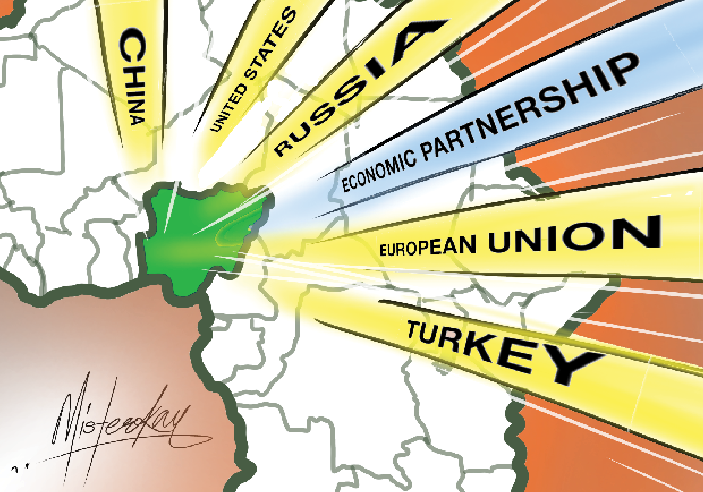
In this modern scramble, the dynamics differ considerably. The focus has shifted from territorial to economic conquest wrapped in infrastructure investments, aid and strategic alliances. Leading global actors—such as China, the United States, the European Union, and emerging powers like Russia, Turkey, and India—vie for influence across Africa through diplomacy, trade deals, and development initiatives. While politically independent, Africa remains a stage for intense geopolitical competition, as the world’s most powerful nations recognise the continent’s potential and seek to secure a share of its resources and promising future.
Nigeria is pivotal in Africa’s trajectory as the continent’s most populous country and largest economy. The country is rich in oil reserves, has a rapidly expanding technology sector, and boasts an increasingly youthful and growing population. By 2050, projections indicate that one in four people will be African, and Nigeria is expected to account for a significant portion of that demographic shift. With its energy and potential, this youthful population presents a promising future, making Nigeria a focal point in global power plays, with its future development and stability crucial for Africa and the world.
However, Nigeria also faces many domestic challenges that complicate its ability to maximise the benefits of this shadow battle for influence by global powers. These issues include endemic corruption, ineffective political leadership, and security concerns. These issues have created a fragile environment for economic growth, even as foreign powers, as part of their grand strategy, seek to invest in the country’s resources and infrastructure to position their countries for influence and economic advantage.
Endless Summits, meaningless outcomes
In recent years, a series of high-profile international summits have been held aimed at solidifying relationships with African nations. These summits, often called an ‘old trick’ in international diplomacy, remain effective in the modern scramble for Africa. They serve as platforms for global powers to compete for influence and partnerships, highlighting Africa’s continued importance in the global geopolitical landscape.
Unfortunately, Africa has learnt nothing from history. Some notable examples of these partnership summits include the Russia-Africa Summit, the U.S.-Africa Leaders’ Summit, the European Union-African Union (AU) Summit, the Tokyo International Conference on African Development, and China’s Forum on China-Africa Cooperation (FOCAC).
Each of these summits represents a strategic attempt by global powers to strengthen ties, secure economic partnerships, and cement their geopolitical foothold in Africa. For instance, the European Union’s Global Gateway project, announced at the EU-AU Summit, seeks to counter China’s Belt and Road Initiative (BRI) by offering substantial investments in African infrastructure. Likewise, the U.S.-Africa Leaders’ Summit highlighted a $55 billion investment plan over three years, reflecting a renewed focus by Western powers on regaining influence in a continent where China’s presence has become increasingly dominant.
China’s FOCAC remains a crucial pillar of its engagement with Africa. At the 2024 FOCAC summit, China pledged USD 51 billion for 30 infrastructure projects across Africa, positioning Beijing for more significant influence on the continent. Meanwhile, emerging powers like India, Turkey, and the Gulf states are also working to deepen their ties with African nations, creating more comprehensive partnership options for African leaders.
What future for Nigeria in this Geopolitics ?
In this evolving global chessboard, the question remains: Is Nigeria a pawn in the hands of international powers, or can it become an active player shaping its destiny? Nigeria’s vast natural resources, demographics, expanding technology sector, and strategic location make it an attractive playground for foreign investment and global geopolitics. However, the country’s ability to benefit from this renewed battle for global influence hinges on its ability to navigate the complex landscape of international diplomacy and partnerships, in addition to the quality of domestic governance, the power of immigration, the rise of Ai and ICT and its positioning in the new global economic order. This is purely a function of leadership that has understanding and requisite navigational skill.
At present, Nigeria faces a delicate balancing act. On one hand, foreign investments can drive much-needed infrastructure development, job creation, and technological advancement. However, the ever-present risk of economic dependency and the challenge of maintaining sovereignty exists. China’s large-scale infrastructure investments, often funded by loans, have sparked concerns over Nigeria’s rising debt burden and the potential for long-term economic vulnerability. These concerns underscore the need for Nigeria to adopt a cautious approach, ensuring that foreign partnerships do not compromise the country’s sovereignty or its long-term developmental goals.
Nigeria’s potential to play an active role in the African continent and emerging global dynamics is inextricably linked to its domestic stability, achieved by strengthening democratic institutions, improving security, promoting inclusive development, and maintaining a favourable investment environment. Nigeria inevitably must build a strong economy as the foundation for effective foreign policy. We cannot continue to tumble from one economic policy to the next and expect to be given strategic importance in this new war for influence by powerful global nations on the continent. Nigeria’s leadership is central to its success in this new scramble for Africa. Without visionary and strategic leadership capable of understanding global dynamics and advancing Nigeria’s long-term interests, the country risks being left behind in the race for international influence.
Nigeria needs to be more active in a world where geopolitical competition intensifies. Its foreign policy must proactively build alliances with traditional and emerging powers while safeguarding the nation’s long-term interests. The country’s leaders must recognise the importance of actively shaping Nigeria’s future and Africa’s collective destiny. With its potential and resources, Nigeria has a significant role in shaping the continent’s future.
So far, sound bites from Nigeria’s foreign affairs minister, Yusuf Maitama Tuggar, seem reasonable, but action is more important. Nigeria is championing the 4D principle, Democracy, Demographics, Development and Diaspora. We led the UN tax reforms, but we have yet to appoint a permanent representative in the global body to advance our agenda items further. Nigeria has yet to appoint substantive ambassadors for all our missions in nearly one year, yet we expect the world to take us seriously in diplomatic engagements.
As one of Africa’s largest economies, Nigeria is uniquely positioned to lead the continent in defining its collective positions in dealings with external powers. However, this requires smart diplomacy and a Pan-African approach, whereby African nations present a united front in their negotiations with global actors. If African nations act as individual entities, they risk being divided and conquered by more considerable powers with far more excellent resources and strategic leverage.
Africa’s ability to thrive in this new era of global competition depends on its capacity to unite as a bloc to secure mutually beneficial deals with external partners. By adopting a coordinated Pan-African strategy, African nations can negotiate from a position of strength, ensuring they benefit from foreign engagement rather than being exploited.
The new scramble for Africa presents both opportunities and risks for Nigeria. Foreign investment offers a pathway to infrastructure development, economic growth, and technological innovation. However, the risk of neocolonialism and economic dependency looms as Nigeria and other African nations rely on external capital for their development. A culture of dependence on aids and foreign capital often creates a disincentive for critical thinking and institutional development.
Nigeria’s future will depend on its ability to manage these external influences, prioritise national interests, and strengthen its internal governance. With strategic foresight and effective leadership, Nigeria can turn the renewed global scramble for Africa into an opportunity for national development, positioning itself as a key player worldwide.
However, if Nigeria fails to navigate these challenges, it risks repeating past mistakes and falling prey to the forces that once sought to dominate it. Nigeria’s future depends on its ability to manage foreign relations while prioritising its national interests and development.
We’ve got the edge. Get real-time reports, breaking scoops, and exclusive angles delivered straight to your phone. Don’t settle for stale news. Join LEADERSHIP NEWS on WhatsApp for 24/7 updates →
Join Our WhatsApp Channel