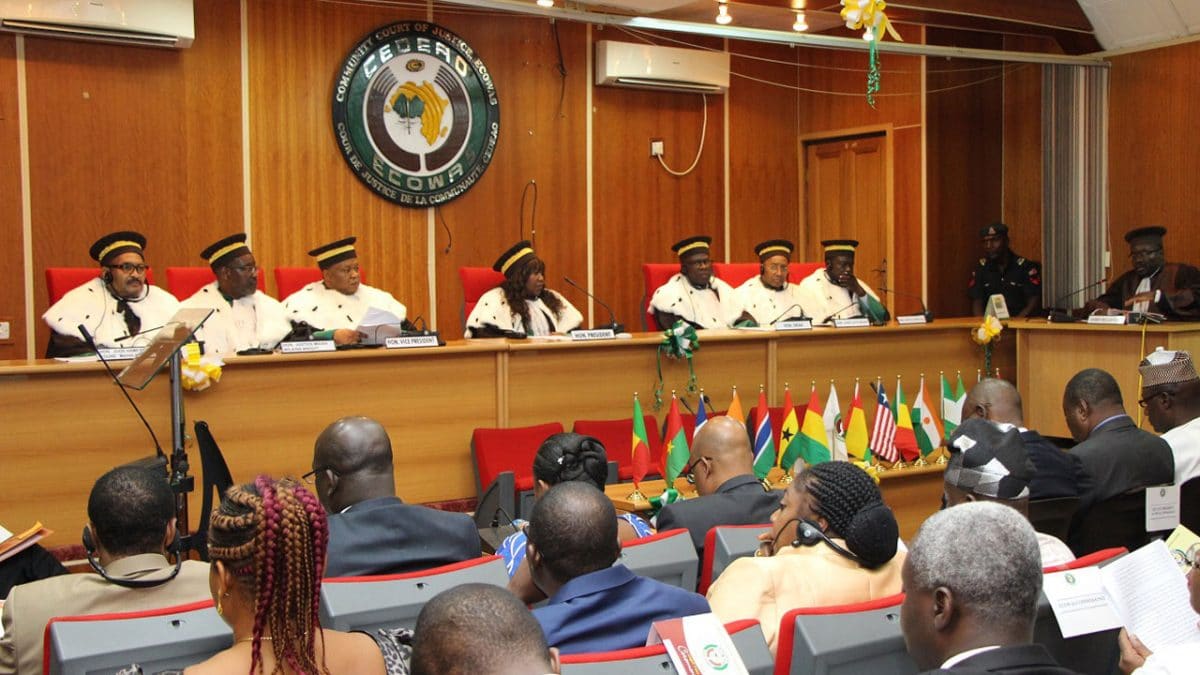
The Socio-Economic Rights and Accountability Project (SERAP) has dragged the federal government and 36 governors before the ECOWAS Community Court of Justice in Abuja over the legality of the Cybercrimes (Amendment) Act 2024.
SERAP is accusing the government of using the Cybercrimes Act to criminalise legitimate expressions and violate the human rights of Nigerians, including activists, journalists, bloggers, and social media users.
It will be recalled that the ECOWAS Court, in a judgment delivered on March 25, 2022, held that the Nigerian authorities must cease using Section 24 of the Cybercrime Act 2015 to prosecute individuals for insulting or stalking public officials online.
The Court held that Section 24 is “arbitrary, vague, and repressive” and directed Nigerian authorities to repeal it in line with the country’s human rights obligations.
However, SERAP argues that although the National Assembly repealed Section 24 of the Cybercrime (Amendment) Act 2024, it has not addressed the arbitrary and vague nature of other provisions.
In a lawsuit filed last week Friday, the civil society organisation is challenging the legality and compatibility of the provisions of the Cybercrime (Prohibition, Prevention, etc.) (Amendment) Act 2024 with the rights to freedom of expression and information.
The plaintiff stated that the Cybercrimes (Amendment) Act 2024 provisions create opportunities for criminalising legitimate expressions and punishing activists, journalists, bloggers, and social media users.
SERAP maintained that the definition of “causing a breakdown of law and order” in Section 24(1)(b) of the amended legislation is unclear and undefined, posing a threat to peaceful and legitimate expressions and paving the way for abuse.
The plaintiff further argued that instead of using the amended legislation to enhance safety in cyberspace, Nigerian authorities frequently weaponise it to infringe on Nigerians‘ human rights and media freedom.
The organisation also submitted that the Cybercrime (Amendment) Act 2024 broadly defines “cyberstalking” in Section 58 as “a course of conduct directed at a specific person that would cause a reasonable person to feel fear.”
SERAP insisted that these provisions represent a harsh and punitive attempt to address issues related to stalking and harassment while lacking adequate safeguards against misuse, particularly concerning the peaceful and legitimate exercise of human rights.
The plaintiff argued that using Section 24 of the Cybercrime (Amendment) Act 2024 to harass those critical of the government poses a direct threat to the organisation‘s staff, members, and supporters, given their advocacy for human rights.
SERAP further stated that the amended legislation is used to threaten and stifle people’s human rights and livelihoods.
The organisation submitted, “The vague, arbitrary, and repressive provisions on ‘cyberstalking’ in Section 24 of the Cybercrime (Amendment) Act 2024 are routinely misused to suppress factual reports by activists, journalists, bloggers, and social media users, leading to a chilling effect on human rights and media freedom.
SERAP asserts that Nigerian authorities have a negative obligation to refrain from interfering with human rights and media freedom and a positive commitment to promote and protect these rights.
“The right to freedom of expression is a fundamental human right for individual freedom and democracy. It serves as the cornerstone of democracy and is indispensable to a vibrant civil society,“ SERAP stated
The organisation also warns that whether labelled as cyberstalking, criminal defamation, the seditious libel of government officials, or false news, the provisions of Section 24 of the Cybercrime (Amendment) Act 2024 disproportionately penalise the accused, inevitably limiting protecting public discussion and debate on matters of legitimate public concern.
On March 25, 2022, the ECOWAS Court ruled that Section 24 of the Cybercrime Act 2015 was arbitrary, vague, and repressive, in violation of Article 9 of the African Charter on Human and Peoples’ Rights and Article 19 of the International Covenant on Civil and Political Rights.
The Court also directed the Federal Republic of Nigeria to amend Section 24 of the Cybercrime (Prohibition, Prevention, etc.) Act 2015 to comply with its obligations under Article 1 of the African Charter on Human and Peoples’ Rights.
Although the National Assembly amended Section 24 and other provisions of the Cybercrime Act in 2024, the new Cybercrime (Amendment) Act 2024 still criminalises ‘cyberstalking’. Its provisions remain vague, arbitrary, and often misused by Nigerian authorities to suppress human rights.
We’ve got the edge. Get real-time reports, breaking scoops, and exclusive angles delivered straight to your phone. Don’t settle for stale news. Join LEADERSHIP NEWS on WhatsApp for 24/7 updates →
Join Our WhatsApp Channel