Nigeria’s drive for a stronger, more reliable energy sector received a boost as the African Development Bank (AfDB) announced a $1.2 million grant to launch the Battery Energy Storage System (BESS) Feasibility Study.
The AfDB Nigeria Country Office director general, Dr. Abdul Kamara, who made this known in Abuja, also affirmed the bank’s commitment to supporting Nigeria’s energy reforms.
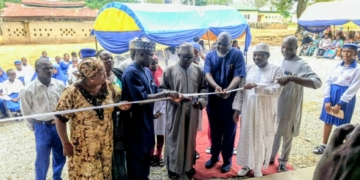
Speaking at the study’s inauguration of the Feasibility Study on the BESS, on Wednesday, Dr. Kamara, who was represented by Chigozie Egerue, of the bank’s Africa Energy Transition Catalyst Programme, underscored the urgency of addressing Nigeria’s electricity access gap.
“This is why the bank has committed a 1.2-million-dollar grant under the Africa Energy Transition Catalyst Programme to support this feasibility study.”
“The mission to bridge the energy gap is more urgent than in Nigeria, home to an estimated 90 million people still without access to electricity.” Dr. Kamara declared.
The project, implemented by the Transmission Company of Nigeria (TCN), will evaluate grid integration potential, business and regulatory models for investment, and capacity-building measures vital for ownership and sustainability.
Dr. Kamara stressed that battery storage “is no longer a luxury; it is a necessity.” He explained that as Nigeria’s power grid modernises, battery storage will be crucial for “frequency stabilisation, reserve capacity, and peak load management.” However, he warned, “Technology alone will not carry the day. Regulatory frameworks and investment environments must evolve to scale innovations sustainably.”
As Nigeria aligns with the Mission 300 initiative, targeting electricity connection for 300 million people across Africa by 2030, battery storage is emerging as a “critical enabler.” Citing the continent’s resources, the AfDB representative highlighted, “Africa holds almost 60 per cent of the world’s best solar resources, yet accounts for only two per cent of global energy storage capacity.”
Beyond the BESS feasibility study, AfDB’s commitment to Nigeria’s energy sector is substantial. “$500 million has already been disbursed, with the second phase on track,” Dr. Kamara restated, referring to the $1 billion Economic Governance and Energy Transition Support Programme. The bank’s $1 million Africa Energy Sector Technical Assistance Programme is also helping implement the Electricity Act, develop state-level power markets, and strengthen governance.
“Nigeria is also a key country under our flagship’s $20 billion Desert to Power Initiative, which aims to generate 10,000 megawatts of solar across the Sahel and provide power to 250 million people. This holds immense promise for Nigeria’s clean energy future,” Dr. Kamara explained.
He said it presented “not just a challenge but an opportunity,” with further examples of battery storage success in South Africa and Kenya reaffirming the technology’s transformative potential.
In his address, Minister of Power Chief Adebayo Adelabu, emphasised the study’s strategic importance: “The feasibility study is not just a technical exercise but a strategic step towards further proving Nigeria’s power infrastructure.”
The minister, represented by the ministry’s assistant director of Renewable Energy, Engr. Ben Anyagwu, reflected on the sector’s ongoing reforms while acknowledging persisting challenges: “With the increasing penetration of solar and wind energy in our energy mix, we must now address the critical challenge of energy storage: storing electricity when generation exceeds demand and dispatching it when needed to maintain balance and reliability.”
He noted that BESS could “enhance grid stability and flexibility, reduce reliance on fossil-fuel-based peaking plants, enable deeper integration of renewables into both grid-connected and off-grid systems, and improve power quality and system reliability—especially during voltage or frequency disturbances. Ultimately, this will help extend access to clean energy in underserved and remote areas.”
The managing director of TCN, Engr. Sule Abdulaziz, focused on the technical constraints: “For years, the challenges have been frequency fluctuations, peak load pressures, and limitations in reactive power support. These technical constraints affect every layer of the value chain.”
Abdulaziz, who was represented by the TCN’s executive director, Transmission System Operation Olugbenga Ajiboye, said the technical constraints affected every value chain layer.
He affirmed that Battery Energy Storage Systems “offer Nigeria a powerful means to address the persistent challenges,” enabling “regulation, reserve capacity, and voltage support,” which would directly strengthen grid performance and maximise use of existing assets.
We’ve got the edge. Get real-time reports, breaking scoops, and exclusive angles delivered straight to your phone. Don’t settle for stale news. Join LEADERSHIP NEWS on WhatsApp for 24/7 updates →
Join Our WhatsApp Channel