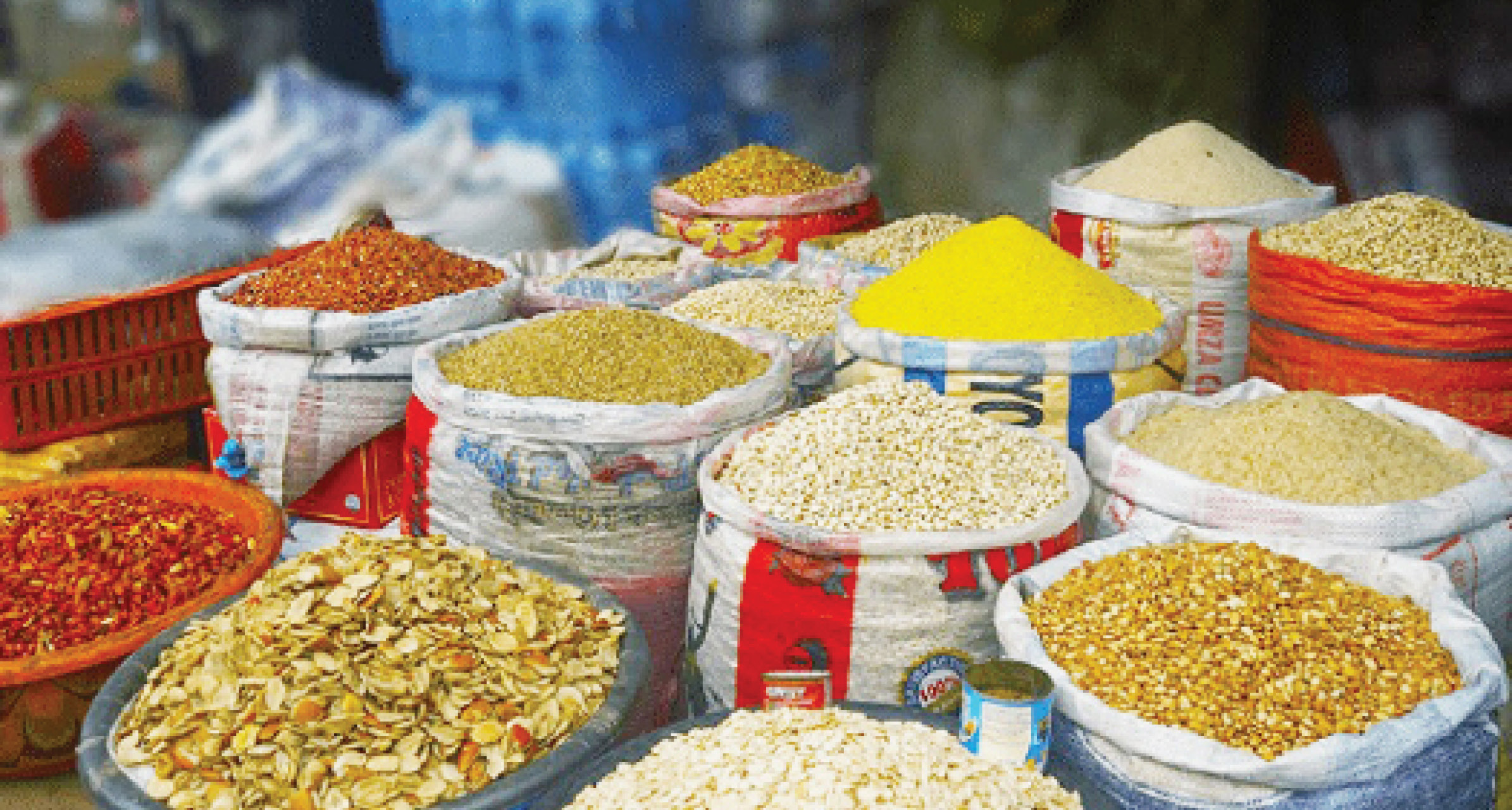
The federal government yesterday said the ongoing decline in food prices across Nigeria is evidence that its agricultural policies are beginning to yield results.
Minister of Agriculture and Food Security, Abubakar Kyari, said this at the 47th National Council on Agriculture and Food Security in Kaduna.
According to the minister, the decline in food prices across several commodities is a sign that government interventions in production, input delivery and market stabilisation are working.
“While we are not yet where we want to be, this positive trend confirms that we are moving in the right direction,” he said.
Kyari stressed that agriculture remains the single largest employer of labour in Nigeria and contributes over one-quarter of the nation’s GDP, describing it as the foundation of national renewal and economic stability.
He explained that current policies are guided by the frameworks of Nigeria’s Vision 2050, the National Development Plan (2021–2025), and the National Agricultural Technology and Innovation Policy (NATIP).
These, he said, form part of President Bola Tinubu’s vision to achieve food sovereignty by building local capacity and promoting inclusive growth.
Kyari highlighted the expansion of the National Agricultural Growth Scheme–Agro Pocket (NAGS-AP) as one of the flagship programmes driving input access and productivity, particularly in wheat cultivation.
He noted that production has grown from 15 states in the 2023/2024 dry season to wider coverage this year with the introduction of rainfed wheat farming in Plateau State as a major milestone toward achieving self-sufficiency.
“Food sufficiency is the first currency of national stability, as we continue to build resilience in our food systems, the falling food prices are proof that our policies are working, and that our collective efforts are beginning to bear fruit,” he added.
To address post-harvest losses and stabilise prices, the minister said the Nigeria Postharvest Systems Transformation Programme (NiPHaST) was developed in partnership with the Alliance for a Green Revolution in Africa (AGRA).
He also disclosed that the operations of the National Strategic Grain Reserve Silos in several states are being strengthened to support long-term food stability, while the recapitalisation of the Bank of Agriculture with N1.5 trillion and an additional N250 billion financing window would expand credit access for smallholder farmers.
Kyari added that the National Agricultural Development Fund (NADF) has been fully operationalised to expand access to finance for value chains and agribusinesses.
At the same time, investments in rural infrastructure, including roads, boreholes, and solar-powered systems, are being scaled up to strengthen rural livelihoods and market access, he said.
In his remarks, minister of state for Agriculture and Food Security, Aliyu Sabi Abdullahi, said the administration remains focused on policies that promote food self-sufficiency through climate-smart agriculture and gender-responsive programmes.
He reaffirmed the government’s broader goals are to reduce import dependence, strengthen market confidence, and position Nigeria as a leading food supplier in West Africa.
“We must continue to strengthen our national solidarity in the fight to end hunger, malnutrition, and poverty. Our commitment to food sovereignty and food security is unwavering, and every policy decision we take is geared toward ensuring that no Nigerian goes to bed hungry”, Abdullahi said.
We’ve got the edge. Get real-time reports, breaking scoops, and exclusive angles delivered straight to your phone. Don’t settle for stale news. Join LEADERSHIP NEWS on WhatsApp for 24/7 updates →
Join Our WhatsApp Channel