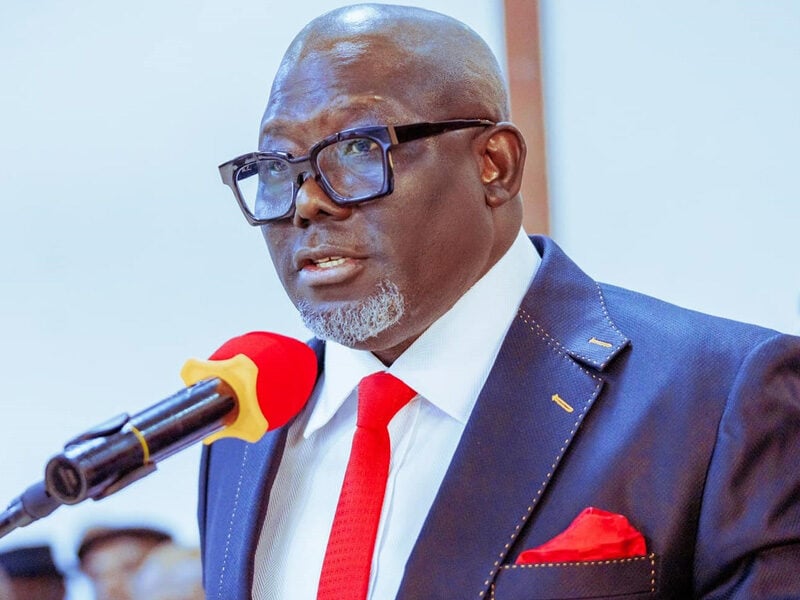
Delta State governor, Hon. Sheriff Oborevwori has presented a N1.664 trillion Appropriation Bill for 2026 to the Delta State House of Assembly, (DSHA) for legislative consideration.
The presentation, held at the hallowed chamber of the Assembly Complex in Asaba, was made pursuant to Section 121 of the 1999 Constitution (as altered).
The total budget size, N499 billion (30 per cent) is proposed for recurrent expenditure, while N1.165 trillion (70 per cent) is earmarked for capital projects, representing a 70 per cent increase over the 2025 appropriation.
The capital expenditure, accordingly, is signalling an aggressive push for infrastructure expansion and socio-economic development in the 2026 fiscal year.
Presenting the budget Christened; “Budget of Accelerating the More Agenda”, Governor Oborevwori said the budget was crafted against the backdrop of an improving national economy, with Nigeria’s GDP projected to grow by 3.9 per cent in 2026.
He noted that rising oil revenues, stabilising fiscal and monetary policies, tax reforms, and renewed federal efforts in tackling insecurity have rekindled hope for economic expansion and improved living standards.
The governor explained that the 2026 budget is designed to drive inclusive and sustainable growth, develop human capital, accelerate infrastructure renewal, enhance social cohesion, reduce debt exposure, and ensure better resource management.
On revenue expectations, Oborevwori stated that the state anticipates significant improvement in federal allocations following the removal of fuel subsidy.
Statutory Allocation including mineral derivation is projected at N720 billion, accounting for 43.28 per cent of total revenue, reflecting a 23.75 per cent rise from the previous year. He also disclosed that ongoing reforms in Internally Generated Revenue (IGR) collection are expected to yield N250 billion in 2026, an 86.5 per cent increase over 2025, driven by professionalised revenue processes and a broader tax net.
The governor noted a “projected N120 billion from VAT remittances”, citing improved VAT administration at the national level, adding that capital receipts are deliberately reduced to N25 billion as the state aims to maintain a zero-borrowing posture, while N489 billion is expected from savings and oil revenue recoveries, reflecting what he described as “the fiscal discipline and prudence” of his administration..
In the expenditure breakdown, personnel costs are estimated at N185 billion, overheads at N204 billion, and N110 billion allocated for social contributions, benefits, and grants.
The governor emphasised that these figures reflect inflationary trends and the state’s commitment to workers’ welfare.
Oborevwori highlighted key sectors earmarked for priority funding in 2026, saying that the Works Ministries (Urban Highways, and Rural and Riverine Roads) will jointly receive N450 billion to accelerate strategic road development across the state.
Education is allocated N105.086 billion to strengthen access to functional learning, while the health sector receives N50.067 billion to improve existing infrastructures across 441 primary healthcare centres, 65 general hospitals, and three tertiary facilities.
The Delta State Capital Territory Development Agency, (DSCTDA) is slated to receive N20 billion, with the governor reaffirming his commitment to addressing flooding and expanding urban infrastructure in Asaba.
A similar sum is allocated to the Warri, Uvwie, and Environs Development Agency, as massive road and flyover projects continue to reshape the oil city.
In the areas of agriculture, energy, and social protection, the proposed budget dedicates N10 billion to boost food security and agro-investment; N16 billion to strengthen electricity supply through the state’s upcoming multi-grid template; and N20 billion to scale up social intervention programmes aimed at lifting more Deltans out of poverty.
Additionally, N100 billion is reserved for direct interventions across all 25 local government areas, translating into an average of N4 billion each.
On security, the governor reiterated his administration’s resolve to deploy cutting-edge technology, including drones and advanced surveillance equipment while continuing logistical and financial support to security agencies.
Oborevwori, commended DSHA for its partnership and urged members to expedite consideration and passage of the budget to sustain ongoing development momentum.
He reaffirmed his administration’s commitment to building “a prosperous, secure, and stronger Delta where no one is left behind.”
Earlier in his welcome remarks, Speaker DSHA, Hon. Emomotimi Guwor described the budget presentation as an affirmation of the covenant between government and citizens.
He praised the governor’s leadership, noting significant achievements under the MORE Agenda, including strategic flyovers, expanded road networks, improved healthcare facilities, strengthened education, and empowerment programmes.
Guwor also commended the Governor for approving the Consolidated Legislative Salary Structure (CONLESS) and initiating the construction of permanent offices for the Assembly Service Commission.
He assured the Governor of the Assembly’s resolve to undertake a thorough and timely review of the appropriation bill, stressing that the legislature remains committed to people-centred governance, accountability, and equitable development.
The majority leader, Hon. Emeke Nwaobi, subsequently moved for the adoption of the Governor’s presentation, and the motion was seconded by Hon. Marilyn Okowa-Daramola, Chairperson of the House Committee on Finance and Appropriations.
We’ve got the edge. Get real-time reports, breaking scoops, and exclusive angles delivered straight to your phone. Don’t settle for stale news. Join LEADERSHIP NEWS on WhatsApp for 24/7 updates →
Join Our WhatsApp Channel