This article is inspired by the recently concluded CNN Global Perspective Discussions on Africa, which explored both the opportunities and the structural challenges shaping the continent’s future. Africa is frequently described by global commentators as a “future marketplace,” largely due to its rapidly expanding population; projected by the United Nations to reach 2.5 billion people by 2050, representing almost one-quarter of the world’s population. A demographic expansion of that scale naturally invites optimism about consumption patterns and market size. However, a large population does not automatically translate into increased purchasing power or economic resilience.
Demographics alone do not confer prosperity; a point well acknowledged by many global commentators on Africa’s development trajectory.
Africa’s total GDP is currently estimated at roughly US $2.3 trillion, with the IMF projecting steady real GDP growth across 2025–2027, averaging between 3.5% and 4.3% for Sub-Saharan Africa. While this upward trend reflects increasing economic resilience, it remains modest relative to the continent’s potential and insufficient to sustain the “future marketplace” vision without deeper structural transformation.
Africa’s projected 4% growth rate is positive, but it carries a different weight when compared to regions like Asia. Asia’s economy is valued at over US$30 trillion, so a 4% rise adds over US$1 trillion in new output. Africa’s economy, at US$2.3 trillion, adds about US$90 billion with the same growth rate. The percentage may match, but the impact does not.
The reason is because, Asia’s growth builds on decades of industrialisation and diversified exports, while Africa is still laying these critical foundations. And with Africa set to drive the majority of global population growth in the coming years, the continent must create 20–25 million jobs annually; a scale that requires consistent 6–8% growth, not 4%. Seen this way,
Africa’s 4% growth is encouraging, but not yet transformative. This is not a criticism of Africa, but a reminder of the scale of the opportunity before us.
Africa must be more than a destination for global exports, a site of geopolitical contestation, or a reservoir of raw materials. It must evolve into an equal contributor to global trade, powered by African innovation, African manufacturing, and African value chains.
This aspiration has been the subject of countless summits, fora, and policy dialogues; yet the critical question remains: have we risen to meet the challenge?
In my humble opinion, education remains a main component in the unaddressed foundation of Africa’s story. Across the continent, education reform has not been pursued with the urgency, ambition or innovation required to reshape the capabilities of the average African teacher: and then by extension, the student.
A few sobering realities illustrate my point. According to the World Bank, over 70% of African
children experience “learning poverty”; meaning they cannot read or understand a simple story by age 10.
In addition, Africa accounts for less than 1% of global research and development (R&D) spending, limiting its ability to generate home-grown scientific breakthroughs. Yes, there are outstanding outliers; exceptionally gifted young Africans who demonstrate sheer ingenuity.
However outliers are not a development strategy. They signal potential, not progress. We owe it to many like them to create education systems that nurture invention, encourage critical thinking, and steward the natural scientific curiosity that is abundantly present across Africa’s youth. The continent’s sustainable development depends on it.
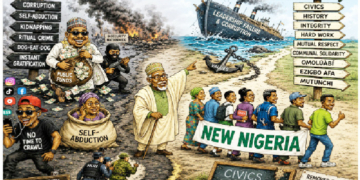
Even with the right population dynamics and a re-engineered education system, Africa’s development challenge is compounded by a myriad of persistent and interconnected obstacles, two of which I call the Twin Constraints: debt and corruption.
Firstly let’s look at debt, African governments are currently burdened by some of the highest public debt
levels since the early 2000s. Africa’s total public debt reached US$1.8 trillion in 2023, according to the African Development Bank.
Furthermore, over 20 African countries are now at high risk of debt distress or already in distress (IMF). While several African governments spend more on debt servicing than on education, healthcare or infrastructure. This debt burden reduces fiscal space, stifles innovation, delays infrastructure projects and traps economies in a cycle of dependence.
Corruption is the other head of this beast; and it is arguably the more destructive one, because its effects are both immediate and systemic. Nigeria offers a striking example:
The Chartered Institute of Forensic and Investigative Professionals of Nigeria (CIFIPN) estimates that between 70% and 75% of Nigeria’s national budget is lost to corruption.
To illustrate this burden, consider Nigeria’s annual budget of approximately ₦55 trillion.
If distributed equally, this amounts to just over ₦200,000 per citizen per year; a small sum
in a country where millions live below the poverty line. If corruption siphons off roughly 75% of that budget, then an estimated ₦150,000 per Nigerian disappears annually into waste, inefficiency or outright theft; leaving citizens with the equivalent of only ₦50,000 of real value.
Dear African reader, the point is simple: we cannot allow corruption because, quite literally; we cannot afford it.
To remove even a single naira from the hands of a Nigerian through corruption is unconscionable. To remove billions is a national tragedy; and it mirrors the wider continental consequences of institutional corruption.
For Africa to transcend its current trajectory, it must pivot boldly from consumption to contribution, from marketplace to manufacturing hub, and from raw material supplier to value creator.
This requires a coordinated transformation built on, but not limited to the following: education aligned to industrial needs, regional manufacturing ecosystems, innovation and R&D investment, governance and integrity systems and expanding Africa’s export basket.
Demographics give Africa potential. Growth gives it momentum. But what leadership chooses to do with these advantages will determine whether Africa becomes a true global contributor or remains a passive marketplace. Africa does not need anyone’s permission to rise. It needs alignment, courage, competence and integrity.
The time to build is now. Not because the world expects it, but because Africa’s future demands it.
–The author is an Abuja based lawyer
We’ve got the edge. Get real-time reports, breaking scoops, and exclusive angles delivered straight to your phone. Don’t settle for stale news. Join LEADERSHIP NEWS on WhatsApp for 24/7 updates →
Join Our WhatsApp Channel