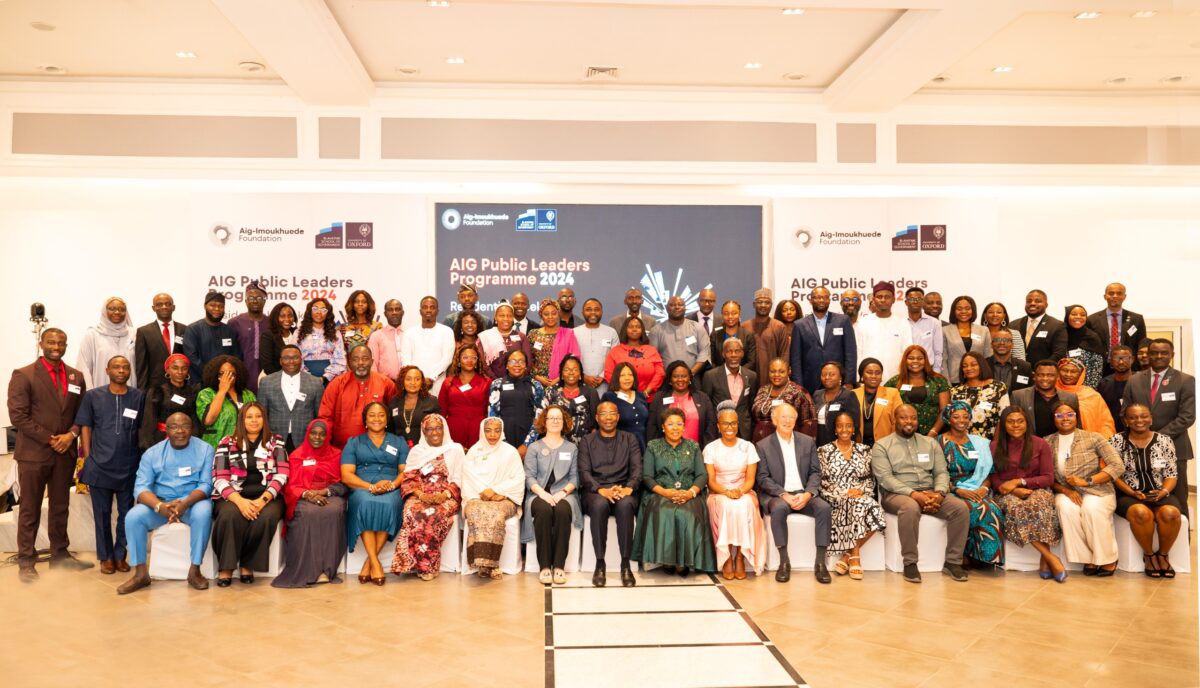
The Communications Team lead, Aig-Imoukhuede Foundation Chioma Bright-Uhara, has reaffirmed the Aig-Imoukhuede Foundation in building leaders that will shaping the future Nigeria and entire Africa globe.
Chioma Bright-Uhara emphasize that the twenty-first century will not be defined by which nations have the most oil, gold, or gas. It will be defined by those that can govern well, unlock the potential of their people, and build institutions that endure.
Bright-Uhara said, around the world, power is shifting, not through military might alone, but through mastery of data, governance, technology, and trust.
As artificial intelligence reshapes labour markets, climate change transforms economies, and global alliances realign, one question grows ever more urgent: which nations will lead the future, and which will be left behind?
She stated this at the AIG Public Leaders Programme in Abuja, yesterday, She
Africa sits at the heart of this moment today, 1.4 billion people call the continent home, a number set to reach nearly 2.5 billion by 2050. Forty percent of the world’s youth will soon be African.
Africa is not just rising; it is becoming impossible to ignore. But numbers alone don’t tell the full story. What will determine Africa’s path is the quality of its leadership, the strength of its institutions, and the courage of its public servants. Without these, opportunity can slip through even the most ambitious governments.
This belief drives the Aig-Imoukhuede Foundation. Founded by Aigboje and Ofovwe Aig-Imoukhuede, the Foundation works quietly but strategically to improve lives across Africa by transforming public service delivery. It doesn’t fund projects from the outside. It invests from within, developing ethical, high-performing leaders who can shape institutions from the inside.
Africa has ambition, creativity, and resources in abundance. Yet too often, potential is held back by governance gaps. Policies exist on paper but are rarely implemented. Budgets are approved but not optimised. Institutions struggle under outdated systems or leadership that cannot adapt to a rapidly changing world. These gaps don’t just slow progress; they erode public trust, discourage investment, and leave citizens underserved.
The Foundation’s approach is different. It invests directly in public servants, giving them the skills, networks, and confidence to drive change from the inside. Its philosophy is simple: sustainable development can only happen if the people and systems delivering it are capable. Roads may connect cities, but it is strong institutions that connect citizens to opportunity.
A central part of the Foundation’s strategy is its partnership with the University of Oxford’s Blavatnik School of Government, a global leader in public policy education. Emerging African leaders study, learn, and gain exposure to international best practices, but with one mandate: they will return home to transform their institutions. The goal isn’t to create expatriates; it is to create reformers. Leaders who see their work not just as administration, but as shaping Africa’s future.
Scholarships are often awarded for personal advancement. The AIG Scholarship flips that expectation. Fully funded by the Foundation, it allows exceptional public servants to pursue a Master of Public Policy at Oxford but with a twist: they must return home to transform their institutions.
Since its inception, 33 scholars have stepped from classrooms straight into the engine rooms of governance, equipped not to observe change, but to lead it.
Take Abdul-Fatawu Hakeem, Head of Debt Policy and Risk Management at Ghana’s Ministry of Finance. His Oxford training translated directly into Ghana’s national debt restructuring programme, shaping the country’s economic stability and fiscal strategy. Or Oluwapelumi Olugbile, the current 2025 scholar from NIGCOMSAT, who arrived at Oxford recently with one mission: to make every naira spent by government deliver real value. For her, finance is not administration, it is public service.
Real change doesn’t come from lone heroes; it comes from strong teams and capable institutions. The AIG Public Leaders Programme (PLP) builds networks of reform-minded public servants and ensures learning translates directly into action. Participants identify real challenges in their agencies and implement solutions as part of their training.
The impact is clear. Titilola Vivour-Adeniyi in Lagos created a secure digital platform to protect survivors and evidence, strengthening the justice system. Thousands of survivors now have a safe way to report abuse and access justice. Idowu Bakare at the National Assembly built a dashboard to track bills, automate legislative processes, and make data accessible to the public.
Millions of Nigerians can now follow the lawmaking process and hold their representatives accountable. Abraham Oludolapo designed a nationwide policy to combat sexual harassment within the National Youth Service Corps, safeguarding over 400,000 corps members and staff each year.
Other projects reach even further. The Nigerian Airspace Management Agency developed Africa’s first standardised on-the-job training manual for Air Traffic Safety Electronics Personnel, improving aviation safety for millions of passengers annually.
The National Agency for Food and Drug Administration and Control automated its dossier review process, resolving a 15-year backlog and accelerating access to essential medicines for millions of Nigerians. At Lagos’s Isheri Olofin Primary Healthcare Centre, patient wait times fell from 82 minutes to 31 minutes, improving healthcare access for thousands of citizens every month. Alumni have also digitised over 20 critical public services, streamlining operations and reducing opportunities for corruption.
These are not experiments, they are reforms executed from within the system, sustained by skill, courage, and networks, transforming lives across Nigeria and beyond.
Foundation apart is its focus on impact. Scholars, Fellows, and PLP graduates form a pipeline of change-agents embedded in government. The returns are not diplomas, they are leaner processes, faster service delivery, more transparency, and restored public trust.
Africa’s greatest opportunity is clear: invest in the people who run the system, and the system itself will improve.
The 2025 AIG Scholar, the 2025 AIG Fellow, and the growing network of AIG PLP alumni show that when you invest in capable public servants, you don’t just change careers, you change institutions, economies, and lives.
For business leaders, philanthropists, and policymakers, the message is simple: if you want an Africa that works, invest in its public service. Here, in the engine room of the state, the continent’s future is being built, not by what is constructed, but by the leaders who ensure it endures.
This is not just capacity-building, it is Africa’s most strategic bet on itself.
We’ve got the edge. Get real-time reports, breaking scoops, and exclusive angles delivered straight to your phone. Don’t settle for stale news. Join LEADERSHIP NEWS on WhatsApp for 24/7 updates →
Join Our WhatsApp Channel