A proposed bill to repeal the Nigeria Social Insurance Trust Fund (NSITF) Act has triggered objections from the organised labour and the private sector, who warned that the draft legislation threatens tripartite governance, weakens worker protection and risks plunging the social security system into a more profound crisis.
Concerns were raised on Monday in Abuja during a public hearing on Senate Bill 557 at the National Assembly, where the Nigeria Labour Congress (NLC) and the Organised Private Sector (OPS), represented by the Nigeria Employers’ Consultative Association (NECA), demanded that the bill be withdrawn and reworked.
The legislation aims to repeal the existing NSITF Act and the Employees’ Compensation Act (ECA) and consolidate them into a new framework, to be known as the Nigeria Social Security Trust Fund Act, 2025.
At the hearing, the sponsor of the bill, Senator Oluwole Fasuyi Cyril, and the chairman of the Senate Committee on Labour, Employment, and Productivity, Senator Diket Plang, maintained that the proposed bill aimed to streamline operations, expand coverage to the informal sector, and strengthen oversight.
However, the NLC and the OPS, under the Nigeria Employers’ Consultative Association (NECA), countered that several provisions undermine long-standing global conventions on tripartism and grant excessive powers to the fund’s management.
NLC President, Comrade Joe Ajaero, faulted the amendment process, arguing that workers and employers were not adequately consulted, despite being direct contributors to the Fund.
He noted that the current structure was built on shared representation among labour, employers and government, warning that replacing this with a government-dominated Board would erode trust and expose workers’ contributions to political interference.
Ajaero said the Employees Compensation Act (ECA) already suffers from poor compliance and urged lawmakers to focus on strengthening implementation rather than weakening safeguards through a new bill.
“The NLC is openly concerned that this amendment was conceived without the ownership of the key stakeholders who fund and rely on the NSITF. A law made outside genuine consultation ceases to reflect the will of the people, and that is why we insist that tripartism must not be tampered with under any guise.
“We demand that the sanctity of the tripartite governance structure be preserved, because any attempt to dilute labour’s representation contradicts global standards. In the spirit of fairness and justice, this bill should be stepped down,” Ajaero said.
The OPS also issued a similar warning.
NECA’s position paper, presented by Thompson Akpabio, highlighted more than 30 areas of concern, including provisions that blur lines of authority, strip the Minister of Labour of oversight, grant sweeping enforcement powers to the NSITF, and conflate compensation with broader social security responsibilities without a corresponding funding structure.
Akpabio argued that private companies currently fund the compensation scheme and should not be burdened with obligations that, in other countries, are shared with the government and employees.
“We align completely with labour on the need to preserve tripartism because that is the foundation on which the NSITF and the Employees Compensation Act were built.
This bill, as drafted, weakens that structure and contradicts international conventions to which Nigeria is a signatory. If unchecked, it will trigger avoidable disputes at the ILO, where the country is already bound to defend its commitments by next year.
“If Nigeria wants a true social security system, then government and employees must also contribute as practised globally. Until a balanced and lawful reform is achieved, we strongly urge the National Assembly to step down this Bill,” Akpabio said.
In turn, Senator Fasuyi defended the bill, insisting it seeks to eliminate duplication, modernise social protection and address long-standing weaknesses in the compensation system.
He stated that the Senate has the constitutional mandate to amend outdated laws and assured stakeholders that their input would inform the final draft.
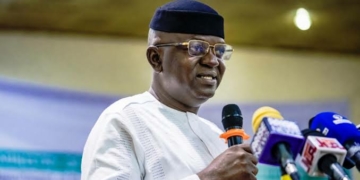
At the end of the hearing, the Minister of Labour and Employment, Muhammad Maigari Dingyadi, called for deeper engagement and assured stakeholders that a balanced outcome of the bill would be achieved.
We’ve got the edge. Get real-time reports, breaking scoops, and exclusive angles delivered straight to your phone. Don’t settle for stale news. Join LEADERSHIP NEWS on WhatsApp for 24/7 updates →
Join Our WhatsApp Channel