
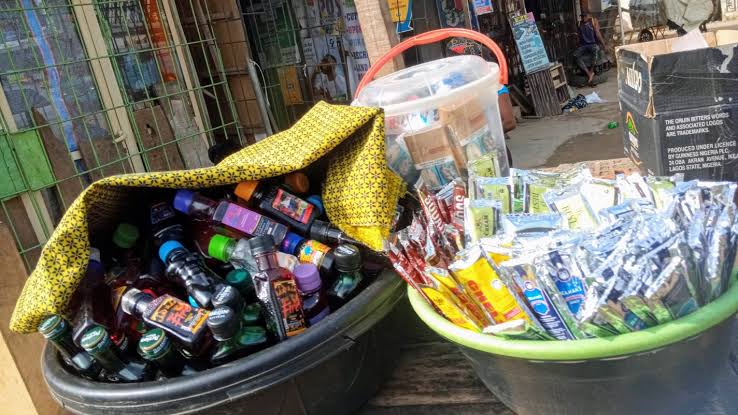
As the National Agency for Food and Drug Administration and Control (NAFDAC) prepares to enforce a total ban on alcoholic beverages packaged in sachets and small bottles (200ml and below), Nigerians who use these low-cost drinks daily due to income are kicking against the ban.
From the Nyanya Motor Park in the Federal Capital Territory (FCT) to the streets of nearby Mararaba in Nasarawa State, sachet alcohol, sold for as low as N100, has become the everyday drink for the urban poor, commercial drivers, artisans and unemployed youths.
However, this popular product is now at the centre of a major public health debate, with NAFDAC insisting that the ban is necessary to curb addiction, road accidents, violence and the rising alcohol crisis among children and youths.
The director-general of NAFDAC, Prof. Mojisola Adeyeye, has reaffirmed the agency’s commitment to enforce the ban as directed by the Senate. The agency said sachet alcohol has become a “public health menace,” citing high alcohol concentration concealed in small, cheap packaging, easy accessibility to minors who can purchase it without restriction, misuse by commercial drivers contributing to road accidents, growing addiction among young people, links to domestic violence, school dropouts and other social vices.
“This ban is not punitive; it is protective. We cannot continue to sacrifice the well-being of Nigerians for short-term economic gains,” Prof. Adeyeye said.
LEADERSHIP Weekend reports that the phase-out began in 2018 under a five-year MoU with manufacturers. Though the deadline was extended to 2025, many companies continued illegal production.
According to the World Health Organisation (WHO), alcohol is responsible for 2.6 million deaths annually worldwide and accounts for 4.7 per cent of the global burden of disease. Between ages 20–39, alcohol is the leading risk factor for premature death.
The global health body stated that alcohol contributes to more than 200 health conditions, including liver disease, heart disease, cancers, mental health disorders, and road traffic injuries.
In 2019 alone, alcohol caused 401,000 cancer deaths, 474,000 cardiovascular deaths, 298,000 road crash deaths, half caused by someone else’s drinking, it added.
Despite these statistics, Nigerians who depend on the cheap drinks said the government is being inconsiderate.
At Nyanya motor park, a group of transport workers “agberos” lamented to our correspondent that the ban would worsen their hardship.
One of them, Gbenga, said “We cannot afford big bottles or expensive drinks. This is what the masses can buy with N100 – N200. The decision is not fair on ordinary Nigerians.”
For them, sachet alcohol is not just a drink, it is a coping mechanism in a tough economy where inflation continues to squeeze daily earnings.
Aside the consumers, hawkers and shop owners also fear loss of livelihood. A roadside hawker in Karu, who sells sachet alcohol said the products “sell faster than anything else” because commuters and okada riders prefer them.
In Jikwoyi, an alcohol shop owner told our correspondent that the ban would destroy her business.
“People come here every evening to buy these small bottles. The profit is high because the patronage is high. Government should allow the production to continue. This is the only business feeding my family,” she said.
At the same shop, a young man sipping from a small bottle expressed defiance. He said “They can’t force us to buy what we can’t afford. This is what we can afford. If they ban it, what do they expect us to drink?”
He said sachet alcohol fits the financial reality of young Nigerians who live “from hand to mouth.”
Across the suburbs of the FCT and other states, the story is the same: dissatisfaction, fear of rising prices, and anxiety about losing a cheap source of relaxation.
However,, public health advocacy groups have urged President Tinubu to resist pressure from manufacturers and fully back NAFDAC. They maintain that sachet alcohol fuels addiction in poor communities, it is responsible for rising violence and loss of productivity, adding that Its long-term cost to the economy far outweighs any profit manufacturers claim.
The groups said sachet alcohol is intentionally designed to target poor and vulnerable populations, including minors with its cheap price and portability.
The Technical Director, Network for Health Equity and Development (NHED), Dr. Jerome Mafeni, said “It is unacceptable that children can buy high-concentration alcohol for N100.”
He emphasised that protecting lives must take precedence. “The long-term social and economic costs of alcohol-related harm far outweigh any short-term profits that manufacturers seek to protect.”
Also, the Executive Director, Corporate Accountability and Public Participation Africa (CAPPA), Akinbode Oluwafemi, said government regulation to protect public health should not be negotiable.
Oluwafemi said “No credible public health agency anywhere would permit the continued marketing of such products in packaging designed to encourage unrestricted, on-the-go, and underage drinking.
As the affected producers, shop owners, drivers, okada riders and other consumers brace for the looming deadline, the country faces a tough balancing act between saving lives and sustaining livelihoods
We’ve got the edge. Get real-time reports, breaking scoops, and exclusive angles delivered straight to your phone. Don’t settle for stale news. Join LEADERSHIP NEWS on WhatsApp for 24/7 updates →
Join Our WhatsApp Channel