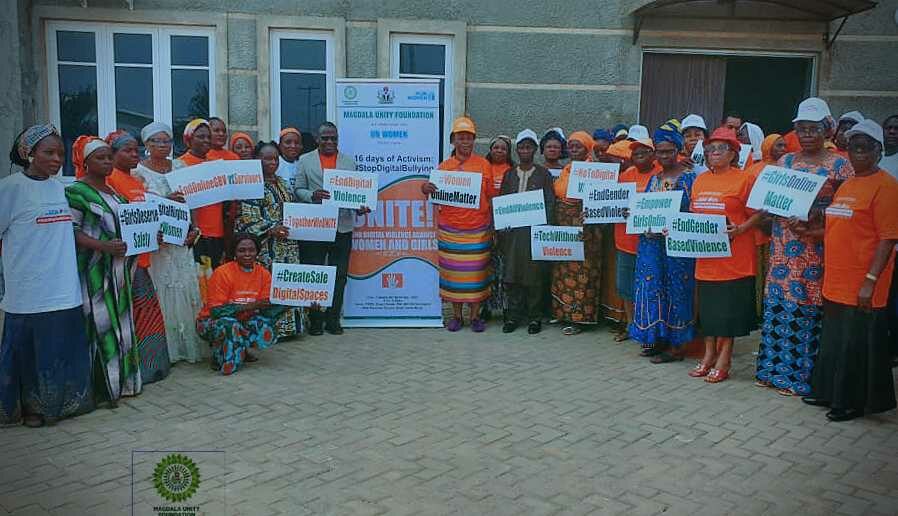
The Magdala Unity Foundation (MUF), in partnership with UN Women, has launched a major campaign to combat digital violence against women and girls, advocating for stronger laws, safer technology platforms, and greater public awareness.
Speaking at the 16 Days of Activism event at TACN Guest House, Durumi, Abuja, MUF President Deaconess Amb. Mrs. Victoria Bolanle Ihesiulor, JP, FNIMN, FNIM (Chartered), said digital violence is as damaging as physical abuse and called for collective action from government, civil society, tech companies, and communities.
“Every woman and girl, everywhere, deserves to be safe, respected, and empowered, both offline and online. The UNITE Campaign urges us all to act boldly to create laws, technologies, and social norms that protect women and girls online,” she said.


The campaign targets abuses including cyberbullying, online harassment, revenge pornography, and digital exclusion. MUF noted that victims often suffer emotional, psychological, social, and financial harm, with some cases escalating into physical violence.
Legal experts at the event, including J.B. Saleh Esq., highlighted protections under the Cybercrimes (Prohibition, Prevention, Etc.) Act 2015, the Violence Against Persons (Prohibition) Act 2015, and the 1999 Constitution.
However, gaps remain, including weak enforcement, limited gender-sensitive policies, jurisdictional challenges, and low public awareness.
Professor Magdalyne Dura, a gender rights advocate, stressed that digital gender-based violence is a human rights violation and warned against normalising such abuse.
“Silence and victim-blaming only empower abusers. Women must know their rights, preserve evidence, and seek support immediately,” she said.
Represented by Mrs. Mabel Ade, Prof. Dura delivered an extensive presentation on the escalating threat of digital gender-based violence in Nigeria.
Mrs. Ade explained that online abuse now includes cyberstalking, digital blackmail, unauthorised image circulation, technology-enabled surveillance, and intimidation via social media.
She urged survivors to prioritise safety, preserve digital evidence, seek timely legal and psychosocial support, and report incidents promptly.
She also called for improved digital literacy for women and girls, community sensitisation to end victim-blaming, and stronger reporting systems on social media platforms.
The event highlighted the need for urgent reforms, including amendments to address emerging threats such as AI-generated harassment, cyber flashing, and online financial abuse. Tech companies were urged to enhance reporting mechanisms and support content moderation.
Speaking on behalf of the UN Women Representative to Nigeria and ECOWAS, Ms. Beatrice Eyong, Mallam Ibrahim Nurudeen, Programme Officer for Ending Violence Against Women (EVAW), said digital violence affects women far more severely than men. He noted that global research indicates that women face disproportionately higher levels of online abuse, including manipulated images and false content used to shame or intimidate them.
He added that more than 65 percent of women surveyed globally reported experiencing some form of online abuse at least once in their lives. Nurudeen also raised concern about cases in Nigeria where online interactions have escalated into real-world harm, warning that digital platforms are increasingly being used to target and endanger women.
He cited recent incidents in Akwa Ibom and Kogi States where young women were lured by individuals they met online, leading to tragic outcomes. He urged the public, especially young women, to prioritise online safety, verify information carefully, and avoid meeting strangers in unsafe or unverified locations.
Nurudeen called for stronger digital safety education, better reporting mechanisms on social media platforms, and a united effort to protect women and girls in both online and offline spaces.
Speakers emphasised that ending digital violence is not just a women’s issue but a broader human rights and development concern. Communities were encouraged to promote inclusion, challenge harmful norms, and support survivors with legal, psychosocial, and practical services.
The 16 Days of Activism event concluded with a nationwide call for awareness, stronger legal enforcement, and survivor-centered support to ensure women and girls can participate safely and confidently in the digital space.
We’ve got the edge. Get real-time reports, breaking scoops, and exclusive angles delivered straight to your phone. Don’t settle for stale news. Join LEADERSHIP NEWS on WhatsApp for 24/7 updates →
Join Our WhatsApp Channel