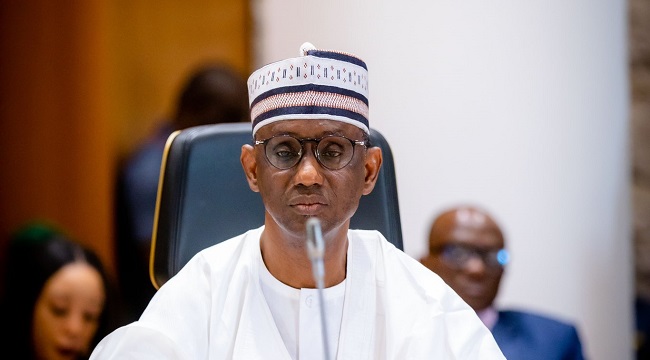
Security experts have reacted to President Bola Ahmed Tinubu’s fresh security directives, in which he instructed the National Security Adviser (NSA), Malam Nuhu Ribadu, and the secret police, the Department of State Services (DSS), to arm forest guards.
President Tinubu also asked the security agencies to tighten protection measures and ensure that no citizen is left vulnerable as the country confronts kidnapping and terrorism.
Speaking during an address to the Federal Executive Council meeting on Wednesday, the President stated that he had already instructed the Inspector-General of Police (IGP) to handle any security issues arising from the nature of ongoing assignments, noting that the Minister of Police Affairs must coordinate with the IGP whenever necessary.
“And I told the IGP, and I hope the Minister of Police Affairs is here; if you have any problem of security, because of the nature of the assignment, please contact the IGP and get my clearance,” he said.
Tinubu further directed the Minister of Interior to work with the Inspector-General and the Nigeria Security and Civil Defence Corps (NSCDC) to ensure that police officers withdrawn from special duties are replaced without creating security gaps.
On broader security coordination, the President mandated the National Security Adviser (NSA) and the Department of State Services (DSS) to provide additional information and form a committee to review the existing structure.
“NSA and DSS to provide further information and form themselves the committee and review the structure,” he directed.
Tinubu stressed that the instructions must be implemented immediately, warning that the nation is facing serious security threats.
“It should be effective. We face challenges of kidnapping and terrorism; we need all the forces that we can utilise,” he said.
The President acknowledged that some citizens remain vulnerable and called for special provisions to protect them. He also requested that the NSA ensure forest guards are adequately armed.
“I know some of our people are exposed and I understand that we have to make exceptional provision for them, and that civil defence personnel are equally armed; and I want the NSA to arm our forest guards too; take it very seriously,” he said.
Turning to livestock reform, Tinubu directed Vice President Kashim Shettima to engage the National Economic Council (NEC) on identifying villages or grazing reserves that can be restored for ranches and livestock settlements.
“Again, especially livestock reform, I think the Vice President should get the NEC first of all to see which villages or grazing reserves can be salvaged or rehabilitated into ranches, livestock settlements,” he said.
Tinubu asserted that the reforms must prevent conflicts and transform livestock management into sustainable economic development.
“We must eliminate the possibility of conflicts and turn the livestock reform into economically viable development. The opportunity is there, let’s utilise it,” the President said.
Tinubu also emphasised that land belongs to the states under constitutional provisions, and directed the National Economic Council to work with states to convert suitable areas into livestock villages.
“And it is in NEC, if we exercise the constitutional requirement which states that the land belongs to the states, whichever one they can salvage, convert to a livestock village. Let us stop this conflict area and turn it into economic opportunities and prosperity,” he said.
Arming Forest Guards Welcome Development – Experts
Reacting to the deployment and arming of forest guards, security expert Iyke Odife said it is long overdue, as the forest has become a significant hideout for bandits and terrorists.
He stated that well-trained and armed forest guards would reduce the workload of the Police Force, as they would ensure the safety of the forests, thereby deterring criminals from entering forest areas.
According to him, “When the forest is cleared of bandits and terrorists, the criminals would have no option but to look for another job. Our forests have been too exposed and have become a haven for many criminal activities. This deployment and arming of forest guards is a welcome development.”
Also, Col. Ahmed Abdul Usman (rtd), speaking on the federal government’s plan to deploy forest guards to help tackle insecurity, said the initiative is a welcome one but called for a well-coordinated and community-sensitive approach.
He stressed that recruitment must be based on integrity, transparency, and rooted in local trust.
According to him, “All forest guards must operate strictly under the supervision of conventional security agencies to ensure accountability and prevent any potential excesses.”
He called for effective communication between forest guards and the communities they serve, noting that trust-building is vital to the success of any security intervention.
For ACP John Undu (rtd), the forest guards would require extensive training to cope with current insecurities.
He said terrorists had already taken over the forests, and for any security agency to recover them, operatives must be well trained.
He argued that places like Sambisa Forest would be a no-go area for the forest guards, as it has become one of the most challenging terrains for Nigerian security agencies to operate in.
A security consultant, Abdullahi Mohammed Jabi, also said that arming forest guards was long overdue.
He said the guards need adequate arms to confront non-state actors in the bushes.
“It’s a good one. We are trying to equip those who have not been adequately equipped.
“Remember we could not arm them at that material time, but the exigencies of our time now demand that, since they are forest guards, let them be properly equipped. So it is a step in the right direction,” he said.
Arming Forest Guards Not the Solution
A former director of the Department of State Services, who wished to remain anonymous, said he was tired of talking.
He said the solution was not about arming a new security outfit but addressing the root causes of the crisis.
A retired general who also did not want his name mentioned said it was not about arming a new outfit but addressing the root causes of insecurity, such as social injustice, unemployment, and underemployment.
While disagreeing with the plan, he said that arming society to the teeth has never done any nation any good.
He cited examples from South Sudan, Sierra Leone, and Liberia, and therefore cautioned against such moves.
We’ve got the edge. Get real-time reports, breaking scoops, and exclusive angles delivered straight to your phone. Don’t settle for stale news. Join LEADERSHIP NEWS on WhatsApp for 24/7 updates →
Join Our WhatsApp Channel