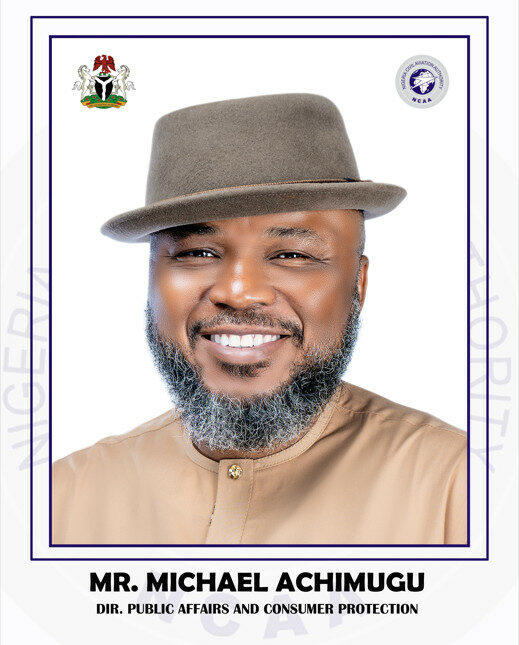
Nigeria’s aviation industry has had an interesting year, with different cases of unruly passengers, hikes in airfares during festival periods, flight cancellations, among others. In this interview with EJIKE EJIKE, the director of Public Affairs and Consumer Protection at the Nigerian Civil Aviation Authority (NCAA), Michael Achimugu, talks about why the NCAA should be allowed to prosecute violators of aviation regulations.
Looking back on 2025 so far, how have you been able to make tangible progress? Could you outline the major initiatives and achievements recorded this year, especially in strengthening consumer protection?
Well, we have been able to enforce Part 19 of the Nigerian Civil Aviation Authority (NCAA) regulations much more effectively than ever before. This is why, this year, we have achieved the highest volume of refunds, compensation payments, hotel accommodations, and similar entitlements. These were things that previously seemed alien to passengers.
Also, our stakeholder engagement is now more robust. Passengers know that there is always someone willing to listen. Even if they do not get a resolution by the end of the day, it won’t be because nobody listened to them. We are available for passengers 24 hours a day, which has helped build trust in the system. The airlines themselves now understand that the terrain has changed.
It is no longer business as usual. And so they even comply naturally with the regulations such that most times we don’t need to escalate to them. Between May and July this year, for instance, domestic airlines paid out over a billion Naira in refunds without recourse to NCAA.
As the director of public relations and Consumer Protection at the NCAA, what has been the most challenging task you’ve faced in your role?
The most difficult part of this job, I would say, is dealing with unruly passengers. Many seem unwilling to take responsibility for their actions. They are very aware of their rights but often overlook their responsibilities, which can make handling situations challenging.
And then, because of the emotional approach of most Nigerians, when you want to enforce the regulations in that regard, you tend to see that the opinion of the general public favors the bad behavior of these people. So most times you are torn between morality and the law when dealing with such cases. Government sometimes also has to try and balance things out, you know, around these situations.
Because we care about the passengers. We’ve proven that we care about them. As a matter of fact, airlines accuse us of being more on the side of the passengers.
Sadly, the passengers whose rights we are protecting accuse us of being on the side of the airlines. So, like I keep saying, ours is a thankless job. But there’s nothing we are not up to.
There is a lot of tasks, challenges we face, and we are not living up to the challenge. You know, to be on the part of the operators, and trust me, the operators can be very stubborn too. Sometimes they try to beat the system, but they know now that we will stand our ground and enforce the regulations.
Even among our own staff, we also face difficulty. I don’t ignore what goes on internally as well.
We have had to do a lot of in-house training. The DGCA, Captain Chris Najomo has sent a lot of staff out on training internationally. Even general staff who never used to go statutorily, they now go for this training.
Could you clarify the current status of the VDM case involving Mr. Jollof, and what key factors are influencing its developments?
The issue has long been resolved in the sense that the airline came out publicly to issue a statement without recourse to the NCAA that they had forgiven both parties.
You know, the NCAA does not have prosecutorial powers. Normally, what we would do is a criminal referral to the Attorney General and the Inspector General of Police, asking them to prosecute the parties involved.
Pushing the case forward, the airline has a right to sue them. That is what happened in the case of Ms Comfort Emerson. She had attacked a staff of the airline. The airline felt bad about it and they sued. The NCAA did not sue or imprison Comfort. The NCAA did not have the powers to sue or imprison Comfort.
Same scenario with the Very Dark Man issue as well. I was busy working on that case when I saw the airline response to that issue. Once they have done that, there is nothing the NCAA can do any further because it was their property.
It happened inside their property. I think that the airline made that decision because it was not their staff that was assaulted. It was a case of two fighting. People need to understand that in some of these cases, even when the regulations do not apply, the laws of the land apply. The airline chose to let it go. In the Ibom Air case, the airline chose to go ahead because their staff was assaulted. So that matter is concluded.
Do these developments in any way challenge the authority of the NCAA or affect your capacity to enforce regulations effectively?
I think that our regulations in that regard have gaps that need to be filled. Because why do we not have prosecutorial powers? We are the regulatory authority.
We should have those powers. That way it’s more within our control. Because why are we expending so much energy preaching, speaking out against unruly passenger behaviour? Why do we have in our regulations penalties for unruly passenger behaviour that we cannot enforce? So there are gaps.
I have asked for a review of the regulations. And I know that the regulations committee presently is working on that.
Everyone knows that December is peak period and most people travel in and out of the country and even within states around. Are there special measures that you are taking to ensure that there is a reduction in flight cancellations and all that with airlines?
We have always told everybody in advance before December that because of weather, there will be disruptions in December. It is a given. There is nothing anybody can do about it. Even abroad it is the same thing.
I was on a flight recently. We had boarded in Paris and then we were kept on board waiting for over two hours because of snow at Heathrow airport. So we waited and nobody complained.
There is nothing you can do about that.
What we have a problem with is what the airlines do when there’s a disruption. Because the regulations allow or recognize that disruptions will happen everywhere.
But that’s why every country has regulations that stipulate what the airlines should do when there is a disruption.
For bad weather, the airline actually owes you nothing because you can’t punish an airline for weather.
There’s a bird strike. No airline is supposed to provide itself with bird strike equipment. That’s a duty for the authorities to do.
So if bird strike equipment does not exist, and then the bird flies into the engine of an aircraft, and it develops a technical fault, why should we punish the airline? Because they are a business. And for no fault of theirs, they are spending millions of dollars to fix those problems. And each time a bird strike, for instance, happens, there is a ripple disruption effect on every route that aircraft was supposed to fly for that day.
Where we have problems is when an airline is at fault. Where they fail to do what our regulations says, there will be sanctions for these things. And I think that we are proving our capacity.
When I came into office, I was told that nobody can sanction any airline in Nigeria. As far as this department was concerned. We sanctioned seven, including some of the biggest international airlines and nobody has died.
Nigeria under President Bola Tinubu wants to become what Nigeria ought to be. Thankfully, he has made aviation the center of his economic plan. So it means that for his entire economic plan to succeed, we need to get aviation right. Countries like Ethiopia are making a ton of money from aviation. For us, it is not even really the profit. It is that aviation drives so many other indices for development. Trade, international trade, tourism, and all of those things. So we must get it right.
And we have had the support of the President and the Honorable Minister. So we’re thankful for that. That is why we are able to sanction those people without repercussions.
What are your major innovations, achievements recorded since you resumed as the Director, Public affairs and Consumer Protection, NCAA?
When I was appointed as director here, I met a very destabilized, unmotivated environment. The staff of the department were not being respected by the airlines. There was almost zero compliance with the regulations and all of that. But when we came in, we brought in a different approach. We brought in the vibe. Right now, the current DG is supporting us so well and that is why we are succeeding.
I am the youngest director in the NCAA. So I still have the energy, the willingness to push things there.
I have been able to push things where they really ought to be pushed. And the staff now know that they are protected. If you slapped any of my staff at any terminal, you know what’s coming to you. If you do not provide information to them as prescribed by the regulations, you know what’s coming to you. And by sanctioning airlines now, they now know that it is possible to be sanctioned.
I will tell you a story. A day before I announced the first set of sanctions, the owner of one of the airlines called me at 1.30 a.m. Somehow, I felt that someone had given him the information of the sanctioning earlier and then he spoke to me offering different excuses and stuff. He spoke to me until 4 a.m. I was like, oh, sorry. People are sabotaging you. Oh, sorry about that. We will sue them and we will support you. In the morning, I announced the sanction. He went to the minister and asked what kind of guy is this? And the minister told him, the guy is doing his job. So now they know, too, that as much as we are supporting them, we will enforce the regulations.
And they know that the era is gone where they can rely on orders from above. So, yeah, there has been that. And then, again, when we came in, passengers were complaining that they couldn’t recognize our officers at the terminals. So, we gave them uniforms so that people no longer have that complaint.
They stand out at the terminals. We built the Consumer Complaints Portal. So, now complaints are treated more seamlessly. We uploaded all of the airlines on that portal. You send your complaint to us. From that same portal, the airlines can see it. There is a dashboard showing how many cases have been sent to this airline. How many they have resolved. How many are still pending. How many are unresolved. So, it is a self-reporting system as well for the airlines. If you don’t treat your cases fast, it is never shown on the dashboard.
Some of these challenges happen because there is not much of competition yet, and the minister has been trying to deal with this. There are some airlines in Nigeria that nobody will fly if they had choices. But there’s no choices. That’s why one airline charged N500,000 Naira for a one-way ticket. People complain and they still fly. This is because of lack competition. Personally, I don’t subscribe. I don’t agree that any ticket anywhere in Nigeria should cost N500,000 naira.
But it’s down to market forces. The NCAA does not regulate airfares. Because I know that this is a burning issue. No NCAA anywhere in the world regulates airfares. So, there’s not much we can do about it.
In early November, I wanted to purchase a ticket on one airline. They told me N400,000 economy, one way. I asked my personal assistant to look for another airline. I got a ticket for N200,000. This is what competition does. If the competition had been enough, those ones would never sell for as high as N500,000 when the majority of others sell for less than half of that rate will be out of business.
Competition forces down the airfares. It is because of the lack of capacity that we have been having this issue. All of these conversations actually are just centered around lack of capacity.
We simply do not have enough aircraft for competition.
But by 2026, there is going to be enough aircraft in Nigeria. I have been informed that in February, nine dry lease aircraft are coming in. Also, there is another conversation the Honorable Minister is having with partners from somewhere that would bring in more aircraft to Nigeria market.
I don’t have the authority to divulge that information yet. But should that go through, and it will, there will be a surplus of wet lease aircraft coming into Nigeria next year.
We’ve got the edge. Get real-time reports, breaking scoops, and exclusive angles delivered straight to your phone. Don’t settle for stale news. Join LEADERSHIP NEWS on WhatsApp for 24/7 updates →
Join Our WhatsApp Channel