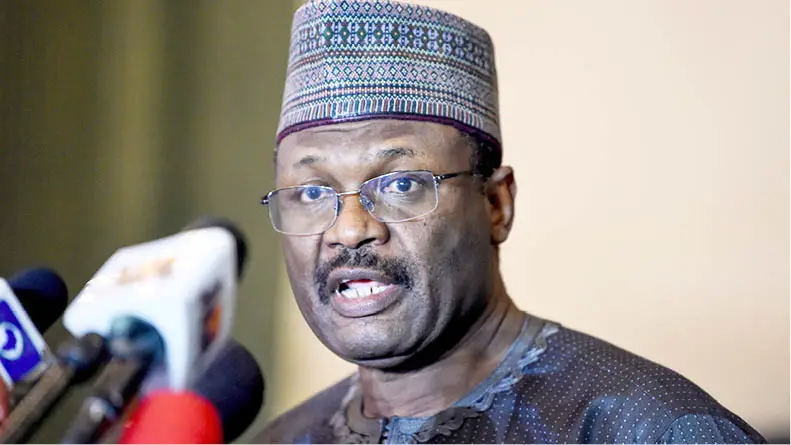
The Office of the Auditor-General of the Federation (OAGF) has uncovered financial irregularities amounting to ₦288.18 billion in the accounts of the Independent National Electoral Commission (INEC), raising concerns over procurement breaches, weak internal controls, and unremitted revenues under the leadership of the immediate-past chairman Professor Mahmood Yakubu.
The revelations were contained in the Auditor-General’s Annual Report on Non-Compliance and Internal Control Weaknesses in Ministries, Departments and Agencies (MDAs) for the 2022 financial year.
According to the report, the flagged expenditures primarily covered INEC’s activities between 2018 and 2019, including questionable payments to contractors, unretired advances, and non-remittance of statutory deductions.
One of the most significant audit observations involved a ₦5.31 billion payment for the supply of Smart Card Readers (SCRs) used during the 2019 general elections.
The Auditor-General revealed that INEC awarded the contract through a restricted procurement method without prior approval from the Bureau of Public Procurement (BPP), even though the amount exceeded the approval limit of the commission’s Tenders Board.
Instead of obtaining clearance from the Federal Executive Council (FEC), INEC relied on a presidential approval granted under Section 15(2) of the Public Procurement Act, a clause the audit report noted “does not apply to the procurement of Smart Card Readers.”
Auditors also found that mobilisation and additional payments were made without adequate documentation or clear evidence that the items were supplied as claimed.
In response, INEC insisted that it followed due process, maintaining that presidential approval was secured through official correspondence and that “the urgency ahead of the 2019 elections justified the procurement approach.”
The commission said mobilisation payments were necessary to ensure timely delivery, adding that “all required documents, including Advance Payment Guarantees, were on file.”
However, the Auditor-General dismissed the explanation as unsatisfactory, stressing that “presidential approval cannot substitute the statutory procurement approvals required under existing laws.”
The audit also queried ₦4.51 billion paid to six contractors representing 35 per cent of contract sums without any documentary evidence of deliveries. The report faulted the use of conditional Advance Payment Guarantees, describing it as a violation of public procurement regulations.
Required records such as contractors’ eligibility documents were reportedly missing, preventing proper audit verification.
Another finding showed ₦331.23 million paid to contractors under “doubtful circumstances,” with discrepancies suggesting that some payments were made before the contracts were formally awarded.
INEC was also indicted for making ₦235.8 billion in contractor payments without deducting the mandatory one per cent stamp duty, leading to an estimated ₦2.19 billion in unremitted revenue to the federation account.
“The Commission offered no justifiable explanation for its failure to deduct and remit the statutory charge,” the report stated.
The audit identified ₦630.63 million granted as non-personal advances to INEC officials that remained unretired as of the audit period. In several cases, officials reportedly received multiple advances without retiring previous ones, a breach of financial regulations.
Also flagged was the procurement of four Toyota Land Cruiser vehicles at a total cost of ₦297.78 million, which auditors said exceeded prevailing market prices at the time.
INEC also came under scrutiny for contracts worth ₦41.31 billion awarded for the printing of ballot papers and result sheets. The Auditor-General said there was no evidence that contractors met eligibility criteria or had relevant experience.
The report noted that the contracts were awarded without FEC’s approval and without a ‘No Objection’ Certificate from the BPP, both mandatory under procurement law.
Despite INEC’s repeated defence that due processes were followed and presidential approvals were obtained, the Auditor-General maintained that many of the explanations failed to address core legal and procedural breaches.
The report recommended that INEC Chairmanmat the time, Prof. Mahmood Yakubu, account for the queried sums before the Public Accounts Committees of the National Assembly.
It also advised the recovery of irregular payments and their remittance to the treasury, warning that “sanctions relating to irregular payment and failure to manage public funds effectively, as prescribed under paragraphs 3106 and 3115 of the Financial Regulations (2009), should apply.”
We’ve got the edge. Get real-time reports, breaking scoops, and exclusive angles delivered straight to your phone. Don’t settle for stale news. Join LEADERSHIP NEWS on WhatsApp for 24/7 updates →
Join Our WhatsApp Channel