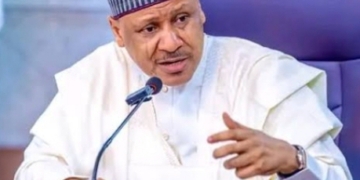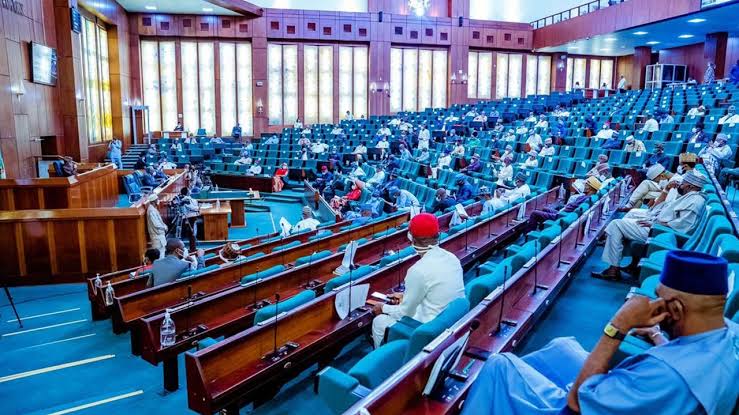
The House of Representatives on Tuesday passed the N43.56 trillion 2024 revised budget.
This followed the consideration and adoption of the report of the House Committee on Appropriations in the Committee of Supply and subsequent passage for third reading in plenary.
Out of the total sum of N1.74 trillion, N1.74 trillion is for statutory transfers, N8.27 trillion for debt service, N11.26 trillion for recurrent (non–debt) expenditure, while the sum of N22.27 trillion is for capital expenditure and development fund contribution for the year ending December 31, 2025.
Equally, at the plenary, the House passed the revised 2025 budget of N48.31 trillion, out of which N3.64 trillion is for statutory transfers and N14.31 trillion for debt service.
Additionally, out of the total sum of N13.58 trillion, N13.58 trillion is earmarked for recurrent (non-debt) expenditure, while N16.76 trillion is for contribution to the development fund for capital expenditure for the year ending March 31, 2026.
LEADERSHIP reports that President Bola Tinubu had on Friday transmitted to the House the Appropriation (Repeal and Re-enactment) Bills, 2024 and 2025, for consideration and approval.
The first bill sought to repeal the 2024 Appropriation Act of N35.05 trillion and re-enact it by authorising the issuance from the Consolidated Revenue Fund of the Federation of the total sum of N43.56 trillion.
The second bill intended to repeal the 2025 Appropriation Act of N54.99 trillion and re-enact it by authorising the issuance from the Consolidated Revenue Fund of the Federation of the total sum of N48.31 trillion.
The president explained that the bills were submitted to address all items not previously recognised while also reflecting a revised capital implementation target of 30 per cent.
He added that the adjustment aligned with current fiscal realities and execution capacities, while ensuring that budget performance remains credible and transparent.
Tinubu stated that the move sought to extend the 2025 budget to March 31, 2026, to allow for full release of the target 30% for Ministries, Departments and Agencies (MDAs).
He also said the approach was part of a broader fiscal reform measure aimed at eliminating the overlap of multiple concurrently running budgets, thereby strengthening planning, execution, and accountability across government expenditure cycles.
We’ve got the edge. Get real-time reports, breaking scoops, and exclusive angles delivered straight to your phone. Don’t settle for stale news. Join LEADERSHIP NEWS on WhatsApp for 24/7 updates →
Join Our WhatsApp Channel