At the start of every new year, the world performs a familiar ritual: we pause, assess and predict. Governments issue plans, analysts forecast trends, and citizens make cautious resolutions. Yet experience tells us that the most important messages of a year rarely arrive with ceremony. They emerge quietly in patterns that repeat, pressures that intensify, and choices that reveal what truly matters.
The danger, globally, is not that we misread the signs. It is that we have grown accustomed to living with them. If we are willing to listen, therefore, 2026 is already telling us a great deal about the state of our world. Not through grand announcements, but through the early signals of what is being normalised, neglected, and tolerated.
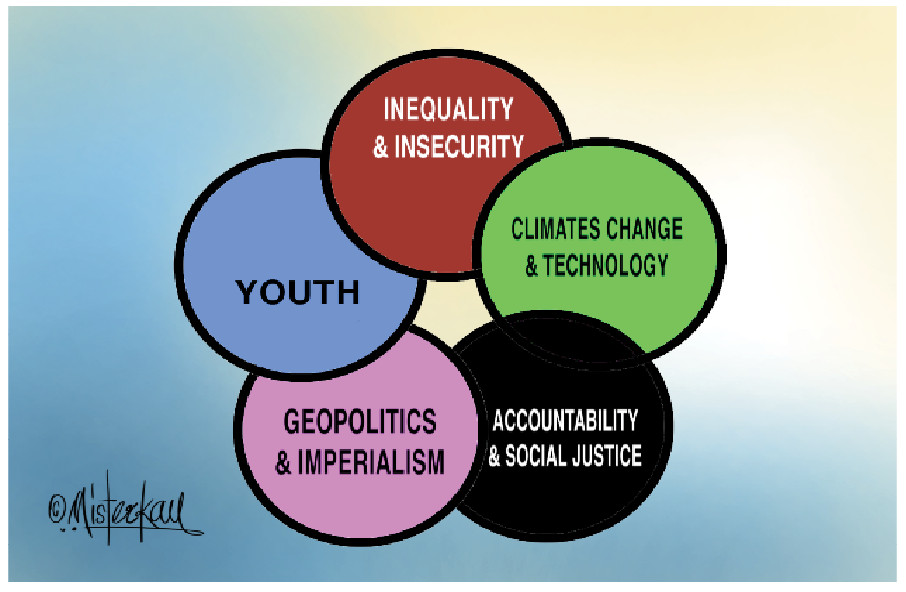
Growing Inequality and Insecurity
First, 2026 is telling us that inequality has moved from a development challenge to a defining global condition. Across continents, the gap between those insulated from shocks and those exposed to them is widening. Economic growth, where it exists, is unevenly felt. Inflation, debt, and rising living costs are eroding household security across low, middle, and high-income societies.
What distinguishes this moment is how inequality now shapes resilience. Access to healthcare, digital tools, climate protection, and political influence increasingly determine who can recover from crises and who cannot. The pandemic exposed this fault line, and subsequent economic and geopolitical shocks have deepened it.
2026 is already showing us that inequality is no longer cyclical; it is structural. When inequality hardens, social cohesion weakens, trust erodes, and democracies strain. This is not a local problem; it is a global warning.
Second, the year is reminding us that insecurity has become a shared international reality, though it wears different faces. In Africa and the Middle East, insecurity is driven by armed conflict, insurgency, polarisation, erosion of public safety or organised crime. In Russia–Ukraine and more recently the U.S.–Venezuela, it manifests as geopolitical aggression. The common thread is declining trust in the state’s ability or willingness to protect its people, alongside resurgent imperialism.
What 2026 is making clear is that security cannot endure where governance is fragile, exclusion is deep, and justice is selective. Militarised responses may suppress symptoms, but they do not resolve root causes. Globally, people are adjusting their lives to risk. This adaptation may look like resilience, but a world that normalises insecurity is slowly recalibrating its sense of freedom downward.
Geopolitics and Imperialism
Third, 2026 is amplifying fears of resurgent imperialism and the geopolitical vulnerability of resource-rich states. Recent American actions in Venezuela over the weekend, alongside security operations involving U.S. interests in Nigeria over the Christmas period, have sharpened global anxieties about the reassertion of great-power dominance under the language of security, stability, or enforcement.
For many countries in the Global South, particularly resource-rich nations, these events reinforce a long-standing concern: that sovereignty remains conditional when strategic commodities, energy security, or geopolitical advantage are at stake. The perception of selective intervention deepens mistrust in the international system, raises the cost of capital, and complicates diplomacy for states already navigating fragile economies and internal pressures.
For the global community, the implication is sobering. A world drifting toward unilateralism and power-based order risks normalising coercion over consensus, weakening multilateral institutions, and re-entrenching hierarchies many believed had been left behind.
Without renewed commitment to international law, diplomacy, mutual restraint, and equitable global governance, the fault lines between power and vulnerability, particularly in resource-rich regions, will continue to widen, with consequences that extend far beyond national borders.
Climate Change and Technology
Fourth, 2026 is laying bare the cost of continuing to sideline climate change. Extreme weather is no longer exceptional. Heatwaves, floods, droughts, wildfires, and rising sea levels are disrupting economies, displacing communities, and intensifying competition for land, water, and food from small island states to major global cities.
Global responses, however, remain fragmented. Climate action is still too often treated as an environmental concern rather than a core economic, security, and justice imperative. Adaptation financing lags behind need, while vulnerable populations bear the brunt of impacts, they did little to cause. The early months of 2026 are reinforcing a hard truth: climate stress deepens inequality, fuels migration, and exacerbates conflict. Ignoring this reality is not short-sighted; it is destabilising.
Fifth, 2026 is confirming that technology has become a geopolitical force, not a neutral tool. From artificial intelligence and digital surveillance to data governance and platform power, technology now shapes global power relations as profoundly as oil or arms once did. States are racing to control digital infrastructure and assert data sovereignty, while private technology firms wield influence that increasingly rivals governments.
What 2026 is revealing is the uneven distribution of risk and reward. Without strong governance, countries become testing grounds, citizens face exclusion or surveillance, and economies risk being locked out of future growth. Technology governance is no longer niche; it is central to power, accountability, equity, and sovereignty in a fragmenting global order.
Accountability and Social Justice
Sixth, 2026 is exposing a growing global fatigue with accountability. Across political systems, there is a quiet weariness with demanding consequences for failure, corruption, or abuse of power. Scandals surface and fade. Investigations stall. Responsibility diffuses.
This fatigue is dangerous because it is subtle. It shows up in lowered expectations, declining civic participation, and the normalisation of impunity. When accountability weakens, legitimacy erodes. Without legitimacy, governance increasingly relies on coercion or spectacle rather than consent. What 2026 is already signalling is that societies cannot afford this erosion. Accountability is not a luxury for stable times; it is the infrastructure that allows institutions to withstand crisis.
Seventh, the year continues to reveal whose lives remain negotiable in the global order. From gender-based violence and racial injustice to the marginalisation of people with disabilities and the precarity faced by migrants and displaced populations, the pattern is familiar. Outrage flares. Statements are issued. Structural change lags.
These injustices persist not because they are unseen, but because they are deprioritised. When protection systems are underfunded and justice inaccessible, societies communicate—implicitly but powerfully—whose safety is optional. Inclusion is not rhetorical; it is measurable in budgets, laws, enforcement, and outcomes.
Eighth, 2026 is highlighting a global crisis of imagination about young people. The world is young, yet institutions remain stubbornly old. Young people are framed as future leaders but rarely trusted as present decision-makers. The result is a widening gap between aspiration and opportunity. Many respond by migrating, disengaging, or building parallel systems. This is not apathy; it is adaptation to exclusion.
What Can We Do Differently?
Finally, 2026 is asking us an uncomfortable question that resonates everywhere: what have we actually learned from all the crises we have survived in the last decade?
The world has endured a pandemic, economic shocks, climate emergencies, and geopolitical instability. Survival alone should not be the benchmark of success. Yet too often, resilience is celebrated without reflection, and endurance is mistaken for progress.
The choice is clear. We can continue adjusting to broken systems: managing decline, lowering expectations, and absorbing harm privately. Or we can insist on transformation: redesigning institutions, rebalancing power, and investing in long-term legitimacy.
Doing things differently, therefore, would mean aligning policy with lived realities, treating inequality, climate, security, and social justice as interconnected challenges and restoring accountability and justice as a shared global norm, not a selective instrument.
We’ve got the edge. Get real-time reports, breaking scoops, and exclusive angles delivered straight to your phone. Don’t settle for stale news. Join LEADERSHIP NEWS on WhatsApp for 24/7 updates →
Join Our WhatsApp Channel