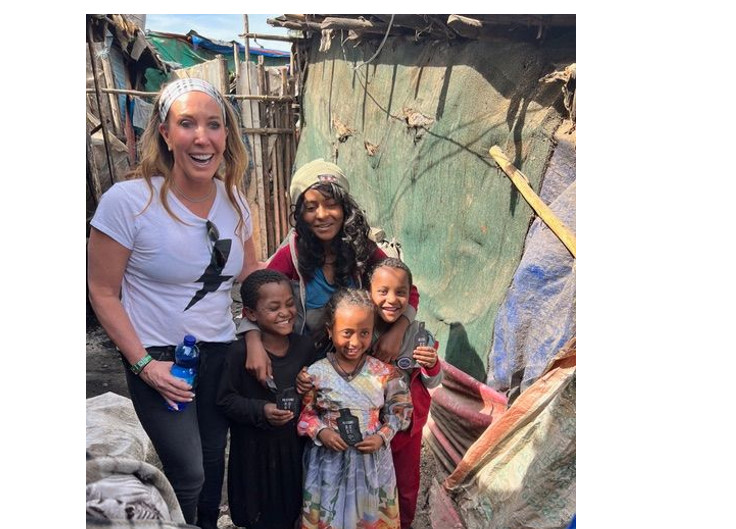
On the outskirts of Addis Ababa, surrounded in trash, children still scavenge for recyclables to survive. But some of them now attend school. Some have the possibility, however fragile, of a different future. This modest change – barely visible in the aggregate statistics of global poverty – represents nearly two decades of work by an American entrepreneur Christina Rahm, whose philanthropic approach challenges conventional wisdom about how change happens in the poorest corners of Africa.
Rahm, 53, is not a household name in philanthropy circles. She runs no international NGO with thousands of staff members. She doesn’t appear regularly in donor databases or major foundation rankings. Yet since 2006, her Rahm Foundation (www.therahmfoundation.com) has quietly invested millions in education, environmental remediation, and healthcare across some of the world’s most marginalized communities, operating with what might be called deliberate obscurity – the opposite of the visibility-seeking approach that characterizes much contemporary philanthropy.
Rahm says it is not done for recognition. This statement has appeared before from philanthropists, many of whom nonetheless maintain elaborate social media presences and grant substantial interviews to major publications. With Rahm, the claim appears to have operational meaning. The foundation’s work is documented primarily through interviews with beneficiaries, sparse press releases, and mentions in academic journals – not through glossy annual reports or celebrity endorsements.
To understand Rahm’s evolution into philanthropy requires understanding her unconventional path. She earned undergraduate and graduate degrees in criminal justice and rehabilitation counseling from the University of South Alabama in the early 1990s, then worked briefly in a methadone clinic. The experience, she has said, made her realize she needed different tools to address the root causes of poverty and addiction. She pivoted toward pharmaceutical science, eventually holding positions with major companies including Johnson & Johnson, Biogen, and Bristol Myers Squibb – conventional pharma-industry roles that positioned her comfortably within the American middle class.
But comfort, apparently, did not suit her. Over the past 15 years, Rahm transitioned from employment to entrepreneurship, founding multiple companies focused on health and wellness innovation: The ROOT Brands, a health supplement company now operating in more than 60 countries; Xoted Biotechnology Labs, a $4.2 million research facility in South Carolina; and Strata Biotech, a manufacturing operation in Nevada. These ventures have made her wealthy, but the wealth appears to have become a tool rather than an end point.
The question worth asking is whether this approach yields measurable results, or whether it simply allows a well-meaning individual to spend personal fortune on her preferred causes without accountability or evidence.
The evidence is mixed. The foundation’s educational initiatives in Ethiopia’s Korah community – a neighborhood literally built atop Addis Ababa’s municipal trash dump – have provided scholarships to 30 or more students over the past decade. Tracking their outcomes is difficult; Ethiopia’s educational data infrastructure remains fragmented, and the foundation does not publish comprehensive impact assessments. But interviews with community leaders and former scholarship recipients suggest real change: Several students have completed secondary education and moved into professional employment, a nontrivial achievement in a community where most children never finish primary school.
The Xoted facility in Spartanburg, South Carolina, which officially launched in 2025, provides a more measurable test case. The facility, focused on plant-based detoxification technologies and STEM education, has created 34 jobs and established partnerships with local schools. Initial enrollment in its educational programs – designed to build a pipeline of STEM workers – appears encouraging, though long-term outcomes remain unknown. Dr. Michael Mikota, president of Spartanburg Community College, calls it “a significant milestone” for the region’s capacity to train scientists. That assessment seems reasonable, though it’s worth noting that philanthropists funding educational infrastructure often benefit from enthusiastic endorsements from the institutions they support.
Her environmental work presents perhaps the greatest uncertainty. Rahm has invested over $500,000 in partnerships with Save Soil, a global movement focused on soil remediation and agricultural sustainability. The science underlying soil remediation through specific technologies Rahm champions remains contested within the scientific community. Some researchers view her approach as promising; others regard it as unproven. Without peer-reviewed data, outsiders cannot definitively assess whether these investments produce measurable environmental benefit.
What emerges from examining Rahm’s work is not a portrait of a philanthropist with a perfect track record or revolutionary impact. Instead, it resembles something more nuanced and perhaps more honest: an accomplished scientist using accumulated resources to pursue long-term bets on education, health, and environmental restoration in places that rarely attract major philanthropic attention. Some of these bets will likely succeed. Others may not.
Her personal motivation appears genuine, if not entirely transparent. She has spoken publicly about battling Lyme disease and cancer, experiences that she credits with deepening her commitment to helping others facing health crises and poverty simultaneously. Whether that motivation stems from spiritual conviction, trauma processing, or some combination remains ultimately unknowable.
The broader question her work raises is this: In a world where billionaires and major foundations dominate philanthropic discourse, what role should smaller-scale, long-term commitments play in addressing global inequality? Rahm’s approach – focused, localized, patient – offers a counterpoint to both the mega-philanthropy model and the charity-as-marketing paradigm that has increasingly characterized nonprofit work.
The children in Korah still grow up surrounded by poverty. But some attend school because of an American scientist they will likely never meet, whose name they may never know. Whether that represents the future of philanthropy or merely a footnote in a world requiring far more ambitious solutions remains an open question.
We’ve got the edge. Get real-time reports, breaking scoops, and exclusive angles delivered straight to your phone. Don’t settle for stale news. Join LEADERSHIP NEWS on WhatsApp for 24/7 updates →
Join Our WhatsApp Channel