
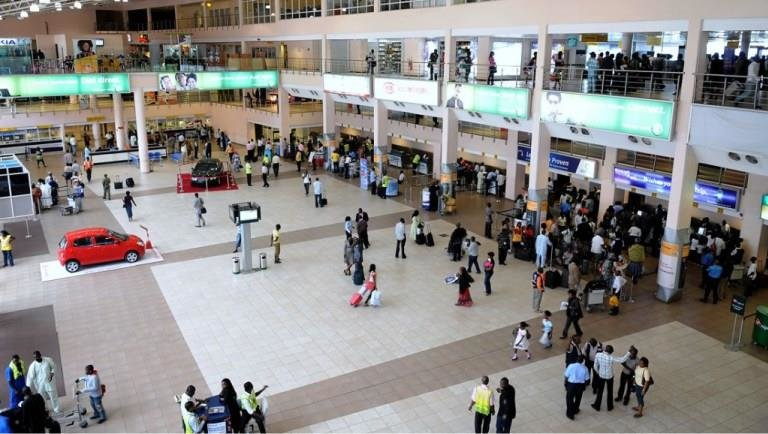
Travellers across Nigeria are breathing a sigh of relief as flight and road transport fares, which skyrocketed during the December festive season, have sharply declined.
During the peak holiday period, one-way flight tickets reached unprecedented levels, with fares ranging from N400,000 to N500,000 depending on the route.
The surge coincided with heightened insecurity and kidnapping along major highways, prompting many Nigerians to opt for air travel despite the steep costs.
LEADERSHIP Sunday recalls that road transport became unusually expensive, with bus fares reaching N55,000 for trips from Abuja to Lagos and N30,000 to N45,000 for routes such as Abuja to Enugu.
Transport operators had cited rising fuel prices, vehicle maintenance costs, and peak demand during the holiday season as key drivers.
Our correspondents, who visited airports, motor parks, and other transport companies, discovered that fares have now returned to more manageable levels. For instance, Abuja to Lagos now costs N31,000, while Abuja to Enugu costs between N23,000 and N28,000. Abuja to Ibadan: N28,000, Abuja to Port Harcourt: -N36,000
The cost of air travel has also drastically reduced. Average one-way tickets from Abuja to Lagos have fallen by 72 per cent, from N450,000 during the Yuletide to approximately N125,000 now. Other routes, such as Abuja to Enugu and Abuja to Ilorin, have also seen significant reductions.
Further investigation revealed that as of January 10, 2026, a one-way flight from Abuja to Lagos cost between N122,458 and N125,001, while a round-trip fare ranged from N237,002 to N263,989. Flights from Abuja to Enugu were as low as N93,300 for trips on January 12–14.
LEADERSHIP Sunday recalls that the surge in December drew national attention. On December 10, 2025, precisely, the Nigerian Senate raised alarms over the high cost of flight tickets.
Senator Abdulfatai Buhari who raised the alarm then, told the Senate that fares had escalated to between N400,000 and N650,000 for Abuja to Lagos, around N500,000 for Abuja to Enugu, and N450,000 for Abuja to Ilorin.
Despite the public outcry, aviation authorities maintained that ticket prices were largely market-driven.
The Minister of Aviation and Aerospace Development, Festus Keyamo ( SAN) even explained that high fares stemmed from operational constraints, including limited aircraft access, costly leasing conditions, the lack of local heavy-maintenance facilities, and airlines’ reliance on foreign exchange for overseas mandatory checks.
He emphasised that the government does not have the authority to regulate fares for private airlines.
Keyamo’s argument was supported by Michael Achimugu, director of public affairs and consumer protection at the Nigeria Civil Aviation Authority (NCAA), who believed that increased competition and greater availability of aircraft could lead to lower prices.
He noted, however, that the NCAA had no authority to control fares. “With multiple options available, Nigerians would have the right to choose, and prices would likely come down,” he said.
Despite these reductions, airline executives offered a contrasting perspective. The chairman and CEO of Air Peace, Allen Onyema, argued that Nigerians were paying some of the cheapest domestic airfares in the world. In an interview with ARISE News, he said: “A one-hour flight costs over $400 abroad, but in Nigeria, tickets were still available for N125,000, less than $60. This is why airline mortality in Nigeria has been high over 80 airlines have come and gone.”
In contrast, Dr. Alex Nwuba, president of the Aircraft Owners and Pilots Association of Nigeria (AOPAN), presented findings from a study titled ‘Reassessing Nigerian Airfares: A Global Affordability Perspective.’ Comparing domestic air travel across 19 countries, he found that Nigeria’s average short-haul fare of N131.67 ($175), based on NBS data, was higher than most countries when adjusted for income and purchasing power parity (PPP).
According to Dr. Nwuba, countries such as India ($250), Vietnam ($400), Malaysia ($1,200), Thailand ($700), the Philippines ($350), Indonesia ($300), Brazil ($900), Mexico ($700), the United States ($6,900), Canada ($4,200), Australia ($4,800), Japan ($3,200), China ($1,200), the UK ($4,000), Germany ($4,500), UAE ($3,500), South Africa ($1,100), Kenya ($250), and Ethiopia ($100) all had higher average monthly wages but lower domestic airfares than Nigeria. For travellers, fares in India were $75, Vietnam $65, Malaysia $55, and Ethiopia $95, compared with $131.67 in Nigeria.
Dr. Nwuba further highlighted the stark contrast between Nigeria and Ethiopia. “These were the two least affordable domestic aviation markets in the dataset,” he said. “Yet Ethiopia is home to the most successful and expansive airline in Africa, while Nigeria struggles to sustain stable carriers.”
He explained the difference lay in each country’s aviation model. Nigerian airlines depended heavily on domestic passengers, with no major international hub, limited long-haul networks, and minimal transit traffic. When domestic affordability collapsed due to low wages, weak PPP, and high operating costs, the entire system became fragile.
Ethiopian Airlines, by contrast, relied minimally on domestic passengers, who contributed less than 10 per cent of its revenue. Its success was built on a global strategy, not local demand. Nigeria, despite a large domestic market, remained unprofitable due to weak purchasing power and the absence of international connectivity, leaving airlines trapped in a domestic environment unable to sustain long-term growth.
Meanwhile, the cost of airfares and road transport in Imo State had posed significant challenges to residents, driven by steep increases implemented by operators.
Each festive season provided opportunities for people to travel and visit relatives, but the high costs of both air and road transport placed heavy financial burdens on commuters. Observers noted that some operators appeared to time their fare hikes to coincide with peak travel periods, effectively exploiting travelers’ need to move.
A transporter, speaking on condition of anonymity, explained that the rising cost of vehicle maintenance had forced them to increase fares.
Similarly, commuter Maduka Ohakwe said transporters and airline operators routinely took undue advantage of travellers during festive periods. He urged the government to intervene and prevent such exploitation.
Even after the festive season, airfares and road transport remained relatively high in Imo State. Flights from Lagos to Owerri, for example, ranged from ₦140,000 to ₦287,800, depending on the airline and time of booking time.
However, road transport fares from the state have become more affordable:
While Owerri to Lagos is put at N31,000, the same Owerri to Abuja cost N34,000, even as Owerri to Port Harcourt: stands at N9,000
When contacted, some transport operators, who requested not to be named, explained that fares are influenced by demand, limited capacity, and rising operational costs. Meanwhile, commuters have called on the government to intervene to ensure lasting solutions.
In Gombe, a survey by our correspondent revealed significant changes in transport fares before and after the Christmas period, with sharp increases particularly on private routes.
Findings on Thursday showed that government-owned vehicles maintained relatively moderate fares from Gombe to major destinations. Fares were N15,000 to Abuja and Makurdi, N8,500 to Kano, N7,500 to Jos, N8,000 to Jalingo, N9,500 to Maiduguri, N6,500 to Yola, and N4,000 to Bauchi.
In contrast, private transport operators raised fares sharply. Travel to Abuja now costs N30,000 on Vectra vehicles (up from N22,000), N25,000 on Sharon buses (previously N17,000), and N22,000 on Hummer buses (up from N15,000). Fares to Kaduna rose to N20,000 on Vectra buses and N18,000 on Sharon buses, while trips to Jos on Sharon buses now cost N9,000.
Passengers, including Salomi Samuel, Salisu Adamu, and Faisal Ibrahim, lamented the steep fare hikes and the difficulty in securing vehicles during the period.
Explaining the situation, Musa Bala, a Sharon driver, said the earlier lower fares had been unsustainable, as drivers often returned without passengers. Operators were therefore forced to adjust prices to cover operational costs.
Passengers, including Salomi Samuel, Salisu Adamu, and Faisal Ibrahim, lamented the steep fare hikes and the difficulty in securing vehicles during the period.
In Enugu, airfare and bus fares to destinations in the South-East and South-South surged during December. One-way economy tickets from Abuja to Enugu, Owerri, and Port Harcourt often cost ₦335,500 and above, with some peak periods exceeding ₦350,000. Several airlines fixed fares at ₦350,500 for most of December.
After January 1, 2026, fares reportedly dropped by over 50 per cent, reflecting reduced holiday demand. Bus ticket prices on South-East routes had also spiked 20–30 percent during December but moderated in early January.
Commuter Obi Okoye explained that the reduction came as many travellers completed their holiday journeys, easing ticket availability. Ibekwe Uzoegbu, a leader of the Enugu Road Transporters Union, noted that seasonal fare spikes and post-holiday drops had been a recurring trend.
FRSC officer Ohagwa Joshua stated that, despite expectations of lower fares due to fuel price reductions, December fares were not as high as in previous years, and transport costs were now more affordable. Aviation sales agent Tony Nwachukwu added that festive season demand influences air ticket prices, rather than the airlines themselves.
In Cross River State, an official of the Federal Airport Authority (FAAN) at Margaret Ekpo International Airport, Calabar, speaking anonymously, revealed that airline fares have dropped significantly after Christmas and New Year.
For instance, ValueJet now charges N200,000 for Calabar–Lagos flights, while NG Eagle charges N130,000 for Calabar–Abuja or Calabar–Lagos. Ibom Airlines charges N171,000 for the Calabar–Port Harcourt route. This is lower than pre-holiday fares, which were higher due to increased demand during the festive period. The official noted that the changes reflect basic supply and demand.
Similarly, head of the Ikom Drivers Association, Mr. Stephen Manyor, explained that transport fares traditionally rise before Christmas and New Year. During the holidays, passengers traveling from Calabar to Ikom paid N13,000–N15,000, compared to N10,000–N12,000 now. Fares from Calabar to Ogoja and Obudu ranged from N15,000–N20, but are now N15,000 on the return trips.
Manyor added that transport companies charge higher fares during festive periods due to high demand, though patronage remains strong. After the holidays, fares typically decrease. For example, trips from Calabar to Aba, Enugu, or Akwa Ibom are now more affordable, while only high-demand routes, such as Abuja–Lagos, remain expensive. Most transport companies reduce fares around January 12–15, returning to normal post-holiday levels.
Economists warn that the recent drop in fares may only be temporary, influenced by post-holiday market corrections. However, the reductions have provided much-needed relief for Nigerians facing the harsh realities of rising economic costs.
We’ve got the edge. Get real-time reports, breaking scoops, and exclusive angles delivered straight to your phone. Don’t settle for stale news. Join LEADERSHIP NEWS on WhatsApp for 24/7 updates →
Join Our WhatsApp Channel