A public health expert and vaccine specialist, Mr. Emmanuel Adebayo, has warned that the growing number of zero-dose children in Nigeria poses a serious threat to public health and could reverse gains recorded in disease control.
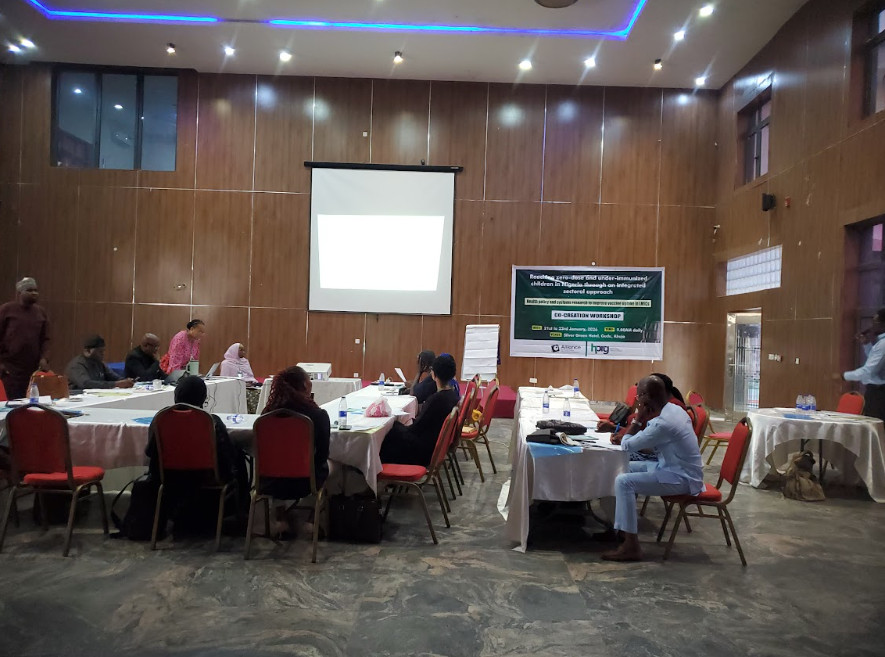
Adebayo, an epidemiologist and former National Director of Disease Control and Immunisation, stated this during a co-creation workshop organised in Abuja on Wednesday between January 21-23,2025 by the Health Policy Research Group (HPRG), University of Nigeria, in collaboration with the Alliance for Health Policy and Systems Research on reaching zero-dose and under-Immunized children in Nigeria through an integrated sectoral approach.
Adebayo said a zero-dose child is one who has not received any vaccine at all, noting that even small gaps in coverage can expose communities to outbreaks. “One in ten unvaccinated children poses a serious public health risk,” he said.
He explained that zero-dose vaccination becomes particularly dangerous when it reaches about 10 per cent of children in a community, as it weakens herd immunity and increases the likelihood of disease transmission.
According to him, many zero-dose cases are not the result of outright rejection of vaccines but are driven by parental hesitancy, poverty, misinformation and systemic gaps in healthcare delivery. “Most zero-dose children are not unvaccinated by choice, but as a result of parental hesitancy and systemic failure,” Adebayo noted.
He clarified that vaccination should not be confused with immunisation, stressing that administering a vaccine does not automatically guarantee immunity. “Vaccination is not the same as immunisation; immunity only occurs when the body develops protective antibodies. A child can be vaccinated and still fail to become immunised,” he said.
Adebayo identified vaccine hesitancy as a major challenge in Nigeria, attributing it to cultural and religious beliefs, political distrust and lack of confidence in government services. “When basic services fail, communities begin to question repeated vaccination campaigns,” he said, adding that hunger and poverty have also become barriers to vaccine acceptance in some areas.
He further explained that while herd immunity can protect communities, it does not fully protect zero-dose children. “A community may appear protected while individual children remain dangerously exposed,” he warned.
On data and monitoring, Adebayo said zero-dose vaccination figures are dynamic and must be tracked continuously rather than relying on fixed national estimates. “Zero-dose data is dynamic; trends matter more than fixed figures. Inaccurate statistics can mislead the public more than no figures at all,” he said.
He called for stronger stakeholder collaboration, data-driven planning and community engagement to address the challenge. “Ending zero-dose vaccination begins with a shared understanding of the problem. Public health interventions must be planned, monitored and measured for impact,” Adebayo added.
Also speaking, Director of Health and Bio-Medical Sciences at the Federal Ministry of Innovation, Science and Technology, Mr. Adebayo Adeyemi, said that sustained advocacy, continuous public education and community sensitisation are critical to reducing the number of zero-dose and under-immunised children in Nigeria.
Adeyemi expressed optimism that the multisectoral approach being promoted at the workshop would significantly enhance immunisation coverage and address persistent gaps in vaccine access.
Speaking further, Adeyemi stressed the importance of sustained community engagement, improved service delivery and the strategic use of incentives to boost vaccine uptake.
“Zero-dose and under-immunisation challenges are not peculiar to Nigeria; they are global issues. Even frontline nations still grapple with zero-dose children,” he said.
He noted that while absolute perfection may be unrealistic, the prevalence of zero-dose children can be significantly reduced through coordinated action.
“Zero-dose is a major and ongoing problem, but we can reduce its prevalence. The multisectoral approach this discussion is focusing on will complement existing efforts and strengthen government interventions aimed at eliminating zero-dose cases,” Adeyemi said.
The director explained that vaccine hesitancy is driven not only by beliefs or financial constraints, but also by access-related issues.
“Advocacy, education and continuous sensitisation can correct misconceptions about vaccines. Access remains a major challenge, whether physical access or simply knowing where and how to get vaccinated,” he added.
Adeyemi also highlighted the role of service improvement, calling for continuous education, encouragement and incentives for caregivers and health workers to support immunisation programmes.
During the workshop, researchers examined infant immunisation trends, offering insights into addressing vaccine hesitancy and strengthening health systems to reduce zero-dose and under-immunised children.
A policy brief presented revealed that although the National Programme on Immunization (NPI) has recorded improvements in recent years, significant gaps still persist.
The report identified logistics constraints, misinformation-driven vaccine hesitancy and weak coordination among immunisation sub-systems as key factors undermining efforts to achieve universal immunisation coverage.
The policy brief analysed findings from a study conducted by HPRG, drawing input from caregivers of children under five, health workers and community leaders.
Fieldwork was conducted across six states; Abia, Bauchi, Edo, Kano, Nasarawa and Oyo—representing Nigeria’s six geopolitical zones.
Findings showed that high transportation costs, long distances to health facilities and difficult terrain continue to pose major barriers to vaccine access, particularly in hard-to-reach areas.
The report also revealed that misinformation surrounding vaccines and incentives has fuelled mistrust among caregivers and communities.
Statistics from the study indicated serious weaknesses in immunisation logistics and infrastructure, with 73.26 per cent of vaccine storage facilities either inadequate or non-functional, while 36 per cent of transportation systems were found to be inadequate.
In addition, 32 per cent of health facilities experienced vaccine stock-outs before resupply, while 16.6 per cent reported shortages of manpower or the absence of storage systems.
The study concluded that effective immunisation requires stronger coordination across sectors, improved transportation services and increased efforts to educate fathers and families to strengthen support for childhood vaccination.
We’ve got the edge. Get real-time reports, breaking scoops, and exclusive angles delivered straight to your phone. Don’t settle for stale news. Join LEADERSHIP NEWS on WhatsApp for 24/7 updates →
Join Our WhatsApp Channel