
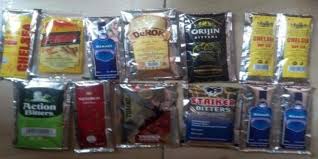
The Director-General of the Manufacturers Association of Nigeria (MAN), Segun Ajayi-Kadir, has warned that the proposed ban on the production and sale of sachet alcohol will be counterproductive, threaten jobs, reduce government revenue and worsen public health outcomes by pushing consumers toward illicit and unsafe alternatives.
Ajayi-Kadir raised the concerns during an interview on ARISE News Channel on Thursday, accusing the National Agency for Food and Drug Administration and Control (NAFDAC) of acting unilaterally by fixing and enforcing a ban date without stakeholder consensus, despite contrary findings from joint studies and directives from key government institutions.
“To set the record straight, we did not agree that the ban should take effect in December. It has always been a monologue between NAFDAC and us. They fixed the date and they are executing the ban,” he said.
He argued that NAFDAC ignored several institutional resolutions opposing the ban, including directives from the House of Representatives and the Federal Government through the Office of the Secretary to the Government of the Federation (OSGF).
“What they actually did was to ignore the directive of the House of Representatives, ignore the directive of the Federal Government … and they also ignored a study conducted jointly by NAFDAC and MAN, which did not indicate that a ban would be effective or necessary,” Ajayi-Kadir said.
While stressing that manufacturers support efforts to prevent underage alcohol consumption, he described the proposed ban as a simplistic response to a complex problem.
“We agree that alcohol consumption by children is wrong and should be condemned and punished. But that is a completely different argument from banning the production and sale of alcohol in sachets,” he said, dismissing claims that MAN had shifted its position on the issue.
Ajayi-Kadir explained that sachet packaging was a legitimate business model designed to serve low-income consumers and is widely used across multiple product categories.
“If it gets into the hands of the wrong people, the solution is to put measures in place, not to ban the product,” he said.
He outlined access-control measures proposed by manufacturers, including stricter licensing, product labelling, traceability, value-chain engagement and sustained public education campaigns. According to him, manufacturers can track distribution channels and use data to identify leakages.
Citing international best practices and recommendations from anti-drug agencies, Ajayi-Kadir said global responses to underage drinking focus on restricting access rather than outright bans.
He warned that bans often produce unintended consequences, noting that similar policies in other countries failed and pushed consumers toward unsafe, locally brewed alcohol.
“This policy will affect livelihoods, industrialisation, government revenue and jobs. It will disrupt the market and open the door for illicit alcohol,” he said.
Ajayi-Kadir also denied MAN’s involvement in recent protests against the ban, attributing them to labour unions concerned about potential job losses.
Calling for renewed engagement, he urged regulators to adopt collaborative, evidence-based approaches.
“Regulatory agencies must work with stakeholders, not impose predetermined decisions. We are committed to preventing children’s access to alcohol, but bans are not the solution. Let us work together,” he added.
We’ve got the edge. Get real-time reports, breaking scoops, and exclusive angles delivered straight to your phone. Don’t settle for stale news. Join LEADERSHIP NEWS on WhatsApp for 24/7 updates →
Join Our WhatsApp Channel