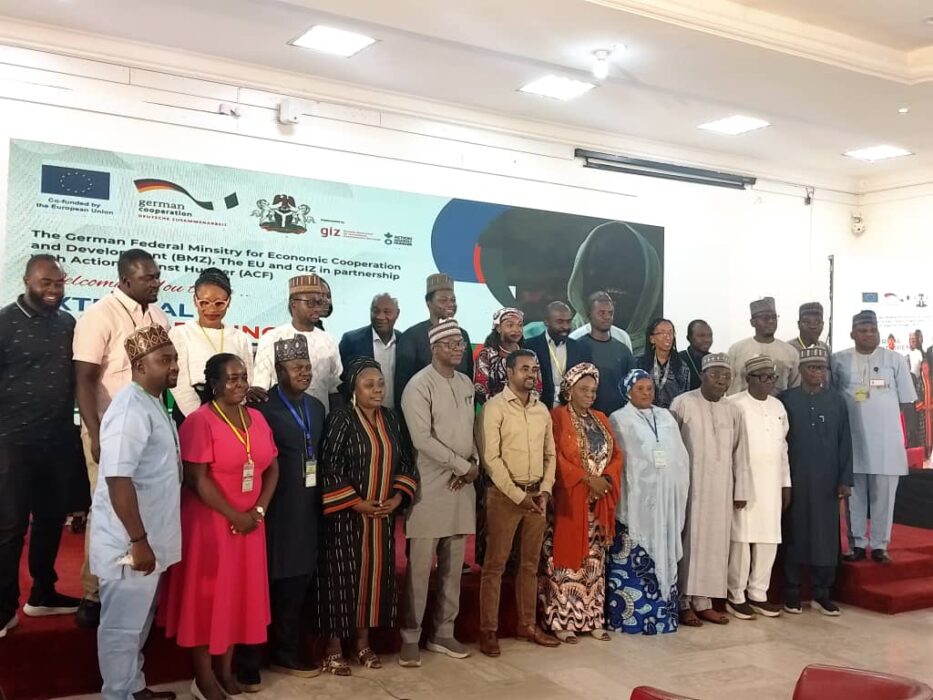
Action Against Hunger Nigeria (ACF) and the German Agency for International Cooperation (GIZ) have launched a new programme aimed at strengthening social protection systems in Borno and Adamawa States.
The initiative, funded by the European Union (EU) and the German Government (BMZ) under the SEPIN–SUSI framework, targets the expansion and improvement of the social register in both states, using community-based and data-driven targeting approaches.
Speaking during the Kick-off Meeting with Action Against Hunger (ACF) on the Improving Social Protection in Adamawa and Borno States (ISPAB) through Expansion of the Social Register, the Country Director of ACF, Thierno Samba Diallo, said the programme was a reaffirmation of the organisations’ commitment to protecting vulnerable households from poverty, hunger, and shocks, especially in conflict-affected communities in the Northeast.
Diallo described social protection as a “core priority” for ACF, noting that the organisation’s work in Jigawa and Kano States had demonstrated how strong institutional systems could reduce vulnerability and restore dignity to families.
He raised concerns about worsening food and nutrition insecurity, citing the October 2025 Cadre Harmonisé analysis, which shows 27.2 million Nigerians experiencing Crisis-level food insecurity or worse.
In Borno alone, 1.92 million people are currently in crisis or emergency levels, while 1.21 million people in Adamawa are in similar conditions.
“The nutrition outlook is equally alarming,” he added, referencing the 2025 IPC Acute Malnutrition analysis, which estimates 6.4 million children across northern Nigeria will be acutely malnourished between October 2025 and September 2026.
Representing GIZ, the Head of Programme, Mrs. Ana Vanambres, said the partnership with ACF aims not only to expand the social register but to improve its credibility, quality, and institutional ownership.
Vanambres, who was represented by Bolaji Aina, noted that the project reinforces Nigeria’s ongoing social protection reforms and supports state-level systems to better identify and assist vulnerable people, including women, internally displaced persons, returnees, and host communities.
“The social register is the cornerstone for shock-responsive support and effective resource allocation. This initiative strengthens the humanitarian-development-peace nexus needed in Adamawa and Borno,” she said.
Speaking for the National Social Register (NSR), Mr. Mohammed Bala, revealed that the national database was undergoing major updates.
“Of the 19 million households previously captured, over 10 million have already been visited, with 10 million individuals verified through NIMC,” he said, adding that household coordinates are being captured to enhance credibility.
The Director of Social Welfare in Borno State, Mrs. Aisha Shattima, described the state’s vulnerable population register as a vital tool that must be strengthened to fight hunger and ensure targeted support.
“I call for renewed action against hunger, which remains a serious public health concern in Borno,” she said.
In her remarks, Executive Chairman of the Adamawa State Planning Commission, Dr. Mary Paninga, said the programme comes at a crucial time for the state. She commended partners for their support and highlighted Adamawa’s full readiness, citing innovations such as AI integration in social protection systems.
We’ve got the edge. Get real-time reports, breaking scoops, and exclusive angles delivered straight to your phone. Don’t settle for stale news. Join LEADERSHIP NEWS on WhatsApp for 24/7 updates →
Join Our WhatsApp Channel