
The National Identity Management Commission (NIMC), in collaboration with the World Bank, has unveiled a nationwide initiative aimed at taking identity enrollment directly to Nigerian communities, in a bid to reach millions of citizens previously excluded due to distance, insecurity and poor infrastructure.
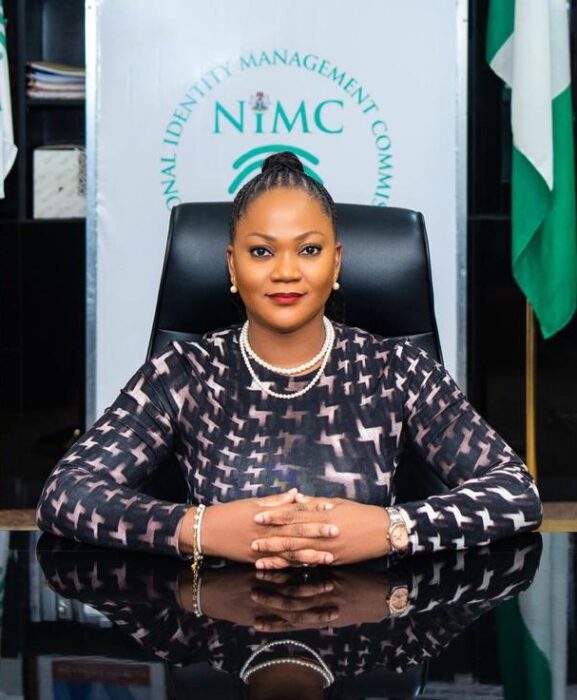
The Director-General of NIMC, Engr. Abisoye Coker-Odusote, disclosed this during a prime-time interview on ARISE News Channel in Abuja, explaining that the Commission was shifting enrollment from local government offices to ward and community-level outreach, in line with President Bola Tinubu’s Renewed Hope Agenda.
Odusote noted that for many Nigerians, identity extends beyond an 11-digit number or a physical card, serving instead as a gateway to essential services such as banking, telecommunications, healthcare and government interventions. However, she admitted that limited reach and physical barriers have, over the years, kept millions outside the national identity system.
“At the heart of what we do is the issuance of an 11-digit National Identification Number (NIN) for every citizen and legal resident,” she said, adding that this represents only one aspect of NIMC’s broader mandate.
According to her, the Commission operates on five core pillars: issuance of the NIN; development and protection of a secure national identity database; issuance of the General Multi-Purpose Card (GMPC); harmonisation of identity data across Ministries, Departments and Agencies (MDAs); and the provision of authentication and verification services.
She stressed that effective verification, beyond enrollment, is key to ensuring seamless use of identity across critical sectors such as banking, telecommunications, healthcare and governance.
While NIMC currently operates about 1,200 offices nationwide—including state offices, local government desks and co-location centres with agencies such as the Federal Road Safety Corps (FRSC)—Odusote acknowledged that physical infrastructure alone has not bridged the access gap.
“In some parts of the country, especially the North-East, travelling from one local government to another can take four to six hours,” she said. “It is simply unacceptable for any Nigerian to be excluded from modern life because our system has not reached their road.”
To address this challenge, NIMC is transitioning to ward- and community-based enrollment, following a presidential directive under the Renewed Hope Agenda. The expansion is being driven through a partnership with the World Bank’s Identification for Development (ID4D) initiative, which enables vetted partners to operate within Nigeria’s digital identity ecosystem and rapidly scale enrollment.
Odusote emphasised that enrollment under the programme is completely free, warning Nigerians against paying for the service.
“No one should pay to be enrolled. We do not want Nigerians spending money just to get an identity,” she said.
From February 16, the Commission will commence a six-week intensive community-level enrollment exercise, targeting hard-to-reach and previously unreached populations. To ensure effective grassroots mobilisation, NIMC is working with the National Orientation Agency (NOA) to deploy sensitisation materials in multiple local languages.
As part of its modernisation efforts, NIMC has also introduced the NINAuth App, a digital authentication and verification platform that allows citizens and legal residents to securely and consent-based manage how their NIN is used. The app enables real-time verification, reduces fraud and gives users control over what information is shared, with whom, and for how long.
In addition, recent legal reforms have strengthened Nigeria’s digital identity framework, with updates to the NIMC Act incorporating provisions from the Cybersecurity Bill (2015) and the Data Protection Act (2023), aligning the system with international best practices.
Since its establishment, NIMC has conducted over 2.2 billion identity verifications, largely within the private sector, and is now focused on empowering individuals with reusable digital credentials for easier access to services.
As Nigeria deepens its digital governance and inclusion drive, NIMC’s community-focused approach marks a significant shift—underscoring that national development begins with recognising and including every citizen, one community at a time.
We’ve got the edge. Get real-time reports, breaking scoops, and exclusive angles delivered straight to your phone. Don’t settle for stale news. Join LEADERSHIP NEWS on WhatsApp for 24/7 updates →
Join Our WhatsApp Channel