On Friday, 30 January 2026, Dr Ngozi Okonjo-Iweala, Director-General of the World Trade Organization, delivered the 45th Pre-Convocation Lecture at Ahmadu Bello University, Zaria. Her presentation, titled Challenges and Opportunities for Africa and Nigeria in the Present Global Geopolitical and Geostrategic Context, offered a rare and clear-eyed assessment of the world as it is, not as it once was. It was a realist evaluation of power, economics, and national interest, and a sober reminder that Nigeria’s future will be shaped by the strategic decisions it makes today.
Beyond ceremonial significance, the lecture raised a fundamental question: How does a large, resource-rich country position itself in a world defined by rivalry, insecurity, and economic uncertainty? Dr Okonjo-Iweala’s answer was grounded in evidence, informed by experience, and anchored in an understanding of contemporary global dynamics.
The World Nigeria Faces
The global system today is unsettled and fragmented. Major powers openly compete for influence, technology, and markets. Conflicts from Eastern Europe to the Middle East disrupt trade routes and energy flows. Climate change is reshaping production, investment, and migration patterns, while technological breakthroughs in artificial intelligence, digital finance, and automation are redistributing economic power. Supply chains that once stretched seamlessly across continents are now being shortened, regionalized, or diversified to reduce vulnerability.
Economics and geopolitics are inseparable. Countries no longer trade solely to reduce costs; they trade to manage risk, protect strategic sectors, and secure long-term advantage. Energy, water, food, data, technology, and minerals have become instruments of power. Nations that control them shape global outcomes; those dependent on imports remain exposed. Nigeria is not immune. External shocks quickly translate into currency volatility, inflation, and slower growth.
Energy and the Question of Power
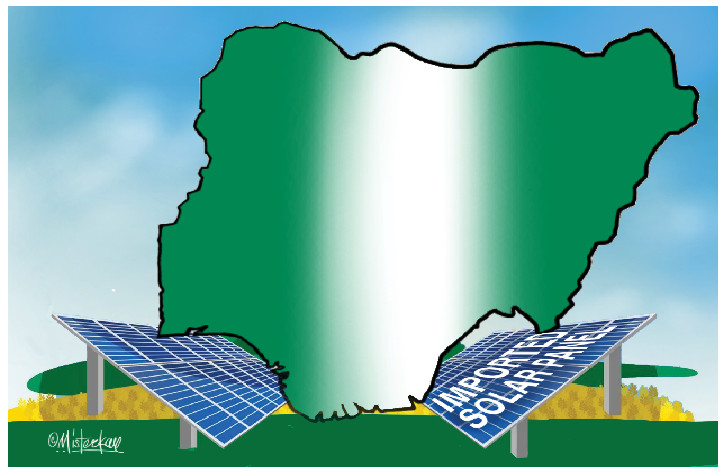
Dr Okonjo-Iweala’s call for Nigeria to reduce dependence on imported solar panels, particularly from China, must be seen as a matter of strategic realism. She did not argue against trade but for purposeful engagement. Nigeria is endowed with abundant sunlight and wind, yet millions still lack reliable electricity. Simultaneously, the country spends substantial foreign exchange importing renewable energy equipment, a dynamic that undermines energy security and constrains resources for domestic investment.
Evidence supports her point. Countries that manufacture their own renewable energy technology generate more jobs, strengthen supply chains, and stabilize energy systems. Import-heavy models remain vulnerable to price fluctuations, supply disruptions, and geopolitical shocks. Energy security today is inseparable from national security. Nations unable to reliably power industry, hospitals, or digital infrastructure struggle to compete globally. Local production of solar panels and other renewable components is not a panacea, but it represents a strategic first step toward autonomy, resilience, and industrial learning. Historical examples from Japan in the Meiji era and South Korea in the 1960s illustrate how domestic industrialization can reduce dependency and project influence on the global stage.
Nigeria’s current energy model constrains productivity, raises the cost of doing business, and diminishes global competitiveness. Investing in local renewable technology would transform natural endowments into industrial capability, technological expertise, and long-term economic resilience. It would also anchor Nigeria in the emerging global energy landscape, positioning the country as more than a passive consumer.
Clean Energy as Industrial Strategy
Globally, the transition to clean energy is both an environmental necessity and an industrial contest. The United States, European Union, China, and parts of Asia are investing heavily in domestic renewable energy manufacturing to secure jobs, retain technological expertise, and enhance geopolitical influence.
China’s dominance in solar panels reflects decades of foresight, state support, and consistent industrial policy. Other nations are now pursuing domestic capacity to avoid dependency and capture strategic value. Nigeria cannot remain a passive buyer in this expanding market without risking lost opportunity, industrial stagnation, and strategic vulnerability.
Clean energy offers Nigeria more than electricity. It provides industrial learning, skill development, and access to growing global markets. With deliberate policy, local firms can progress from assembly to component production and eventually to innovation-driven manufacturing. Emerging economies in Asia and Latin America demonstrate that industrial policy, combined with infrastructure investment and human capital development, can convert potential into sustainable competitive advantage.
A strategic approach to clean energy could also foster new industries, attract foreign investment, and create high-skill jobs. For Nigeria, it is an opportunity to build not only power capacity but national economic sovereignty. In this context, energy policy becomes inseparable from industrial strategy, technological modernization, and geopolitical positioning.
Africa’s Place in Global Investment
Despite abundant resources and renewable potential, Africa attracts only a fraction of global clean energy investment. This is not a question of opportunity but of structural limitations: policy gaps, weak infrastructure, inconsistent regulations, and limited access to financing.
Nigeria, as Africa’s most populous nation and largest economy, carries a particular responsibility. Its policy clarity, coherent industrial strategy, and consistent implementation set a precedent for the continent. Decisions made in Abuja ripple across Africa, shaping investor perceptions and confidence.
Dr Okonjo-Iweala highlighted encouraging developments. The Dangote Refinery demonstrates that large-scale industrial projects are achievable when policy and capital align. The lithium processing plant in Nasarawa State illustrates an emerging understanding that raw materials must be processed domestically to capture value. Nigeria’s technology and fintech sectors show that young talent can compete globally when supported by infrastructure, regulation, and investment.
These examples emphasize a central point: Nigeria’s current challenges are not structural inevitabilities. They are policy choices
.
Trade With Purpose
Trade is not neutral. Its benefits depend on how it is used. Dr Okonjo-Iweala’s message was pro-strategy. Countries now use trade to support industrialization, protect strategic sectors, and manage geopolitical risk. Nigeria must do the same. Reducing trade costs, improving port efficiency, aligning industrial policy with export ambitions, and investing in human capital are essential. Without engineers, technicians, and researchers, factories remain empty, and trade opportunities are lost.
Regional integration amplifies these gains. The African Continental Free Trade Area provides access to over one billion consumers. Strategically leveraged, it can generate economies of scale, attract investment, and establish an industrial base that a fragmented domestic market alone cannot sustain.
Governance as Competitive Advantage
Opportunity alone is insufficient. Governance determines outcomes. Countries with predictable policy, quality infrastructure, and effective institutions attract investment; those without are bypassed. Universities play a strategic role. Ahmadu Bello University’s contributions to global scholarship, including research that influenced WTO agreements on harmful fisheries subsidies, show how evidence-based research can shape policy. Collaboration between academia, government, and industry is indispensable for translating strategy into tangible outcomes.
A Moment Demanding Clarity
Dr Okonjo-Iweala’s lecture was a strategic brief for Nigeria. The global system is turbulent but also abundant with opportunity. Energy transition, technological change, digital trade, and shifting supply chains create openings for countries willing to act decisively.
Nigeria faces a clear choice. It can continue importing critical technologies, exporting jobs and capital, and remaining a passive actor. Or it can invest in domestic capacity, strengthen energy security, and establish itself as a serious participant in the new global economy. In practical terms, Nigeria can either continue buying its future or begin building it at home. In a world defined by competition, uncertainty, and strategic rivalry, that choice will determine the nation’s power, prosperity, and relevance for decades.
We’ve got the edge. Get real-time reports, breaking scoops, and exclusive angles delivered straight to your phone. Don’t settle for stale news. Join LEADERSHIP NEWS on WhatsApp for 24/7 updates →
Join Our WhatsApp Channel