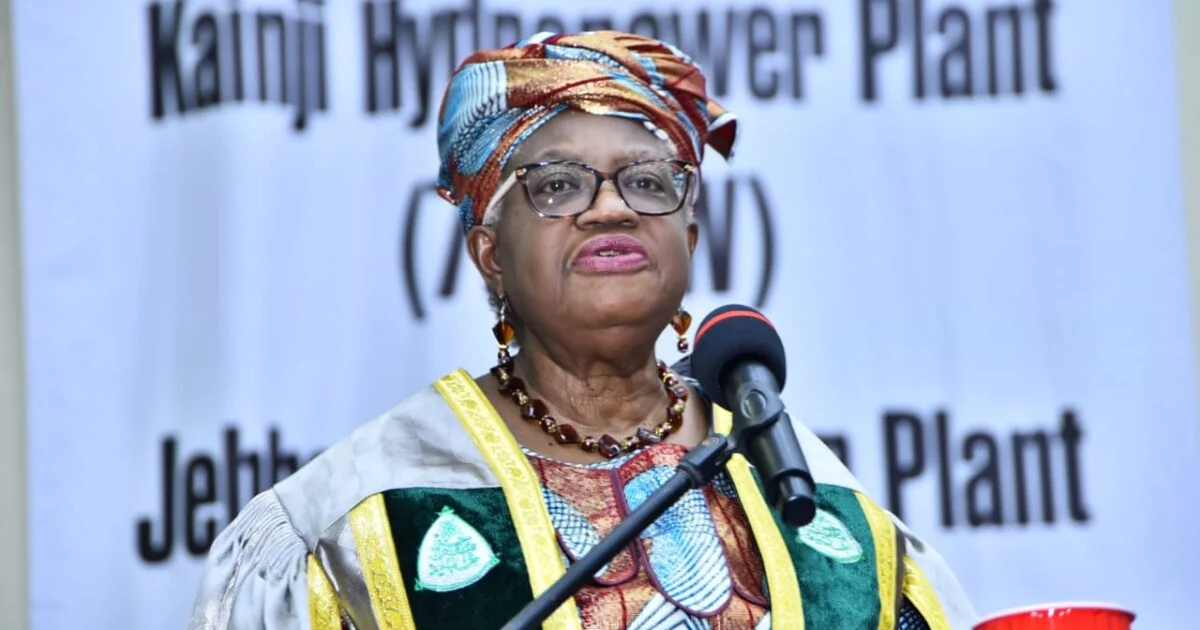
University convocations are rarely seismic events. They are designed to conclude, not to provoke; to certify, not to challenge. Gowns are worn, speeches delivered, degrees conferred, and life moves on. Yet the 45th convocation ceremony of Ahmadu Bello University refused to be merely ceremonial. It turned into a quiet but forceful argument about gender, opportunity, and Nigeria’s most underutilised asset: the educated girl child.
The reason was not fanfare but presence. When Ngozi Okonjo-Iweala arrived in Zaria, the response was electric. Students poured out in waves. Faculty, alumni and townspeople converged on Samaru campus. The gathering cut across social classes and cultural lines, drawing in people too often caricatured as conservative, resistant, or uninterested in female advancement. They did not come to resist a symbol of modernity. They came to witness it.
Dr. Okonjo-Iweala’s career is, by now, familiar but no less instructive for that. She has made a habit of occupying rooms once declared inaccessible. First female Minister of Finance. First Coordinating Minister of the Economy. First African—and first woman—to lead the World Trade Organization. These achievements are frequently celebrated as personal milestones. They are more accurately understood as institutional stress tests—proof that exclusion, not ability, has been the binding constraint.
That this message landed in Zaria mattered. The city, and Northern Nigeria more broadly, is routinely flattened in public discourse into a single, unhelpful stereotype: socially rigid, educationally hesitant, hostile to girls’ ambition. Reality, as usual, is more complex. The turnout at ABU suggested not resistance but hunger—an appetite for examples that reconcile local identity with global relevance. In Dr. Okonjo-Iweala, many saw not a repudiation of their values but their fulfilment: discipline, learning, and service elevated to scale.
The symbolism extended beyond the keynote address. The convocation itself supplied a piece of evidence that would be at home in any serious policy brief. The second-best graduating student was a woman from Bida in Niger State. This was not tokenism or coincidence; it was outcome. Where girls are allowed to learn without obstruction, performance follows. Human capital behaves predictably when it is not deliberately suppressed.
This is the point often missed in debates about girl child education. It is too frequently framed as moral generosity—a favour extended to women rather than a necessity imposed by economics and demography. In truth, denying girls education is among the most expensive habits a society can maintain. Countries that educate girls experience lower maternal mortality, higher productivity, smaller and healthier families, and more resilient institutions. Those that do not pay twice: once in lost output, and again in social fragility.
Northern Nigeria, with its youthful population, can ill afford such waste. The region’s development challenge is not a shortage of talent but the inefficient allocation of opportunity. Intelligence does not respect gender; systems do. When half the population is systematically constrained, growth stalls not for lack of effort but for lack of sense.
ABU’s decision to invite Dr. Okonjo-Iweala—rather than default to the predictable circuit of political speeches—was therefore more than cosmetic. It was corrective. Politicians trade in promises; technocrats trade in results. By placing competence at the centre of its convocation, the university quietly reminded its students what leadership actually looks like: credibility built over time, decisions anchored in evidence, and ambition disciplined by service.
For northern Nigerian girls watching from the audience, or following from afar, the lesson was neither abstract nor distant. It was proximate and practical. Excellence need not migrate to be legitimate. Tradition and aspiration are not mutually exclusive. The distance between a lecture hall in Zaria and the commanding heights of global governance is long—but it is navigable.
Dr. Okonjo-Iweala’s visit, then, should not be remembered as a moment of celebration alone. It should be read as a metaphor with policy implications. Educate the girl child, and progress compounds. Ignore her, and underdevelopment persists. The choice is not ideological; it is arithmetic.
Zaria spoke clearly. The question is whether Nigeria will listen.
Impressively musing
We’ve got the edge. Get real-time reports, breaking scoops, and exclusive angles delivered straight to your phone. Don’t settle for stale news. Join LEADERSHIP NEWS on WhatsApp for 24/7 updates →
Join Our WhatsApp Channel