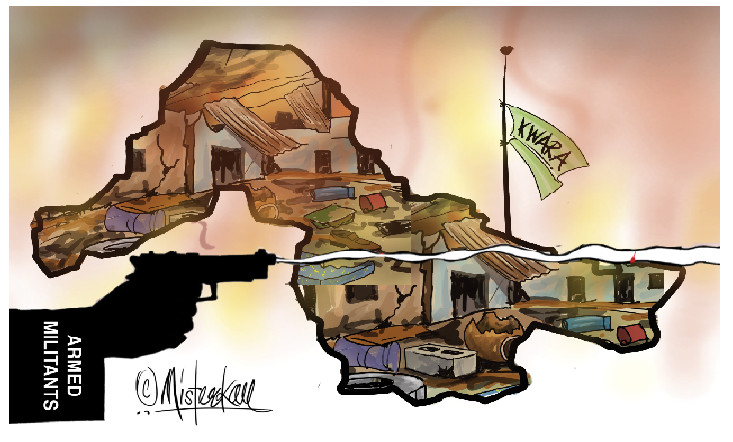
Kaiama Local Government Area in Kwara State has once again become the epicentre of national grief. Last week, rural communities including Woro and Nuku were attacked by armed militants, resulting in a loss of life and destruction that underscores decades of neglect. While the Nigeria Police Force and the Kwara State Government have officially confirmed 75 fatalities, independent sources present a far grimmer reality. The Red Cross and local lawmakers have documented at least 162 to 170 deaths, with community advocacy groups suggesting the toll may exceed 200. This stark disparity between official and independent counts highlights not only the scale of the violence but the inherent difficulty of verifying casualties in under-governed spaces during a humanitarian crisis.
The human cost is immense. Beyond the statistics lie lives—fathers, mothers, children, and elders—whose absence reverberates through farms, markets, and households. Kaiama’s tragedy is neither spontaneous nor unpredictable. It reflects structural neglect, chronic underdevelopment, and the gradual erosion of governance that has left the area exposed to armed actors for years.
From Sporadic Violence to Mass Killings
The pattern of violence in Kaiama mirrors historical trajectories seen across Nigeria. Peripheral communities often experience incremental attacks that escalate into mass casualty events when early warning signs are ignored. In Kaiama, prior incidents involved attacks on travellers, threats against farmers, and intimidation of village heads who cooperated with authorities. These warnings, while documented locally, rarely prompted decisive state intervention. The cumulative effect of these small-scale disturbances set the stage for the devastating attacks witnessed in February.
This pattern resembles the early stages of the Boko Haram insurgency in Borno State. Between 2002 and 2008, sporadic killings and low-scale attacks were largely dismissed as local disturbances. By 2009, however, Boko Haram had evolved into a fully organised insurgency that displaced over two million people and caused tens of thousands of deaths. Similarly, banditry in Zamfara began with sporadic cattle rustling and localized attacks before escalating into mass abductions and village raids. Kaiama’s recent massacre represents the moment when incremental insecurity crossed the threshold into large-scale humanitarian crisis.
Armed Groups and Territorial Opportunism
The perpetrators in Kaiama are identified locally as the Mahmuda group, linked to Boko Haram splinter factions and the Islamic State West Africa Province. Their operational logic follows patterns observed elsewhere in Nigeria and the Sahel. Armed groups under pressure in core conflict zones expand into peripheral areas where state presence is weak and response is slow. These peripheral regions become laboratories for operational consolidation, recruitment, and consolidation of control.
Witnesses describe attackers arriving on dozens of motorcycles, targeting multiple villages, and operating for several hours without effective opposition. Such coordinated movement demonstrates prior planning and knowledge of the terrain, indicating that Kaiama was assessed as permissive territory. Globally, similar patterns have been observed in rural Colombia, Afghanistan, and northern Mali, where armed actors exploit under-governed spaces to entrench themselves socially, economically, and militarily.
Kaiama as an Ungoverned Space
Kaiama’s vulnerability is not only geographic, but historical and structural. The Borgu axis, encompassing Kaiama, is vast and sparsely populated. In several wards, population density is below 20 persons per square kilometre, limiting administrative oversight and the reach of law enforcement. Forests and game reserves, once preserved for ecological purposes, have become de facto sanctuaries for armed groups.
Infrastructure deficits compound these vulnerabilities. Roads connecting Kaiama to administrative centres such as Wawa and New Bussa are in disrepair. Journeys of fewer than 40 kilometres can take two hours or more, particularly during the rainy season, delaying both security responses and humanitarian access. In such under-governed spaces, the absence of effective state presence does not create neutrality. It creates opportunity for armed actors to operate, recruit, and intimidate local populations with impunity.
Historical parallels abound. In colonial Nigeria, peripheral regions were administered indirectly and sparsely, visited occasionally, and invested in minimally. In postcolonial Nigeria, similar patterns persisted in places such as Zamfara and Kaduna, where forested corridors became havens for bandits due to intermittent governance.
Humanitarian and Developmental Consequences
The immediate human toll in Kaiama is mirrored by broader socioeconomic disruption. Kaiama is an agrarian local government area. With farms abandoned and local markets closed in the aftermath, households are losing both sustenance and income. Children will likely be pulled from schools, so also will women and elders face reduced access to daily income, while displaced families will increasingly rely on external aid.
These consequences echo patterns observed in Borno after 2013 and in Zamfara after 2018. Displacement and the disruption of agricultural cycles create long-term vulnerabilities that persist well after the immediate threat has subsided. Household incomes decline, food production falls, and social cohesion erodes, producing conditions that perpetuate insecurity.
Lessons from History
Kaiama’s tragedy is instructive because it aligns with recurrent historical patterns. Peripheral regions neglected by governance structures experience incremental violence that can evolve into full-scale crises. In Nigeria’s Middle Belt during the 1960s, early communal skirmishes foreshadowed larger regional upheavals. In Plateau and Benue States in the 1980s and 1990s, low-level rural killings escalated into cycles of reprisal. More recently, rural violence in Borno and Zamfara evolved along a similar trajectory, demonstrating how delayed intervention and absent governance allow insecurity to metastasize.
Globally, comparable dynamics are evident. In Rwanda, localised killings in rural prefectures presaged the genocide of 1994. In Colombia, decades of unmonitored rural violence ultimately spilled into urban centers. In each case, early warning signs were evident but underestimated. Kaiama, like these historical examples, underscores that marginal neglect is not innocuous. It accumulates, escalates, and eventually becomes catastrophic.
Kaiama in the Mirror of Memory
History teaches that peripheral violence, if ignored, rarely remains contained. The trajectory from small-scale attacks to mass casualties has been observed repeatedly across Nigeria and globally. Kaiama presents an opportunity to break this cycle. Sustained security presence, integrated development, and active governance can prevent recurrence and restore livelihoods. Failure to act decisively will not only deepen local suffering but will also reinforce the historical pattern of violence in Nigeria’s neglected regions.
The people of Kaiama are not asking for exceptional treatment. They seek the basic assurance that their lives, farms, and communities will not be sacrificed to the absence of governance. The massacre is both a tragedy and a warning. It is an indictment of systemic neglect and a call to action. History will judge whether Kaiama remains another footnote in Nigeria’s catalogue of peripheral crises or becomes a turning point in how the state approaches rural security, development, and humanitarian protection.
A Path Forward
Government interventions must go beyond temporary troop deployments or public statements. Security must be sustained, intelligence-led, and complemented by structural interventions. Roads should be rehabilitated to function as both economic and security infrastructure. Forests and reserves must be actively governed, integrating ecological stewardship with territorial control. Local communities must be empowered to report threats without fear, and these reports must trigger timely response.
Hence, a structural approach would be critical, because absence of governance has created the conditions for repeated attacks. Kaiama and neighbouring Local Government Areas cannot, and should not be treated as an isolated emergency, rather, a historically vulnerable area whose marginalization has rendered it susceptible to armed incursions.
We’ve got the edge. Get real-time reports, breaking scoops, and exclusive angles delivered straight to your phone. Don’t settle for stale news. Join LEADERSHIP NEWS on WhatsApp for 24/7 updates →
Join Our WhatsApp Channel