
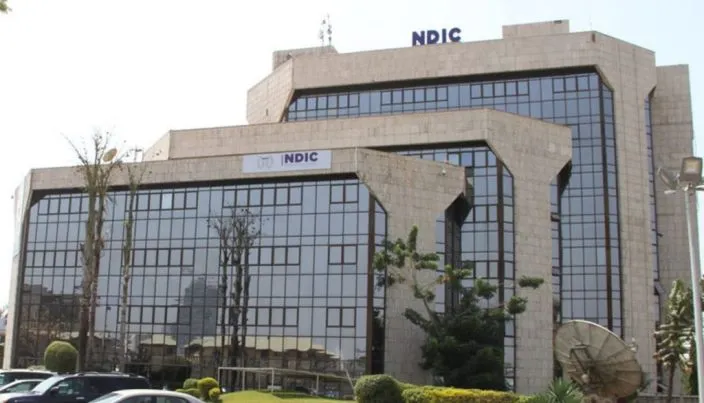
The Nigeria Deposit Insurance Corporation (NDIC) has intensified efforts to recover about N1.3 trillion in outstanding debts linked to more than 50 Deposit Money Banks currently in liquidation.
The Corporation said the enhanced provisions of the NDIC Act 2023 had strengthened its capacity to pursue obligors and improve reimbursement to depositors.
Speaking at a sensitisation seminar for NDIC debt recovery agents in Lagos, the director of Legal Department, Olufemi Oladepo Kushimo, described the revised law as providing a full bouquet of tools for effective debt recovery.
According to the NDIC, as of December 31, 2024, it had recovered a cumulative N34.98 billion from debtors of closed banks.
Of this amount, N33.54 billion was recovered from 50 closed deposit money banks with a combined risk asset book value of N1.37 trillion involving 60,851 debtors.
Kushimo stressed that the Corporation is determined to deploy every legal instrument available under the Act to enhance recoveries.
“We intend to utilise every section, provision and enforcement mechanism available under the law. This includes pursuing parties at fault, not only to enhance recoveries but also to serve as a deterrent and sanitise the banking industry. Those responsible for bank failures must be held accountable,” he said.
He emphasised that debt recovery is central to NDIC’s mandate of maintaining financial system stability and protecting depositors.
While insured deposits are paid from the Deposit Insurance Fund, he noted that amounts exceeding insured limits depend largely on successful asset realisation.
“Debt recovery is central to our ability to reimburse depositors effectively. The uninsured portion depends largely on successful debt recovery. That is where your role as debt recovery agents becomes critical,” he added.
Kushimo reminded participants that victims of bank failures are largely ordinary Nigerians.
“The depositors we serve are ordinary Nigerians, market women on the streets, PoS operators under umbrellas, small business owners, and individuals whose funds may exceed the insured threshold.
“For them, these monies represent livelihoods, life savings and working capital,” he said.
He explained that the strengthened Act was designed to enable quicker and more effective recoveries, accelerate liquidation dividend payments and reinforce public confidence in the banking system.
“The Act now incorporates strengthened mechanisms for recovering debts, including powers that address recalcitrant debtors and, where necessary, matters that may involve criminal infractions,” he noted, adding that agents would be guided on identifying such infractions and referring them to appropriate agencies.
The director of Asset Management at the Corporation, Patricia Okosun, said the revised law has reinforced the framework for debt recovery and broadened the mechanisms available for pursuing outstanding obligations.
“The NDIC Act has strengthened the framework for debt recovery and enhanced the mechanisms through which outstanding obligations are pursued.
“We are engaging debt recovery agents to familiarise them with the additional tools now available under the revised Act, beyond what they previously relied on,” she said.
According to Okosun, the sensitisation programme is aimed at ensuring recovery agents fully understand the new provisions to improve their effectiveness.
“We are confident that these enhanced powers will enable us to recover more debts, and more efficiently, so that we can reimburse depositors,” she added.
Responding to questions on the Corporation’s optimism about recovering the estimated N1.3 trillion exposure, Okosun said the agency remains confident, although timelines may be affected by litigation and procedural hurdles.
“We are optimistic about recovery. That optimism is precisely why we are equipping recovery agents with strengthened legal tools. Our objective is to recover as much as possible,” she said.
She, however, acknowledged that legal realities may slow the process.
“Naturally, the earlier the recovery, the better, as it enables quicker reimbursement of depositors. However, given the realities of litigation and related processes, it is not possible to fix a definite timeline. What remains clear is that speed and efficiency are priorities.”
On the ongoing banking sector consolidation, Okosun expressed hope that institutions would meet regulatory thresholds to avoid failures. “We hope all banks will meet the required thresholds. No one wishes to see any institution fail. Our expectation is that banks will scale through successfully,” she said.
Okosun further stated depositors of failed banks had continued to mount pressure for payment, describing their concerns as legitimate.
“As for depositors, it is natural for those with funds in banks under liquidation to demand payment. That pressure exists, and it is understandable. We also share the same objective, to ensure depositors are paid. The responsibility to meet those expectations is part of why we are intensifying recovery efforts,” he said.
From 55 closed primary mortgage banks, the Corporation recovered N996.86 million against outstanding loans of N58.81 billion involving 5,237 debtors. In the microfinance segment, N378.45 million was recovered from 546 closed institutions with total exposure of N51.81 billion and 305,016 debtors.
Beyond loan recoveries, the NDIC realised N28.71 billion from disposal of physical assets of failed banks, including N27.18 billion from deposit money banks, N1.30 billion from microfinance banks and N236.99 million from primary mortgage banks.
It also realised N6.82 billion from the disposal of investment assets such as shares, treasury bills, bonds and fixed deposits. Of this amount, N6.59 billion came from deposit money banks, N164.30 million from microfinance banks and N75.05 million from primary mortgage banks.
We’ve got the edge. Get real-time reports, breaking scoops, and exclusive angles delivered straight to your phone. Don’t settle for stale news. Join LEADERSHIP NEWS on WhatsApp for 24/7 updates →
Join Our WhatsApp Channel