In this column, I turn my attention to a moment that transcends headlines and borders: a Washington gathering where Muslim and Christian leaders came together not to contest doctrine, but to reaffirm a shared commitment to justice, mercy, and enduring peace. With Muslims worldwide observing Ramadan—a season of fasting, reflection, and renewed devotion—it would be easy to centre the conversation solely on ritual. Yet I chose to foreground the Washington conference because it tests the meaning of faith in action. It asks how leadership is shaped when gentleness and courage are paired with accountability and service, and how communities heal divisions not by erasure but by embracing our common humanity while honouring the differences that distinguish us. The miracle, if one might call it so, lies in our capacity to envision a society where faiths converge in a common purpose, and where interfaith cooperation is not a compromise of convictions but a fuller expression of them—an integration of beliefs into a shared moral landscape that recognises the sacredness of every life.
This piece invites readers to consider how faith—humble, patient, and steadfast—becomes a force for justice and the protection of the vulnerable, shaping not just dialogue but deeds. If Ramadan teaches self-discipline and empathy, the Washington moment challenges us to translate those virtues into concrete steps that nurture peace across faith lines and across borders. It is a call for mutual respect within difference, for harmonious coexistence that honours distinct traditions, and for a collective enterprise in which the diversity of our prayers enriches the common good.
The Invitation
I accepted the invitation with a quiet heaviness and a hopeful light. A bosom friend, Imam Fuad Adeyemi, Chief Imam of Al Habibiyyah, Nigeria, spoke of a gathering of Muslim and Christian leaders convening under the aegis of the Global Peace Foundation, Pepperdine University, and the Religious Freedom Institute. My duty was clear: to lend the weight of our lived faith to a moment that might steer Nigeria and its fractured regions toward a future where faith does not fracture, but unites. I accepted with gratitude the chance to bear witness, to testify with care, and to contribute to a narrative that might quiet the drums of fear with the sound of responsibility.
Abuja’s Resolve—Origin Of A Shared Covenant
The Abuja gathering of December 9, 2025, shaped the map on which our hopes would travel. We, a circle of a few religious leaders, with scope to grow, signed a communique, a living document born of urgency and sincerity. We did not seek to unify creeds; we sought mutual respect and peaceful coexistence, acknowledging our differences while recognising the common ground of human dignity. The communique called for a Joint Interfaith Advocacy Committee on Freedom of Religion or Belief, quarterly interfaith consultations, and meticulous documentation of violence and hate speech. It charged us to press Nigeria’s political leadership to meet the governance obligations of security and the rule of law, to safeguard the vulnerable, and to model leadership that trustfully serves the least powerful among us.
The signing, not framed as a Washington ratification, was the Abuja endorsement—our moment to set a moral anchor, a reference point for the dialogue that would travel across oceans and time. Our intention was clear: to be courageous in public, disciplined in private, and faithful to the truth that peace requires action more than expiation.
Role Of Faith Leadership At Pepperdine
Pepperdine’s podium, and its moderator, Rev. Fr. Canice Chinyeaka Enyiaka, anchored our thoughts in a practical spirituality. Enyiaka anchors the African Peace Initiative and Engagement at the Global Peace Foundation, a reminder that the work of faith is not merely ceremonial but a daily practice of engagement, restraint, and stewardship. Rev. Yunusa Nmadu Jnr spoke of influence as a trust—not a weapon to bend others to one’s will, but a bridge that invites joint participation. He emphasised that believers should be able to move across sacred spaces without fear, not to erase difference but to honour it through respect and shared responsibility.
Cardinal John Onaiyekan offered caution and hope in the same breath. He reminded us that our problems are not insurmountable if we shape our own responses, and that no nation is an island. His sense of proportion, his insistence on moral clarity, and his steady presence gave us a compass by which we might navigate storms.
The Washington Arrival—Dining, Dialogue, And A Bond Forged In Frost
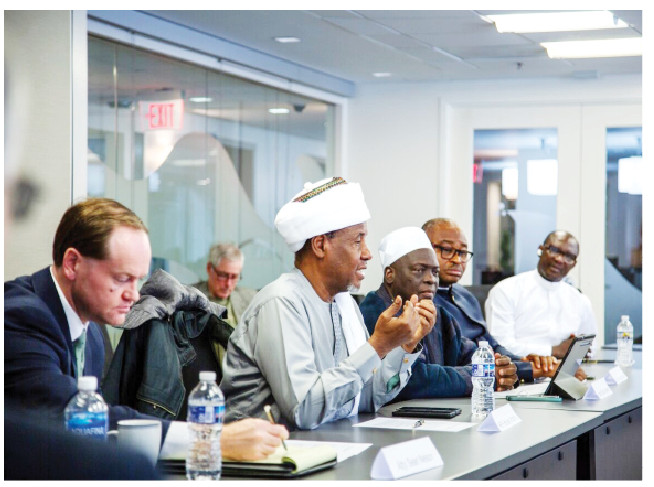
Washington welcomed us with a hush that felt almost sacred, as if the city itself recognised the gravity of a moment when six leaders—three Muslims and three Christians—stood together as a chorus against the rhetoric of division. We dined together, not as diplomats solving immediate policy disputes but as companions who recognised one another as fellow travellers toward a shared horizon: a Nigeria that can be both authentic in its faith and humane in its treatment of all citizens.
Our conversations moved between the practical and the prophetic. We spoke of the sanctity of schooling, the protection of places of worship, and the obligation to shield the innocent from the instruments of fear—the abduction of schoolchildren, the devastation of communities, and the corrosion of trust that comes when violence is normalised. We spoke, too, of women and children—anchors of resilience, the heart of families, the most vulnerable yet the most capable of extraordinary courage.
In Nigeria, communities are ruptured by violence, yet the assertion remains: we are not killing each other daily. The terrorists may kill indiscriminately, but we refuse to be defined by fear. Our presence in Washington, as a cross-faith assembly, was a counterstory: a demonstration that the security and dignity of every person—regardless of faith—must be protected, not exploited for political ends.
A clarifying note about motivation and public discourse
The peace we pursue is not a propaganda of grievance. It is a robust, compassionate insistence that all people deserve safety, education, and the freedom to worship without threat. The idea that Christian Genocide claims alone define a crisis is a narrative used by some to push an agenda; our gathering stood as a witness that the pain of Nigeria is shared among all, and its cure must be shared as well. The future of Nigeria rests not in the magnification of one form of suffering but in the real, practical protection of lives, regardless of faith.
A Movement In Steps—The Walk To The State Department
The most intimate moment of the Washington sojourn was the decision to walk to the State Department for a scheduled meeting with officials from President Trump’s office. The city’s cold was piercing, a physical reminder that courage often comes with discomfort. I have deep respect for His Eminence John Cardinal Onaiyekan. I recall the moment we walked together from our Washington hotel to the State Department. While others, younger in years, walked briskly, I kept pace behind him, aligning with his measured steps to ensure his safety and comfort in the frigid air. I even spoke lightly, saying, “Should anything happen to Your Eminence, the Holy See will hold me responsible,” and we shared a quiet, restorative laugh.
That walk was more than a logistical choice; it was the creation of a bond. The bond formed in the frost—a shared pledge to look after one another, to place the welfare of the other before our own, and to bear the burden of responsibility as a single, forward-moving unit. The younger ministers and the elders alike found in that pace a form of leadership that is patient, resilient, and humane. The pace, not the speed, proved the measure of our unity, and the laughter we shared became a lifeline in the moment of tension.
We’ve got the edge. Get real-time reports, breaking scoops, and exclusive angles delivered straight to your phone. Don’t settle for stale news. Join LEADERSHIP NEWS on WhatsApp for 24/7 updates →
Join Our WhatsApp Channel