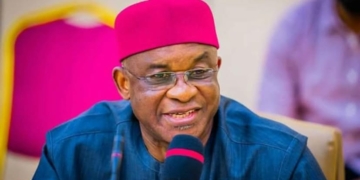
Audu Liberty Oseni, PhD
The debate around the creation of state police has recently gained renewed momentum in Nigeria. Following worsening insecurity across the country, President Bola Ahmed Tinubu has expressed openness to exploring the establishment of state police as part of broader security reforms.
In the same context, the current Inspector-General of Police, Olatunji Rilwan Disu, has reportedly inaugurated a committee within the Nigeria Police system to examine possible frameworks for state policing. At the political level, many state governors under the platform of the Nigeria Governors’ Forum have also intensified their clamour for the decentralization of policing, arguing that state police would allow quicker and more localized responses to security threats.
While these developments may appear promising, I believe the conversation must go deeper.
The real problem is not the absence of state police. The real problem is the absence of state accountability and political will.
In a country where many politicians are more interested in politics than governance, state police could easily become an instrument of political repression rather than public safety.
First, appointments and promotions in state police are likely to be driven by party loyalty rather than competence. From the leadership down to the lowest ranks, positions could become rewards for political loyalists and “political boys,” rather than professional security officers.
Second, there is a serious question of financial capacity. Many state governments have struggled to manage public resources effectively. If states are unable to fund critical public services optimally, how will they sustainably fund a professional and accountable police structure?
Third, Nigeria already faces a deep problem of impunity in security governance. Reports have suggested that large sums of money have been paid as ransom to bandits, yet there is little visible accountability. Public officials accused of serious security failures or controversies often remain in office without consequences.
Fourth, the state’s current approach to insecurity has sometimes appeared to normalize impunity through negotiations, rehabilitation, and non-kinetic responses that lack transparency and accountability. These approaches may be necessary in some contexts, but when poorly managed they risk emboldening criminal actors.
Finally, the current conduct and operational culture within some existing security structures raises a serious concern: if accountability mechanisms remain weak, multiplying police structures at the state level may simply multiply abuse.
Nigeria’s insecurity problem is not fundamentally structural. It is primarily a problem of political will, governance accountability, and institutional integrity.
Until those issues are addressed, creating state police may only decentralize the problem rather than solve it.
Audu Liberty Oseni, PhD, Director, Centre for Development Communication, writes via [email protected]
We’ve got the edge. Get real-time reports, breaking scoops, and exclusive angles delivered straight to your phone. Don’t settle for stale news. Join LEADERSHIP NEWS on WhatsApp for 24/7 updates →
Join Our WhatsApp Channel