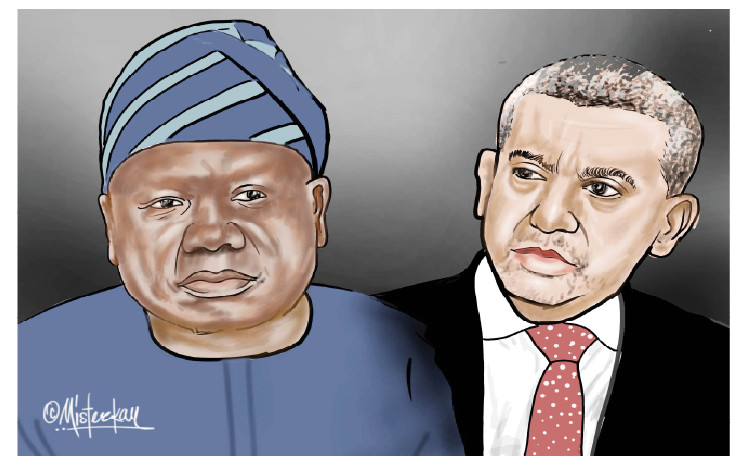
Friday, 6 March 2026, was supposed to be another routine media outing for Daniel Bwala, Special Adviser to President Bola Ahmed Tinubu on Policy Communication, a chance to present government policies and reassure audiences. One can imagine him walking into the Head to Head studio on Al Jazeera with the quiet confidence of someone accustomed to Nigerian domestic media, where interviews often resemble friendly conversations rather than empirical examinations. In Lagos studios, it is common to encounter hosts like Rufai Oseni of Arise TV or Seun of Channels TV, who, despite their professionalism, rarely cross-reference archived statements from five years ago. In such environments, a spokesman can glide through narratives like a skater on a frozen lake, confident that cracks in memory will go unnoticed.
On Al Jazeera, however, the rules are different. Mehdi Hasan is neither a passive interviewer nor a casual conversationalist. He approaches every session with preparation akin to a historian examining manuscripts for inconsistencies. In his presence, words spoken in the past are never lost; they wait patiently like an old creditor demanding repayment. For Bwala, whose training may have emphasized eloquence over archival diligence, this was the first lesson in the limits of improvisation. Expectation met reality, and reality was unforgiving.
Dancing With Historical Memory
The interview quickly became a delicate, sometimes uncomfortable, but fascinating dance between rhetoric and recorded history. Hasan began by reminding the audience that Bwala had spent the 2023 election season criticising Bola Tinubu, describing his political network as problematic, opaque, and potentially harmful to democratic norms. Then came the question every political spokesperson fears: how does a man who once levelled such criticisms now serve as the President’s adviser?
Bwala’s first steps into this dance were cautious yet familiar: “Context matters,” he replied, invoking a phrase that would become the mantra of the evening. Context, in theory, allows a communicator to explain that political statements made in campaign fervor differ from reflections made in office. It is a reasonable concept but, when juxtaposed against video clips showing the exact words in their original, uncompromising form, the defense begins to wobble. Each clip was like a mirror forcing him to confront his own voice.
The struggle of Bwala and others like him is not unusual. Political communicators are trained to pivot, to redirect the conversation toward policy achievements or national priorities. In domestic studios, these maneuvers are often effective, and repetition of phrases such as “I am not aware” or “context matters” may suffice. On a platform like Al Jazeera, however, each pivot is met with precise archival evidence. The metaphorical dance floor is slippery, and the steps require both agility and historical awareness.
Words Against Evidence
By the middle of the programme, the pattern had become clear. Hasan would present a past statement. Bwala would respond with one of his two go-to phrases. Evidence would return. The phrases were repeated with the solemnity of a ritual: “Context matters” and “I am not aware.” They became the musical refrain of a performance that was equal parts comedy and tragedy. Watching a spokesman attempt to reconcile years of recorded criticism with present advocacy resembles a tightrope act in a storm, with gusts of memory and public scrutiny tugging at every word.
Here, one cannot help but feel subtle empathy. Bwala is not a liar; he is a product of a system where selective memory is a survival skill and improvisation is a necessity. Yet the weight of evidence is unyielding. Even a seasoned practitioner cannot charm history away. Every statement, every clip, every contradiction is a stone placed on the scales, and no amount of rhetorical juggling can tip it in favor of abstraction alone.
A trained policy communicator or PR professional would have approached such a scenario differently. Preparation would include reviewing past statements, anticipating difficult questions, and formulating responses that do not rely solely on evasive repetition. Analogies might still be used to clarify policy, but historical facts would be acknowledged openly. “Context matters” would become a tool for explanation, not a shield behind which contradictions hide. In short, empathy and skill are not enough; strategy, research, and foresight are essential.
The Anatomy of Buwalad
To be “buwalad” is to be caught in a moment where preparation, memory, and improvisation collide disastrously. It is not merely embarrassment; it is the public, empirical demonstration of the limits of untested rhetoric. In Bwala’s case, the consequences were amplified by Hasan’s methodical approach, the studio’s global audience, and the permanence of digital archives.
Yet there is also humor and humanity in the spectacle. Imagine a juggler suddenly presented with knives instead of balls, or a tightrope walker realizing the rope has been replaced with a line of barbed wire. Bwala’s habitual phrases, his well-rehearsed abstractions, were suddenly insufficient defences. Yet one cannot fully mock the effort. The man was performing under conditions for which he was trained neither completely nor recently. Many Nigerian political communicators find themselves in similar situations, navigating domestic media with charm, rhetoric, and selective memory, only to face a platform that requires historical precision.
Empathy for Bwala is not about excusing the performance; it is about understanding the structural pressures on communicators in Nigeria. They are expected to be both defenders of the present and historians of the past, a task that often exceeds the training provided.
Lessons for Communicators Everywhere
The key lesson is that skill, preparation, and honesty are inseparable in modern political communication. A trained policy communicator would approach a global interview not as a rhetorical exercise but as an empirical examination. Preparation includes studying one’s own archives, anticipating tough questions, and crafting responses that integrate past statements with present positions. Abstraction, charm, and repetition may enhance delivery, but they cannot substitute for accountability.
Bwala’s experience serves as both satire and guidebook. It is humorous because it reflects the disconnect between expectation and reality, between domestic media norms and international standards. It is instructive because it shows that even experienced communicators can falter when evidence is laid bare and logic is applied rigorously. For aspiring spokespersons, it is a reminder that words are permanent, memory is selective but public, and skillful preparation is indispensable.
In the end, Friday, 6 March 2026, was more than an interview; it was a lesson in the art and science of communication. It was the day when Bwala, like many before him, was caught between improvisation and evidence, charm and logic, history and rhetoric. And while the term “buwalad” carries amusement, it also carries truth: the intersection of accountability, preparation, and public scrutiny is unforgiving.
Those who wish to avoid such moments must embrace transparency, study their own history, and employ both skill and strategy in equal measure. They must understand that a policy communicator is not merely a speaker but a historian of one’s own narrative, a choreographer of rhetoric whose dance must acknowledge the weight of recorded steps. In this light, empathy for Bwala is natural; satire is inevitable; and lessons are profound.
This is how one avoids being buwalad, how preparation meets opportunity, and how the modern communicator learns that in the global media arena, charm alone is never enough.
We’ve got the edge. Get real-time reports, breaking scoops, and exclusive angles delivered straight to your phone. Don’t settle for stale news. Join LEADERSHIP NEWS on WhatsApp for 24/7 updates →
Join Our WhatsApp Channel