Newly inaugurated national president of the Federal Polytechnic Ado-Ekiti Alumni Association (FEDPAAA), Engr. Badru Abdul Rafiu, has raised concerns over the drastic decline in student enrolment in polytechnics across Nigeria.
He claimed that only a fraction of UTME candidates now consider technical education. Rafiu therefore demanded for degree-awarding status for the polytechnics to attract more students.
Speaking to journalists during the association’s maiden National Executive Retreat in Abuja, Rafiu painted a grim picture of the current state of polytechnic education in the country.
“We have noticed for some time that not just our own institution alone, but generally all over the federation, admission into polytechnics has dropped.
“If you check the percentage of students who wrote JAMB that will choose polytechnics or colleges of education, they range between 20 to 25 percent of the total.
This tells a whole lot of story,” he said.
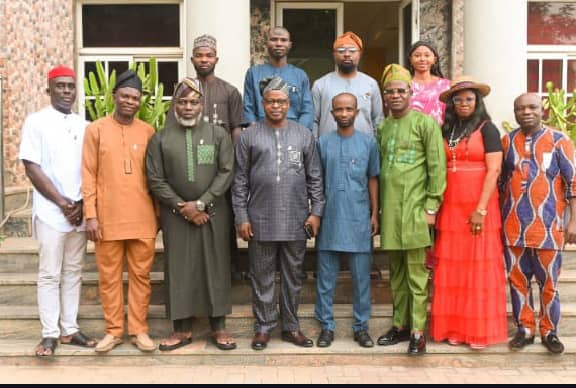
The retreat, which marked the first official function of the new administration following their election on February 21, 2026, in Asaba, brought together national officers to strategise for the next four years.
To reverse the troubling trend, the alumni leader is proposing a radical policy shift, allowing polytechnics to award degrees while retaining their core identity.
“We want to retain the identity of a polytechnic. We don’t want to turn polytechnics to universities, but we want polytechnics today to start awarding degrees. We need to continue to bear the name ‘polytechnic’.
“We have several examples outside Nigeria. You have polytechnics in the UK, you have polytechnics in Russia. That is what is important,” he said.
The alumni president believes this approach makes economic sense, particularly given the government’s recent decision to halt the establishment of new federal universities.
“The federal government put on hold some plans to establish new federal universities across Nigeria. If you have 800 students, you have 1,200 staff. This tells you that it is no longer about access to education,” he said.
He questioned the logic behind creating new institutions from scratch, saying, “If you are talking about access to education, what happens to existing polytechnics?
“They have structures; they have everything. So why don’t you allow them to start awarding degrees instead of creating new universities where you will need to spend a lot of money building infrastructure?”
Rafiu expressed confidence that granting degree-awarding status would transform the fortunes of polytechnics overnight.
“If the government heeds our request and selects programs in polytechnics to start awarding degrees, you will witness a very increased number of enrollment in these institutions.
“We want to start engaging government with a few, and as time goes on, it will explode and cover all polytechnics, both federal and state. If it is successful, it will also be extended to privately-funded polytechnics,” he said.
He expressed optimism regarding the current Minister of Education, Dr Maruf Tunji Alausa, whom he described as ‘very, very keen’ on addressing the challenges facing technical education.
When asked about the obstacles hindering the implementation of this policy, Rafiu attributed resistance to what he called ‘elitist bias.’
“The major inertia to this is the fear of the unknown. They are those who have not attended polytechnics that have that air of superiority over polytechnic graduates. But let me tell you, I am a product of a polytechnic.
“I trained as a Mining Engineer, and today in my own organization, Mitch’s Energy Group, I am the Director of Mining Services. It cannot get better than that. This is just to tell you that people who graduate from universities do not have a different set of brains than those who graduate from polytechnics. They have been equally equipped. It just depends on how you have successfully utilised yours,” he said.
To bridge the professional divide, Rafiu urged government intervention, saying that if the government wants to bridge the dichotomy, they must start engaging people that graduate from polytechnics, and it will be seamless.
The national president explained that the leadership retreat was designed to ensure effective execution of programmes over their four-year tenure.
“We need to come together as members of the National Executive Committee for a retreat. That is why we have chosen this location,” he said.
The retreat’s theme, “Consolidating on the Past and Engineering the Future,” reflects the administration’s respect for its predecessors while charting a new course.
“We recognise the people that came before us. We want to build a very prosperous association, and we acknowledge the elevation they have provided for us to be here today. Alumni associations all over the world are built around two focal points.
“One is giving back to the institution that produced all of us. The second, which is equally as important, is catering to the welfare of members. That is what we are all about. During the four-year time, we will be introducing projects upon projects in the school. We are also looking at innovative ways of assisting and helping our members,” he said.
Delivering a lecture on infrastructure development with a focus on financial management, Pastor Philip Irabor, Managing Partner at Phillips Ojie Irabor and Co., emphasised that accountability remains crucial for successful associations.
“We discussed that managing finances with prudence and accountability makes project execution successful in any association or organisation. To sustain mobilizing resources, the key element is carrying the people along through accountability, which involves regular reporting and showing landmark improvement and achievement.
“This platform develops leaders that will take the stage at the national level. If you know how to account for what you are given at this level, when it comes to the national level, you will be able to account for it. Your goal should be to make impact and affect the lives of others positively,” he said.
Addressing national financial reforms, Irabor urged the government to consider waiving penalties for late tax filing to expand the tax net and boost revenue.
“The objective of the tax reform is to expand the tax net, and the government has introduced incentives for voluntary compliance. Low-income earners have had their tax liability reduced.
“Many people, especially small companies, are finding it difficult to voluntarily file tax returns because of the accumulated penalties involved. If you are to render your tax returns for the past five or ten years, the penalty that will be generated becomes a discouragement.
“That is where we are pushing a narrative to the government to waive that penalty for now. It happened before during the Buhari administration with VAT, where an incentive for voluntary VAT filing brought many companies forward.
“If that is done now, many companies will come up for filing because currently, many are taking the option of incorporating new companies and abandoning the old ones due to tax liabilities and penalties for late filing,” he said.
We’ve got the edge. Get real-time reports, breaking scoops, and exclusive angles delivered straight to your phone. Don’t settle for stale news. Join LEADERSHIP NEWS on WhatsApp for 24/7 updates →
Join Our WhatsApp Channel