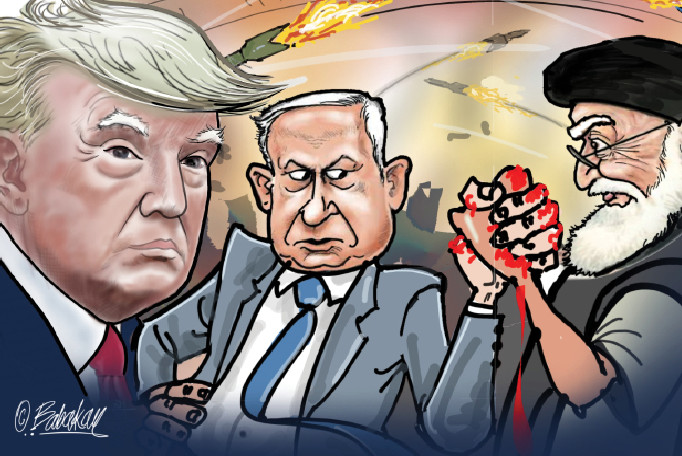
There is a peculiar advantage that distance grants to historians. Time removes the noise. It dissolves the passions that dominate contemporary debates and leaves behind something quieter but far more valuable: patterns. Fifty years from now, when historians examine the ongoing war between the United States/Israel and Iran, they will not read the conflict through the language that saturates present commentary. They will not be guided by political rhetoric, ideological loyalties, or the fevered urgency of television studios. Instead, they will ask a different question altogether. What does this war reveal about the enduring logic of power?
The answer will not begin in Washington, Tehran, or Jerusalem. It will begin much earlier. It will begin in the long gallery of strategic history where rulers, generals, and statesmen repeatedly confronted the same dilemma. How far can power travel before it begins to weaken itself?
Future historians will recognize that the events of today belong to a very old story.
Crossing Dangerous Straits
The story may begin in 480 BC, with the Persian king Xerxes standing before the narrow waters of the Hellespont. Determined to punish the defiant Greek city states, Xerxes assembled one of the largest armies the ancient world had ever seen. Engineers constructed floating bridges across the strait so that Persian troops could march from Asia into Europe. The crossing itself was an extraordinary spectacle of imperial ambition. It was also a moment rich with symbolism. A ruler who could command nature itself surely commanded destiny.
Yet the campaign that followed told a different story. Persian armies marched deep into Greece. Cities burned. Territory was seized. Still, the strategic outcome slipped from Persian control. At Salamis, Greek naval forces exploited narrow waters to destroy much of the Persian fleet. Geography, coordination, and local determination overcame numerical superiority. Xerxes returned to Asia with the sobering realization that power does not always translate into strategic success.
Historians examining today’s war may find the analogy compelling. Great powers often possess overwhelming capabilities. Yet capabilities alone rarely decide conflicts that unfold across complex terrain, resilient societies, and volatile political environments.
Rivalry Among Powers
Another ancient parallel will likely attract the attention of future scholars. The rivalry between Athens and Sparta in the fifth century BC revealed a different strategic pathology. Both states were powerful. Both believed their political systems were superior. Both feared the growing influence of the other.
The Peloponnesian War that followed became one of the most destructive conflicts of the ancient world. Athens possessed wealth, naval supremacy, and a sprawling maritime empire. Sparta commanded unmatched discipline on land and a network of allies across the Peloponnese. At first, the strategic balance appeared stable. Over time, however, ambition intervened.
In 415 BC, Athens launched the Sicilian Expedition. The campaign sought to expand Athenian influence into the western Mediterranean. It also reflected a deeper psychological impulse. Success had bred confidence; confidence had bred risk. The expedition ended in catastrophe. Athenian fleets were destroyed, armies captured, and the city’s strategic position permanently weakened.
Future historians may see in this episode a familiar dynamic. Powerful states sometimes escalate conflicts not because necessity demands it, but because opportunity appears irresistible.
Empire And Prudence
Roman history provides a striking counterpoint. When Julius Caesar was assassinated in 44 BC, the Roman Republic entered a period of chaos. Rival generals-controlled legions. Political factions maneuvered for survival. Civil war seemed inevitable.
Octavian, later known as Augustus Caesar, navigated this crisis with unusual restraint. Instead of pursuing endless expansion, he concentrated on stabilizing Rome’s political order. Augustus consolidated power gradually, restored administrative stability, and established frontiers that could be defended without exhausting imperial resources.
This choice was not accidental. It reflected a sophisticated understanding of strategic equilibrium. Empires endure not because they expand indefinitely, but because they learn when expansion must give way to consolidation.
Historians reflecting on today’s war will likely ask whether contemporary leaders displayed a similar awareness. Did they carefully weigh the long-term implications of military action? Did they understand how regional conflicts interact with broader global commitments?
Storms And Armadas
Strategic overconfidence appears again in the late sixteenth century. Spain under Philip II commanded extraordinary wealth and military power. Silver from the Americas financed vast armies. Spanish influence stretched across continents.
Confident in this supremacy, Philip launched the Armada in 1588 with the intention of overthrowing Queen Elizabeth I and reasserting Catholic dominance in England. The operation was ambitious. It was also deeply flawed.
English naval tactics disrupted the Spanish formation. Logistical problems multiplied. Then the weather intervened. Violent storms scattered the fleet as it attempted to retreat northward around the British Isles. The Armada’s defeat did not destroy Spain immediately. Yet it marked a psychological turning point. Europe began to recognize that even the most formidable empire could stumble.
Historians fifty years from now may note how perceptions shift during prolonged conflicts. Military setbacks often carry symbolic consequences that extend far beyond the battlefield. Alliances evolve. Rivals grow bolder. Strategic landscapes slowly transform.
Winter And Resistance
Napoleon Bonaparte confronted similar realities two centuries later. His early campaigns demonstrated operational brilliance. At Austerlitz and Jena, French armies shattered opposing coalitions with astonishing speed.
Yet Napoleon’s later ventures revealed the limits of military genius. In Spain, French forces encountered relentless guerrilla resistance that gradually drained imperial strength. In Russia, the Grand Army advanced triumphantly to Moscow only to discover that geography and climate could defeat even the most powerful army in Europe. The retreat from Russia destroyed the aura of invincibility that had sustained Napoleon’s empire.
Historians recognize this pattern well. Tactical victories do not always produce strategic success. Rather, wars become prolonged, costs accumulate, political objectives drift further from achievable outcomes.
Lessons Of Strategy
When scholars in the year 2075 study the U.S. and Iran conflict, they will probably interpret it within this long historical continuum. The United States entered the confrontation with immense technological advantages. Precision weapons, intelligence networks, and global logistics created unprecedented operational capabilities.
Iran approached the contest differently. It relied on asymmetric strategies that have appeared throughout history. Proxy networks, regional influence, ideological resilience, and the willingness to endure prolonged pressure formed the core of its strategic posture.
Such asymmetry rarely produces decisive conclusions. Instead, it creates conflicts that stretch across multiple domains. Military engagements blend with economic pressure, information campaigns, and political maneuvering.
Future historians will therefore focus less on individual battles and more on strategic interaction. They will analyse how each side attempted to exploit the other’s vulnerabilities. They will examine how regional dynamics influenced decision making. They will ask whether policymakers accurately assessed the balance between ambition and capacity.
Above all, historians will return to the oldest questions of strategy. Xerxes believed that bridges across the Hellespont would secure his campaign. Athens believed its naval empire guaranteed success. Philip II believed imperial wealth ensured victory. Napoleon believed operational brilliance could overcome geography.
And when that work is done, historians will likely arrive at a conclusion that echoes across centuries. Power is never limitless. Ambition must always negotiate with reality. Statesmen who understand this tension shape durable strategies. Those who ignore it often discover that history is a far more patient adversary than any army they face.
We’ve got the edge. Get real-time reports, breaking scoops, and exclusive angles delivered straight to your phone. Don’t settle for stale news. Join LEADERSHIP NEWS on WhatsApp for 24/7 updates →
Join Our WhatsApp Channel