
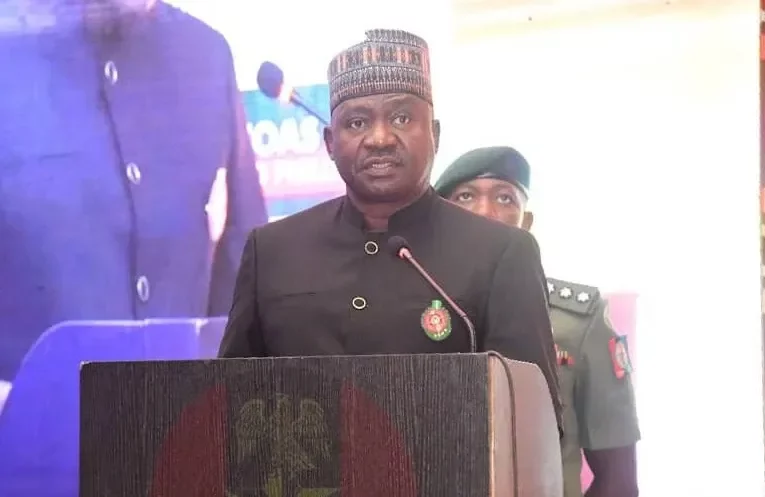
Minister of Defence, Gen. Christopher Musa, has hinted at the federal government’s plans to establish civilian demining teams to curb threats posed by explosive devices and mines in communities.
The teams will comprise retired military personnel, other security veterans and civilians, including youths and medical professionals,
He made the disclosure yesterday at the National Mine Action Stakeholders Workshop in Abuja.
Musa said the workshop provided a platform for the stakeholders to collectively develop a comprehensive draft mine action bill and national implementation measures for the Ottawa Convention on the Prohibition of Antipersonnel Mines.
Musa, who was represented by the permanent secretary of the Ministry of Defence, Mr Richard Pheelangwah, said the threat posed by antipersonnel mines and improvised explosive devices remains a serious humanitarian and security concern.
He explained that, when fully operational, the model will provide a practical setting for knowledge transfer.
The minister said, “A retired combat engineer working alongside a young civilian trainee can pass on critical field experience, ensuring sustainability of expertise. At the same time, the inclusion of civilians fosters trust within affected communities, encouraging the team to come forward for assistance and recruitment.”
Gen. Musa said countries that have successfully cleared mine territories have combined community engagement with advanced protection technologies, “an approach we must adapt to our local context.”
He also advocated for mine-clearance education, adding that a simple awareness campaign in the village can make the difference between life and death.
The minister said, “When communities understand the risks and know how to respond, this step can be drastically improved. Ultimately, our collective effort must restore hope and normalcy.
“We must envision a Nigeria where children can walk to school without fear, where farmers can safely return to their land, and where communities can rebuild without the legal threat of explosive remnants of war,” he said.
Musa noted that in recent years, non-state actors, particularly in insurgency-affected areas, had deployed improvised mines that continue to endanger lives even after active hostilities have subsided.
“In several communities in the northeast, farmland that once sustained families is now abandoned because it is suspected to be contaminated,” he said.
He lamented that the farmer who simply wishes to cultivate his land ends up triggering an explosive device.
“Similarly, children walking to school or playing in open fields unknowingly face life-threatening danger like the video we saw. These are non-distant possibilities. They are real. Every day risk is paid by our citizens,” Musa stated.
In his goodwill message, the United Nations Mine Action Service (UNMAS) representative, Mr Edwin Faigmane, reiterated the UN’s commitment to supporting Nigeria in achieving Article 5 of the Anti-Personnel Mine Ban Convention.
He said the UN, the British and the Japanese governments have been training Nigeria’s police, security and civil defence corps to conduct search and destroy operations of IEDs.
A representative of ECOWAS, Mr Abayomi Adeomi, said the workshop reflected a strong national commitment to addressing one of the region’s most pressing humanitarian and security challenges.
We’ve got the edge. Get real-time reports, breaking scoops, and exclusive angles delivered straight to your phone. Don’t settle for stale news. Join LEADERSHIP NEWS on WhatsApp for 24/7 updates →
Join Our WhatsApp Channel