by Isaac Uzaan
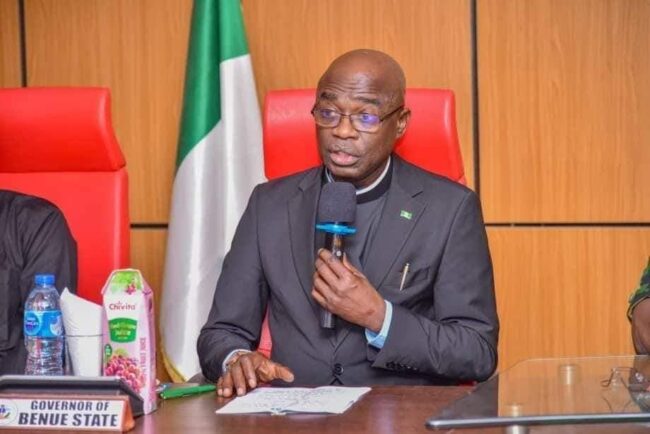
In an era where distance no longer limits participation, Governor Hyacinth Iormem Alia sat before a digital audience that stretched far beyond Nigeria’s borders—Benue sons and daughters scattered across continents, yet deeply connected to home.
The occasion was the second virtual town hall engagement with the diaspora community, an initiative of the Benue State Directorate for Diaspora Linkages and Investments led by its Director General, Professor Abraham T. Girgir.
What unfolded was more than a policy briefing—it was a conversation anchored on trust, reassurance, and a shared vision for a better Benue.
From the outset, Governor Alia struck a tone of inclusiveness, directly addressing concerns that have echoed in political circles, particularly claims of marginalization in parts of the state. Calm but firm, he dismissed the notion, emphasizing that development under his administration is being distributed fairly across the three senatorial districts.
“Governance,” he noted in essence, “will always attract differing opinions,” especially as the political atmosphere gradually builds toward the 2027 elections. Yet beyond the noise, he framed his administration’s journey as one of rebuilding—an effort to fix deep-rooted structural challenges inherited at the start of his tenure.
For many in the diaspora, the Governor’s reflections offered a sobering reminder of the realities on ground when he assumed office: industries that had long gone silent, a fragile healthcare system, and a primary education sector weighed down by inefficiencies, including ghost workers. His message was clear—progress may not always be immediate, but it is deliberate.
Perhaps the most emotionally resonant part of the engagement came during discussions on security the Sankera axis, once a flashpoint of violence, featured prominently. Governor Alia acknowledged the pain of past and recent incidents but balanced it with cautious optimism. From a time when as many as 17 local government areas were under severe threat, the situation, he explained, has improved significantly, with only a few areas still facing challenges.
Behind the statistics are human stories—families displaced, communities disrupted. The Governor revealed that over 600 persons had been forced into internally displaced persons camps at the peak of the crisis. Yet, in a hopeful turn, many have begun returning to their ancestral homes. Support from the Federal Government and figures such as Oluremi Tinubu, alongside other partners, has helped ease the burden, with over ₦1.2 billion mobilized for relief efforts.
Beyond security, the conversation shifted to opportunity—how Benue can harness its strengths and retain its wealth. The revival of Taraku Mills emerged as a symbolic and practical step in that direction. For a state renowned for its agricultural output, particularly soybeans, restoring such industries signals a move toward self-sufficiency and economic resilience.
The Governor also painted a picture of an evolving industrial landscape, with new factories producing juice, bread, water, and beer—initiatives designed not just to create jobs but to stem the tide of capital flight. For diaspora participants, many of whom have the capacity to invest, this was an open invitation to become part of the state’s economic rebirth.
Infrastructure and social services formed another key pillar of the discussion. Road networks are being expanded and rehabilitated, including over 34.5 kilometers within Makurdi, while underpasses in Makurdi and Gboko stand as visible markers of progress.
In education, a notable 22.62 percent of the state’s budget has been committed to revitalization efforts, particularly at the primary level. Healthcare, too, is undergoing gradual repositioning after years of neglect.
Then came a forward-looking promise—housing. Plans to acquire a Federal Housing Estate and develop a “Renewed Hope Estate” in Makurdi are aimed at providing affordable options for civil servants while also attracting diaspora investors eager to reconnect with home in tangible ways.
– Isaac Uzaan is Principal Special Assistant (PSA) to the Governor on Media and Content Creation and he writes from Makurdi.
We’ve got the edge. Get real-time reports, breaking scoops, and exclusive angles delivered straight to your phone. Don’t settle for stale news. Join LEADERSHIP NEWS on WhatsApp for 24/7 updates →
Join Our WhatsApp Channel