| Okays $6bn Tinubu’s loan request
BY SAMSON ELIJAH AND JAMES KWEN
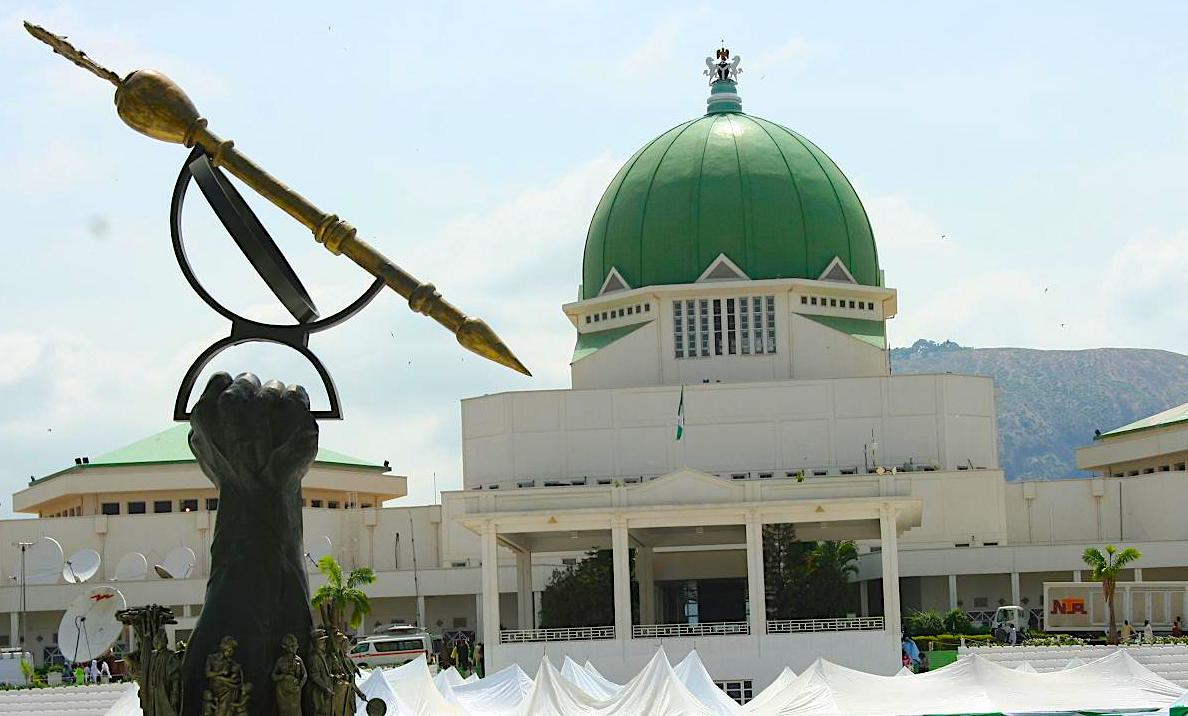
The National Assembly has significantly increased Nigeria’s 2026 budget to N68.30 trillion, passing the Appropriation Bill after approving a fresh $6 billion loan request for President Bola Tinubu’s administration.
The National Assembly on Tuesday passed a sharply increased 2026 Appropriation Bill of N68.30 trillion, up from President Bola Tinubu’s initial N58.47 trillion proposal, while simultaneously approving his request for $6 billion in fresh external loans to bridge fiscal gaps and fund key infrastructure.
The twin approvals were achieved through coordinated efforts in both the Senate and House of Representatives, underscore the legislature’s push to bolster the “Budget of Consolidation, Renewed Resilience and Shared Prosperity.”
Senate President Godswill Akpabio hailed the process as a model of collaboration, noting that no conference committee was needed.
He commended the Senate Appropriations Committee led by Senator Solomon Olamilekan (APC, Ogun West) for its diligence.
The approved budget breakdown is as follows: N4.7–4.79 trillion for statutory transfers (with top allocations to INEC at N1.01 trillion, Niger Delta Development Commission at N618.12 billion, and National Judicial Council at N610.17 billion); N15.8 trillion for debt servicing; N15–15.42 trillion for recurrent non-debt expenditure (led by Defence at N2.69 trillion, Education at N1.38 trillion, and Police Affairs at N1.27 trillion); and N32–32.26 trillion for capital expenditure (topped by Agriculture and Food Security at N3.25 trillion, Works at N3.17 trillion, and Innovation, Science and Technology at N1.83 trillion).
Adjustments incorporated N5.71 trillion in legacy capital obligations from 2025 and N2 trillion for priority projects, reflecting Tinubu’s requests.
Lawmakers also extended the 2025 capital budget implementation to June 30, 2026, to address release delays and ensure continuity.
In lockstep, both chambers greenlit the $6 billion loans following reports from their Local and Foreign Debts Committees, including Senator Aliyu Wamakko (APC, Sokoto North) in the Senate. The package includes a $5 billion facility from Abu Dhabi Bank’s First Abu Dhabi Bank for budget deficit financing and debt obligations, plus $1.0009 billion from UK Export Finance via Citibank London for rehabilitating Lagos Port Complex and Tin Can Island Port.
Tinubu, in letters read at plenary, emphasized the port project’s role in fixing operational inefficiencies, boosting safety, diversifying non-oil trade, and positioning Nigeria as a regional hub—echoing recent approvals like N1.15 trillion in domestic borrowing for 2025.
The Senate approved N68.3 trillion Appropriation Bill for the 2026 fiscal year.
The approval followed the presentation and consideration of the report of the Senate Committee on Appropriations in the Committee of Supply during Tuesday’s plenary.
The report was presented by the Chairman of the Committee, Senator Solomon Olamilekan (Ogun West).
Olamilekan recalled that President Bola Ahmed Tinubu had, on December 19, 2025, presented the 2026 Appropriation Bill before a joint sitting of the National Assembly.
He said the budget, with the theme, “Budget of Consolidation, Renewed Resilience and Shared Prosperity,” reflects the executive’s determination to sustain macroeconomic stability.
According to him, the committee recommended the approval of a total expenditure of N68.3 trillion, comprising: “N4.7 trillion for statutory transfers, N15.8 trillion for debt servicing, N15 trillion for recurrent (non-debt) expenditure, N32 trillion for capital expenditure through the Development Fund.”
Olamilekan stressed the need to address bureaucratic bottlenecks that led to delays in fund releases during the 2025 fiscal year, noting that such challenges must be tackled to achieve the 2026 budget objective of “From Budget to Impact.”
He called for closer collaboration between the legislature and the executive to ensure full and effective implementation of the budget.
He also reiterated the recommendation to extend the implementation of the 2025 Appropriation Act to June 30, 2026.
The lawmaker noted that the capital component underscores the administration’s strong focus on infrastructure development, while the significant allocation to debt servicing reflects ongoing fiscal pressures.
He added that the approved budget includes adjustments requested by President Tinubu, such as the incorporation of N5.71 trillion in legacy capital obligations from the 2025 fiscal cycle and N2 trillion for priority projects across key sectors.
In his remarks, Senate President Godswill Akpabio commended the Appropriations Committee, led by Olamilekan, for its diligence and commitment in processing the bill.
“Your dedication and sacrifice over several months have not gone unnoticed, and you have truly served the nation well,” Akpabio said.
He expressed optimism that the approved budget, alongside expected revenue gains from tax reforms and previously approved loans, would be realistic and impactful.
Akpabio also noted that the collaborative efforts of both chambers of the National Assembly ensured the smooth passage of the bill without the need for a conference committee.
He added that the Senate expects the implementation of the budget to drive growth, strengthen economic stability, and deliver tangible benefits to Nigerians.
The Senate also approved President Bola Tinubu’s request to secure fresh external loans totalling $6 billion aimed at plugging fiscal gaps and financing key infrastructure projects.
The approval followed the presentation and consideration of a report by the chairman of the Senate Committee on Local and Foreign Debts, Senator Aliyu Wamakko (APC, Sokoto North).
The decision came just hours after the President formally wrote to the Senate seeking legislative backing for the facility, underscoring the Executive’s push to secure funding for priority sectors.
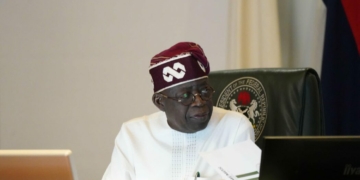
In a letter addressed to the President of the Senate, Godswill Akpabio, and read during plenary, Tinubu sought approval to borrow $5 billion from Abu Dhabi Bank to support budget deficit financing and meet existing debt obligations.
In a separate communication, the President also requested approval to obtain a $1 billion loan facility from UK Export Finance through Citibank in London to fund the rehabilitation of critical port infrastructure.
Tinubu noted that the projects—covering the Lagos Port Complex and Tin Can Island Port—are designed to tackle longstanding operational challenges and reposition Nigeria’s maritime sector.
According to the President, the projects aim to address critical deficiencies, improve efficiency, enhance safety standards, support non-oil trade diversification, and position Nigeria as a trade hub.
Following the reading of the requests, Akpabio referred both letters to the Senate Committee on Local and Foreign Debts, directing the panel to expedite consideration and report back promptly—a directive that culminated in Tuesday’s approval.
The latest borrowing request comes amid the Federal Government’s continued reliance on a mix of domestic and external loans to finance budget deficits and critical infrastructure.
Just four months ago, the National Assembly approved Tinubu’s request to raise N1.15trn from the domestic debt market to fund the 2025 budget deficit, effectively completing the government’s financing plan for the year.
Both chambers endorsed the borrowing after considering reports from their respective committees on local and foreign debts.
At the Senate, the approval followed the adoption of a report presented by Wamakko’s committee, which highlighted key provisions of the 2025 Appropriation Act.
The panel noted that the 2025 budget provided for a total expenditure of N59.99tn—an increase of N5.25trn from the initial N54.74trn proposed by the Executive—highlighting the widening fiscal gap and the government’s reliance on borrowing to bridge the deficit.
Meanwhile, in the House of Representatives has also passed the 2026 budget of N68.30 trillion, jerking it up from the N58.18 trillion proposal requested by President Bola Tinubu.
This followed the consideration and approval of the report of the House Committee on Appropriations at plenary on Tuesday.
Out of the total sum, N4.79 trillion is for statutory transfers, N15.80 trillion is for debt service, N15.42trillion, is for recurrent (Non-Debt) expenditure while N32.26 trillion is for capital expenditure.
LEADERSHIP reports that President Tinubu had in December laid before a joint session of National Assembly the N58.18 trillion budget for the 2026 financial year.
Under the statutory transfers, the Independent National Electoral Commission got the highest allocation of N1.01 trillion, followed by Niger Delta Development Commission with N618.12 billion; National Judicial Council – N610.17 billion; National Assembly -N577.85 billion; Universal Basic Education Commission – N490.28 billion and Basic Healthcare Provision Fund -N245.14 billion
Also, under statutory transfers, National Agency for Science and Engineering Infrastructure is allocated N245.14 billion; North East Development Commission -N244,06 and North West Development Commission -N145.60 billion while North Central, South West, South South and South East Development Commissions got got N140 billion each.
In the Recurrent (Non-Debt) Expenditure, ministry of defence got the highest share of N2.69 trillion; followed by ministry of education with N1.38 trillion; ministry of police affairs – N1.27 trillion; ministry of health & social welfare – N1.01 trillion ministry of interior – N662.74 billion; ministry of youth – N498.06 billion; office of the National Security Adviser – N377. 215 billion; ministry of foreign affairs -N287,90 billion and Secretary to Government of the Federation -N185.49.
For the capital expenditure, the federal ministry of agriculture and food security topped with N3.25 trillion, followed by the federal ministry of works – N 3.17 trillion; ministry of innovation, science and technology – N 1.83 trillion; ministry of health & social welfare – N 1.22 trillion; ministry education – N655.82; billion; ministry of labour and employment – N643.36 and ministry of finance – N625.29.
House extends 2025 budget implementation to June
Meanwhile, the House extended the Implementation of the capital aspect of the Appropriation Act 2025 from March 31, 2026 to 30 June 2026.
This was sequel to the consideration and approval of the report on: “A Bill for an Act to Amend the Appropriation Act (Repeal and Enactment) to extend the implementation of
the Capital aspect of the Appropriation Act, 2025 from 31 March, 2026 to 30 June 2026 and for Related Matters (HB.2743).”
The House had earlier at plenary passed for second reading the Bill for an Act to Amend the Appropriation Act (Repeal and Enactment) to extend the implementation of
the Capital aspect of the Appropriation Act, 2025 from 31 March, 2026 to 30 June 2026, sponsored by Majority Leader Hon. Julius Ihonvbere (APC, Edo).
Similarly, the House approved the request of President Tinubu to establish a structured total return swap external financing programme of $5 billion with First Abu Dhabi Bank to Support federal government funding and fiscal liquidity management.
It equally gave nod to the president’s request for $1,000,945,693.55 United Kingdom (Uk) Export
Finance (UKEF) covered Loan Facility Arranged by Citibank, for the Rehabilitation of Ports Project (Lagos Port Complex and Tin-Can Island Port Complex), Nigeria.
President Tinubu had written to the National Assembly, seeking lawmakers approval to borrow a total sum of $6 billion to support Nigeria’s fiscal and infrastructure needs.
In a letter addressed to the presiding officers of the legislature, the president requested approval for a $5 billion loan facility from Abu Dhabi Bank.
The funds are intended to cover the budget deficit and support debt financing, among other obligations.
In another letter, Tinubu also sought lawmakers approval to secure a $1 billion loan facility from London Citi Bank under a UK Export Finance (UKEF) arrangement
The loan is designated for the rehabilitation of key port infrastructure, including the Lagos Port Complex and Tin Can Island Port.
According to the President, the port rehabilitation project aims to address critical infrastructure deficiencies, improve operational efficiency, enhance safety standards, and support Nigeria’s non-oil trade diversification.
We’ve got the edge. Get real-time reports, breaking scoops, and exclusive angles delivered straight to your phone. Don’t settle for stale news. Join LEADERSHIP NEWS on WhatsApp for 24/7 updates →
Join Our WhatsApp Channel