
By Chidi Chukwu
Zenith’s Reset Shows Cost of Integrity
When Zenith Bank reported a 23% drop in earnings per share and a 29% decline in return on equity for 2025, some saw weakness. The reality demands a different lens: these are the deliberate costs of integrity; the price paid for cleaning up regulatory forbearance-linked exposures.
Where short-term optics too often override long-term health, Zenith’s reset is not a stumble; it is a standard. Africa’s banking sector urgently needs more institutions willing to pay that price.
When Discipline Becomes a Banking Blueprint
Numbers tell stories, but only if you know how to read them. Zenith Bank’s full-year 2025 results, released on 7 April 2026, carry a data point that deserves more than a passing flag: earnings per share fell 23% to N25.32, and return on average equity dropped from 32.5% to 23.2%.
On the surface, that looks like underperformance. Beneath it lies a deliberate, governance-driven decision that should be studied, not second-guessed.
The so-called culprit was a bold write-off of regulatory forbearance-linked loan facilities. The bank absorbed N741.6 billion in impairment charges, a 13% year-on-year increase, to cleanse a balance sheet carrying the residue of crisis-era accommodations.
The result? The NPL ratio fell from 4.7% to 3.8%, the coverage ratio stands firm at 172.6%, and Zenith enters 2026 with one of the cleanest risk-asset portfolios of any major African lender.
This is not about one bank’s quarterly cycle. It is a question the entire African banking system must confront: Is the sector building on solid foundations, or has regulatory forbearance quietly become a structural risk hiding in plain sight?
Discipline Is Not Weakness; It Is Leadership
The central claim of this piece is direct: Zenith Bank’s deliberate decision to absorb near-term financial pain to clean its balance sheet is one of the most important governance moves by a Nigerian Tier-1 lender in recent memory, and Africa’s banking community should recognise it as such.
The bank’s N1.04 trillion profit after tax is a 1% year-on-year increase, modest by headline standards. However, that figure came after absorbing N741.6 billion in impairment charges on loans that had been shielded from full credit classification standards during crisis periods, facilities that, left unaddressed, could have quietly metastasised into a much larger systemic problem.
This was not an accident of underperformance. It was a strategy. As Dame Dr Adaora Umeoji, Group Managing Director/CEO, stated plainly:
“Our 2025 results are a reflection of the discipline and focus with which we executed our strategy. We successfully strengthened our asset quality, optimised our balance sheet, and invested in the capabilities that will propel our next phase of growth.”
A bank that chooses to clean up rather than cover up has made a long-term wager on credibility. That kind of wager is increasingly rare, but increasingly necessary, in African banking.
The Anatomy of a Strategic Reset
What exactly did Zenith do, and why does it matter? The FY2025 results reveal the mechanics of a carefully executed balance sheet correction that simultaneously absorbed costs and unlocked structural improvements.
- Net interest income surged 53% to N2.64 trillion, its highest-ever level.
- Anchored by a 35% rise in interest income to N3.67 trillion, fuelled by high asset yields and disciplined pricing.
- Net Interest Margin (NIM) expanded from 11.7% to 13.7%, a 17% improvement showing the bank extracted better value from its lending book even as it wrote off portions of it.
- Cost of funds declined from 4.8% to 4.2%, and cost of risk improved from 7.3% to 6.7%; efficiencies were achieved not despite the reset, but arguably because of it.
- Customer deposits grew 11% to N24.33 trillion, fuelled by increases in both corporate and retail deposits. When customers deposit money, they vote with their savings.
Zenith’s deposit growth delivers a clear verdict: neither corporate clients nor retail customers flinched when the bank took its medicine.
- Total assets crossed N31 trillion
- Shareholders’ fund expanded 22% to N.92 trillion
Equity growth provides the platform for the next phase of expansion.
The dividend story completes the argument.
- Zenith proposed a total dividend of N10.00 per share for 2025, a 100% increase over the N5.00 paid for 2024.
The bank absorbed the cleanup cost and doubled its shareholder payout simultaneously. That is not the behaviour of an institution in retreat. It is the behaviour of one who has repositioned with confidence.
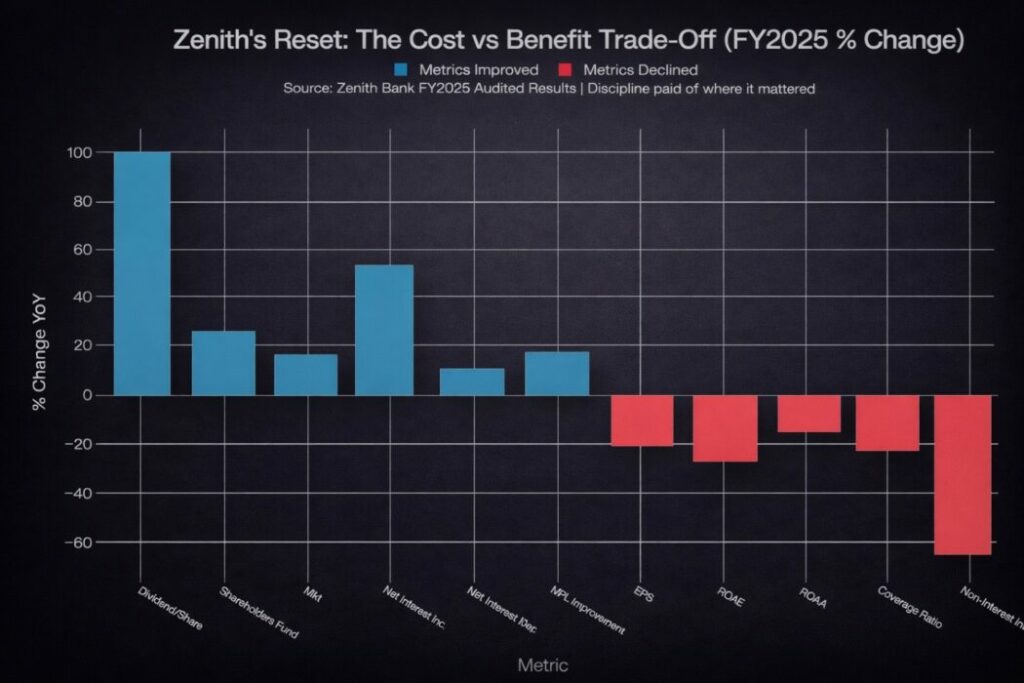
Source: Zenith Bank Plc — Audited Group Results, FY2025
What Africa Gains If This Becomes the Norm
Imagine an African banking landscape where this is the standard, not the exception,
- Where regulators and boards collaborate to unwind forbearance-era accommodations
- Where asset quality is protected rather than papered over
- Where long-term balance sheet health is rewarded above short-term return metrics.
The benefits are not abstract.
For investors, particularly the ESG and impact-aligned institutional capital that Africa must mobilise at scale, cleaner balance sheets and honest financial reporting are the gateway to deeper, longer-duration engagement.
The African banking sector’s challenge is not only capital adequacy; it is credibility adequacy. When banks demonstrate willingness to absorb hard truths, they build the institutional trust that transforms a market from a frontier allocation into a core portfolio destination, attracting the kind of long-term capital that finances infrastructure, energy transition, and inclusive growth.
For communities and citizens, the stakes are even more direct. Banks carrying hidden risk in their loan books are banks that eventually pull back on lending to SMEs, to households, to agricultural value chains, to the infrastructure projects that power economies.
Zenith’s 25.3% Capital Adequacy Ratio and 71.1% group liquidity ratio, both well above CBN regulatory minimums, signal that this bank is not merely surviving; it is building from strength.
A Governance Agenda for Africa’s Banking Sector
Zenith’s reset carries specific imperatives that must translate into action across Nigeria’s banking system and across African financial markets.
- For Nigerian and African regulators:
- The CBN’s banking recapitalisation programme is a structural opportunity to insist on balance sheet transparency as a condition of capital compliance.
- Regulators must not only demand higher capital levels; they must demand that the quality of assets behind that capital is honestly assessed and reported.
- The lesson of the global financial crisis, that opacity in credit books destroys more value than honest impairment ever does, is one Africa cannot afford to repeat at a continental scale.
- For bank boards and management teams:
- Zenith’s leadership under Dame Dr Adaora Umeoji establishes a benchmark for governance-driven strategy.
- Boards must be willing to authorise painful near-term decisions when they serve long-term institutional health, the kind of “discipline and focus” the Zenith CEO references directly.
- That requires a governance culture that prioritises institutional durability over quarterly optics.
- For ESG and institutional investors:
- The case for a governance premium is real and quantifiable here. Investors tracking Zenith’s trajectory, a bank that in 2025 absorbed the pain, doubled the dividend, and entered 2026 from strength, must embed this kind of balance sheet integrity into ESG scoring models, not just environmental and social metrics.
- For ratings agencies and financial analysts:
- The instinct to penalise banks for rising impairment charges must be tempered by context. When impairment is deliberate, strategic, and governance-driven, it is evidence of management quality, not distress.
- Africa’s analytical community needs sharper tools for distinguishing between the two.
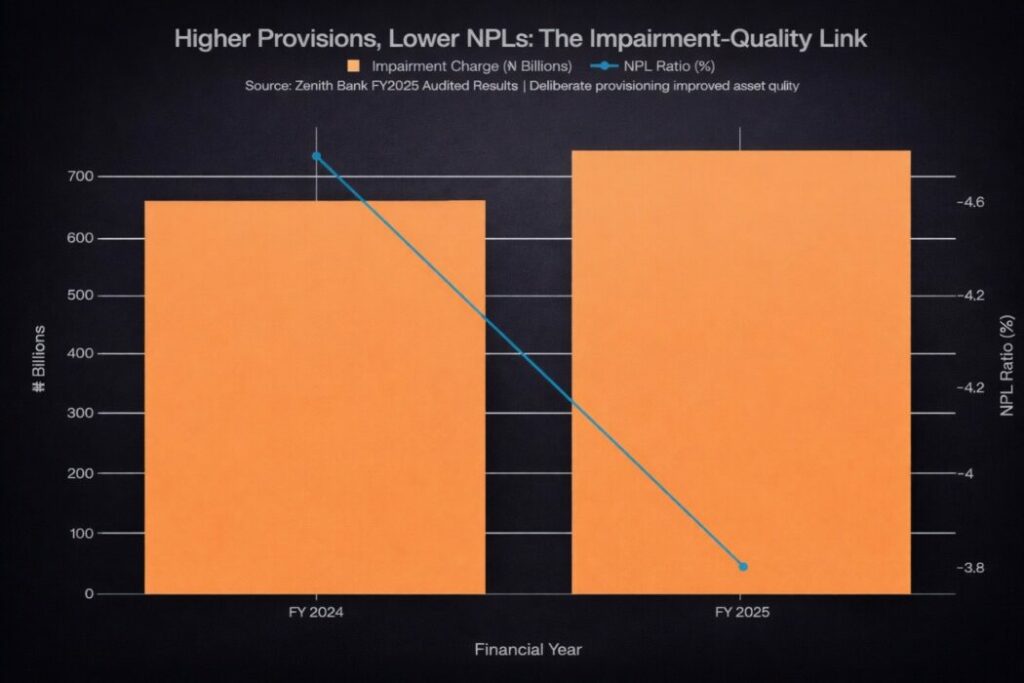
Source: Zenith Bank FY2025 Analysis
Build Africa’s Banks on Truth
Zenith Bank enters 2026 with the credibility earned by making hard choices publicly and purposefully, doubling dividends, expanding NIM, growing deposits by 11%, and cleaning its balance sheet. That is not a coincidence; it is a strategy.
The imperative is collective: Nigeria’s banking sector, its regulators, investors, and multilateral partners must build consensus that long-term balance sheet integrity anchors African financial deepening.
We’ve got the edge. Get real-time reports, breaking scoops, and exclusive angles delivered straight to your phone. Don’t settle for stale news. Join LEADERSHIP NEWS on WhatsApp for 24/7 updates →
Join Our WhatsApp Channel