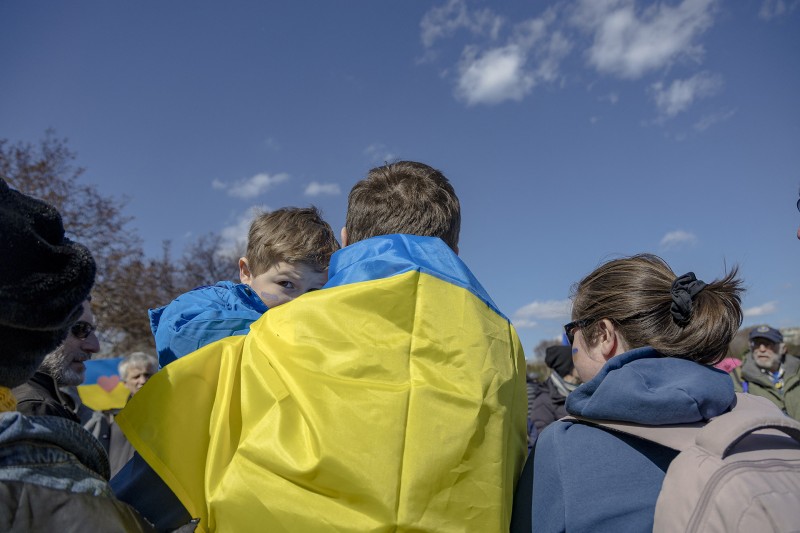
The Ambassador of Ukraine to Nigeria, Ivan Kholostenko, has raised fresh concerns over a reported deportation and forced transfer of nearly 20,000 Ukrainian children by the Russian Government.
The envoy said on Wednesday that the disturbing situation was based on data collected by his country’s Ministry of Justice from February 2026, even as he called for urgent Intervention by the international community to tackle the crisis.
He noted that a total of 19,915 cases involving Ukrainian children have been verified since the onset of Russia’s full-scale invasion.
He added that the confirmed cases were reviewed by Ukraine’s Interagency Commission on the Verification of Information on Children Deported or Forcibly Transferred due to Russia’s armed aggression. According to him, each verified case has been documented in a national register maintained by the Ministry of Justice.
Kholostenko disclosed that Ukrainian authorities are currently processing approximately 20,000 additional records of suspected deportations and forced transfers. These reports, he said, originate from multiple sources, including government institutions, civil society organisations, and international partners, and are undergoing detailed verification.
He, however, stated that the figures remain provisional, noting that the verification process is ongoing and complex, saying that “Behind every number is a real child whose identity, family, and future have been put at risk.”
The Ambassador pointed out the difficulty in determining the full scale of the situation, citing what he described as Russia’s lack of transparency.
He also accused Moscow of refusing to provide official information, restricting monitoring efforts, and denying access to international organisations seeking to locate the affected children.
According to him, representatives of the United Nations and other independent bodies have not been granted access to areas where Ukrainian children are believed to be held. He also noted that Russia has failed to cooperate with the Central Tracing Agency under the Geneva Conventions, thereby complicating humanitarian efforts.
Kholostenko blamed Russia for allegedly pursuing a systematic policy aimed at undermining Ukraine’s future by targeting its younger generation, even as he claimed that identifying and recovering the children is increasingly difficult over time due to deliberate alterations to their personal data.
This, he said, includes changing names, surnames, and dates of birth, as well as granting Russian citizenship and placing children in foster care or adoptive families within Russia.
Citing Russian sources, the Ambassador stated that at least 46,000 Ukrainian children have reportedly been granted Russian citizenship.
He added that earlier claims by Russia’s Commissioner for Children’s Rights suggested that as many as 744,000 Ukrainian children had been “received” since 2022. However, he noted that Russia stopped publishing such figures following the issuance of arrest warrants in March 2023 by the International Criminal Court against Vladimir Putin and Maria Lvova-Belova over the alleged unlawful deportation of Ukrainian children.
On diplomatic efforts, the Ambassador recalled that Ukraine submitted an initial list of 339 abducted children to Russia during negotiations held in Istanbul in June 2025.
He also expressed worries that Russia has yet to provide information on the whereabouts of many of the children listed, ignoring more than 200 of the cases.
Despite the challenges, Ukraine continues to pursue the return of deported children through collaboration with international partners, civil society groups, volunteers, and third-party mediators.
Kholostenko noted that as of March 11, 2026, a total of 2,047 children have been successfully returned under the “Bring Kids Back UA” initiative launched by Volodymyr Zelenskyy.
However, human rights advocates estimate that approximately 1.6 million Ukrainian children remain under Russian control, including those deported, forcibly transferred, or living in temporarily occupied territories where they remain at risk.
The Ambassador called on the international community, including African nations, to support ongoing efforts to secure the safe return of the children and ensure accountability for those responsible.
“We call on African governments to support relevant UN resolutions and on civil society to join efforts to bring every Ukrainian child back home,” he said.
He concluded by emphasising that the issue transcends national boundaries.
“Returning these children is not only a Ukrainian issue. It is a humanitarian obligation of the entire international community.”
We’ve got the edge. Get real-time reports, breaking scoops, and exclusive angles delivered straight to your phone. Don’t settle for stale news. Join LEADERSHIP NEWS on WhatsApp for 24/7 updates →
Join Our WhatsApp Channel