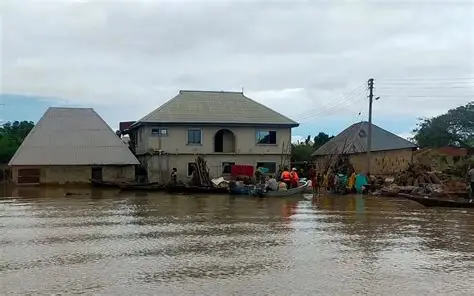
The federal government has warned that severe flooding would hit at least 33 states and the Federal Capital Territory (FCT) between April and November this year, placing over 14,000 communities at high risk.
The alert followed the release of the 2026 Annual Flood Outlook (AFO) by the Nigeria Hydrological Services Agency (NIHSA) on Wednesday in Abuja.
The outlook, themed “Smart Water Resources Management: Moving from Oil to Water-Based Economy,” was unveiled by the Minister of Water Resources and Sanitation, Engr. Prof. Joseph Terlumun Utsev.
Prof. Utsev said Nigeria had reached a “critical moment” in its development journey, stressing the need to prioritise water resources as part of efforts to diversify the economy and build climate resilience. He warned that while water remained a major economic asset, it also posed significant risks, especially as climate change intensified flooding across the country.
The minister disclosed that 14,118 communities across 266 Local Government Areas (LGAs) in 33 states and the FCT were classified as high-risk flood zones in 2026. States expected to be heavily affected include Abia, Adamawa, Anambra, Bayelsa, Benue, Borno, Cross River, Delta, Ebonyi, Edo, Enugu, Gombe, Imo, Jigawa, Kaduna, Kano, Kebbi, Kogi, Kwara, Lagos, Nasarawa, Niger, Ogun, Ondo, Osun, Oyo, Plateau, Rivers, Sokoto, Taraba, Yobe, Zamfara and the FCT.
Another 15,597 communities in 405 LGAs across 35 states were projected to face moderate flood risk. Only Ekiti State was exempted from this category.
Additionally, 923 communities in 77 LGAs across 24 states were expected to experience minimal flooding.
Seasonal Forecast: April to November.
The AFO projected high-impact flooding in different phases of the year: April top June: 9,021 communities in 188 LGAs; July–September: 14,158 communities in 263 LGAs, October–November: 11,575 communities in 224 LGAs. Utsev said the floods could affect agriculture, infrastructure, livelihoods, livestock and the environment.
Major cities, including Abuja, Lagos, Kano, Onitsha, Port Harcourt, Kaduna, Ibadan, Benin City, Calabar, Makurdi and Abeokuta were predicted to experience flash and urban flooding due to intense rainfall, poor drainage systems and inadequate water infrastructure.
Coastal states p, including Bayelsa, Cross River, Delta, Lagos, Ogun, Rivers and Ondo were expected to face coastal and riverine flooding caused by rising sea levels and tidal surges.
The minister said government had modernised the national hydrological monitoring network with automated river gauge stations, improved data collection systems and advanced modelling technologies. He also announced enhanced collaboration with the Nigerian Meteorological Agency (NiMet) to integrate weather and hydrological data for more accurate early warnings.
He emphasised that forecasts alone were insufficient without effective communication, adding that the government was working with NEMA, state emergency agencies, development partners and community leaders to strengthen dissemination of alerts.
In his welcome remarks, NIHSA Director General, Umar Ibrahim Mohammed, said the Agency had upgraded its modelling capacity from traditional systems to an AI-integrated hybrid model to improve reliability and reduce false alarms.
He also announced the launch of a Decision-Support Geo-Intelligence Flood Dashboard and a dedicated mobile app for real-time flood monitoring and alerts.
Call to States and Communities.
Utsev urged state governments, local councils and communities to study the flood outlook carefully and integrate the findings into land-use planning, urban development and disaster preparedness.
“Preparedness remains the most effective strategy for reducing flood risks. When we plan ahead, we protect lives, safeguard infrastructure,” he said.
We’ve got the edge. Get real-time reports, breaking scoops, and exclusive angles delivered straight to your phone. Don’t settle for stale news. Join LEADERSHIP NEWS on WhatsApp for 24/7 updates →
Join Our WhatsApp Channel