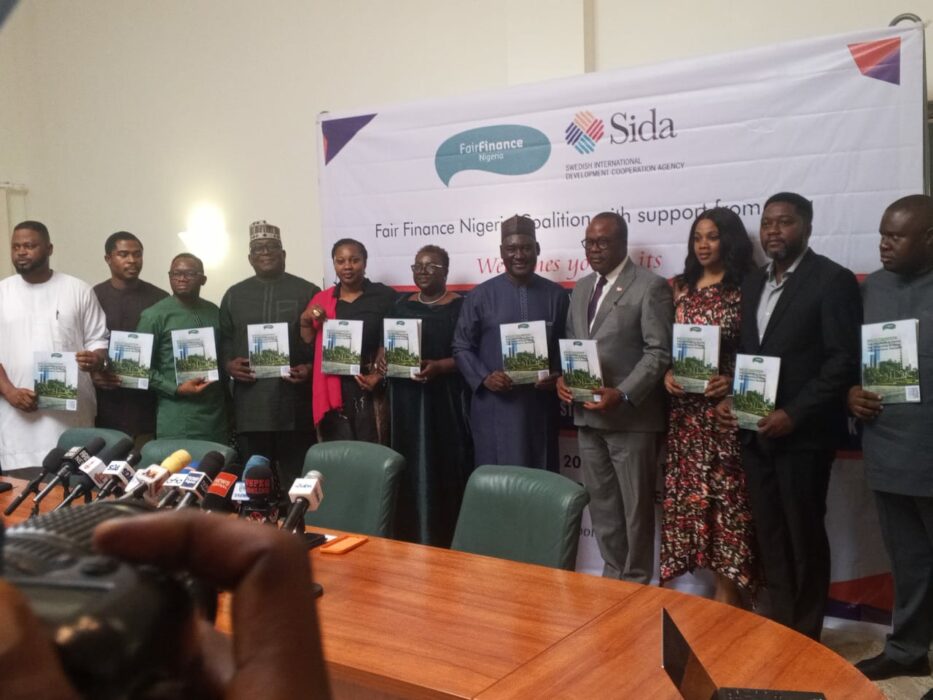
Nigeria’s leading commercial banks have recorded a low average score of 1.7 out of 10 in a new Environmental, Social and Governance (ESG) assessment, triggering calls for urgent reforms in the country’s sustainability banking framework.
The assessment by the Fair Finance Nigeria Coalition reviewed Access Bank, Standard Chartered, United Bank for Africa (UBA) and Zenith Bank against over 400 international sustainability criteria.
Findings unveiled in Abuja on Thursday exposed major gaps in tax transparency, climate action and human rights commitments, raising concerns over weak accountability in the financial sector.
The report showed that all four banks scored zero on tax transparency, citing failure to disclose country-by-country revenues or clarify exposure to tax havens an issue the coalition said undermines global anti-money laundering standards.
The country director of Oxfam in Nigeria, Tijani Ahmed, said the findings highlight serious accountability concerns within the sector.
“Nigerian banks have massive influence; their choices can either accelerate inequality and environmental harm or drive a sustainable future. Right now, they are falling short,” he said.
Ahmed added that the banks recorded an average of 0.9 on climate action, noting continued financing of high-emission sectors without credible transition strategies.
Presenting the report, Executive Director of Civil Society Legislative Advocacy Centre, Auwal Ibrahim Musa, said the overall score reflects a wide gap between current practices and global standards.
“An average score of 1.7 shows that many banks are still operating at minimum regulatory levels rather than aligning with international best practices,” he said.
The assessment also highlighted weak commitments to human rights and biodiversity protection in banks’ financing portfolios.
Programme manager at Oxfam Nigeria, Henry Ushie, said the exercise was not aimed at targeting any bank but to draw attention to gaps and encourage compliance with global standards.
He called for stronger regulatory oversight and improved alignment with international ESG frameworks.
While Standard Chartered recorded the highest score at 2.7, the coalition noted that the performance was largely driven by its global policies, with limited clarity on local implementation.
The group urged the Central Bank of Nigeria and other stakeholders to review the 2012 Nigerian Sustainability Banking Principles and strengthen ESG compliance across the sector.
We’ve got the edge. Get real-time reports, breaking scoops, and exclusive angles delivered straight to your phone. Don’t settle for stale news. Join LEADERSHIP NEWS on WhatsApp for 24/7 updates →
Join Our WhatsApp Channel