
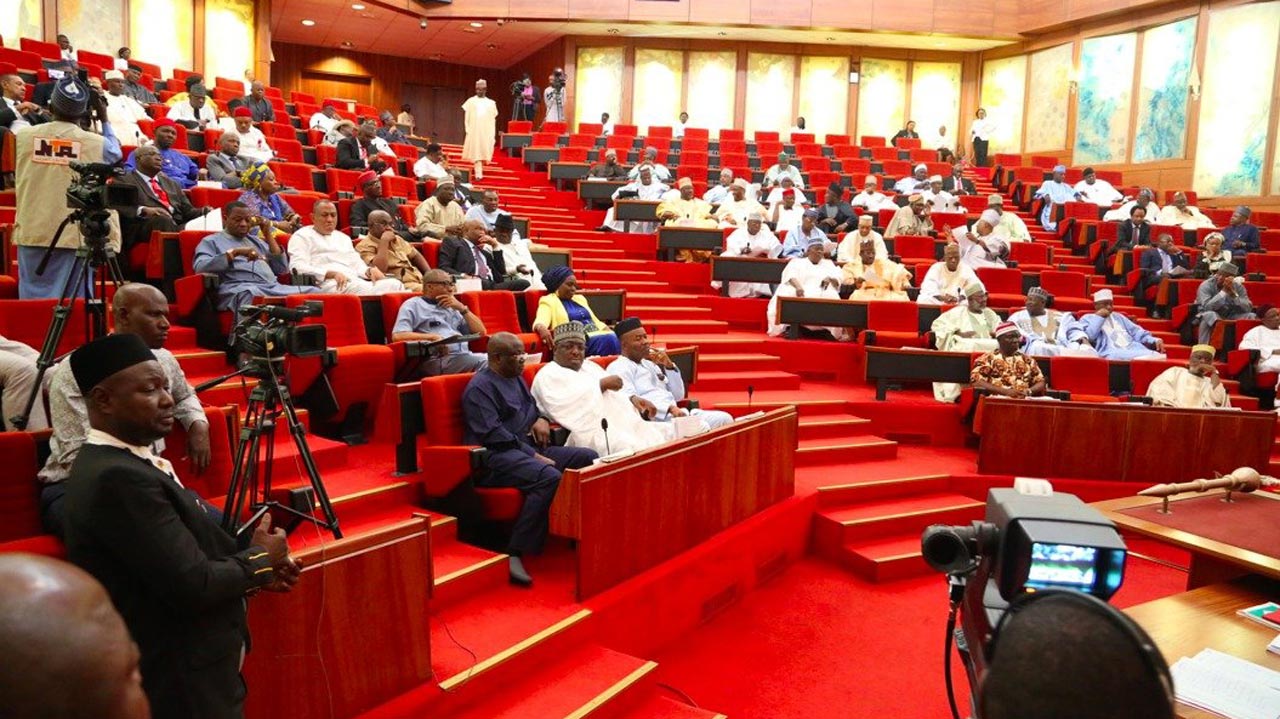
The Senate has passed amendments to the Electoral Act 2026, designating the Court of Appeal as the final arbiter for pre-election disputes involving state Houses of Assembly, National Assembly and governorship elections.
The upper chamber also empowered the Court of Appeal to hear pre-election matters relating to presidential elections as a court of first instance, with appeals proceeding directly to the Supreme Court.
The bill, sponsored by Senator Simon Bako Lalong, representing Plateau South, scaled second and third readings during plenary.
The amendment seeks to assign specific courts to handle pre-election disputes in order to eliminate contradictory judgments from courts of coordinate jurisdiction and streamline the resolution of disputes arising from party primaries.
The legislation is also aimed at ensuring that issues surrounding the legal status of candidates are conclusively resolved before the conduct of general elections.
Leading debate on the bill, Lalong said democracy relies not only on the conduct of elections but also on the credibility and predictability of the legal processes leading to them.
“The legitimacy of candidates and the integrity of party primaries are foundational pillars of representative democracy,” he said.
“Where the legal framework regulating pre-election disputes is uncertain or conflicting, the entire electoral architecture becomes vulnerable to confusion, forum shopping, contradictory judgments, and unnecessary delays.”
According to him, the bill proposes amendments to Section 29 of the Electoral Act and introduces a new Section 29A to clearly define jurisdictional competence in pre-election matters.
Lalong explained that the amendment to Section 29(5) would allow aspirants to institute legal actions either in the Federal Capital Territory or in the jurisdiction where the cause of action arose.
He added that all disputes involving presidential and vice-presidential elections would originate at the Court of Appeal, with appeals lying directly to the Supreme Court.
Speaking in support of the bill, Senator Ekong Sampson, representing Akwa Ibom South, said the amendment addresses critical issues concerning the integrity of the electoral process and the role of the judiciary in sustaining democracy.
“So much has been said about the dangers of forum shopping, where litigants explore spaces that favour them to file suits that will favour them,” Sampson said.
“This is dangerous to democracy. This is dangerous to our political space.”
He noted that the amendment would encourage fairness, consistency, and confidence in electoral adjudication.
Senator Adams Oshiomhole, representing Edo North, also backed the legislation, saying it would help reduce prolonged litigation over candidate nominations and strengthen the electoral process.
The Senate’s action follows a similar move by the House of Representatives last week, when lawmakers also amended the Electoral Act 2026 to designate the Court of Appeal as the final court for pre-election disputes involving governorship, National Assembly, and State Assembly elections.
The House amendment bill was co-sponsored by Deputy Speaker Benjamin Kalu and chairmen of four standing committees, including Adebayo Balogun (Electoral Matters), Babajimi Benson (Defence), Nnolim Nnaji (Ports and Harbour), and Makki Yalleman (Police).
Presenting the general principles of the bill during plenary, Balogun said the amendment to Section 29 of the Electoral Act 2026 would provide “clarity, certainty, and uniformity” in the jurisdiction and determination of pre-election matters arising from party primaries and related electoral activities.
We’ve got the edge. Get real-time reports, breaking scoops, and exclusive angles delivered straight to your phone. Don’t settle for stale news. Join LEADERSHIP NEWS on WhatsApp for 24/7 updates →
Join Our WhatsApp Channel