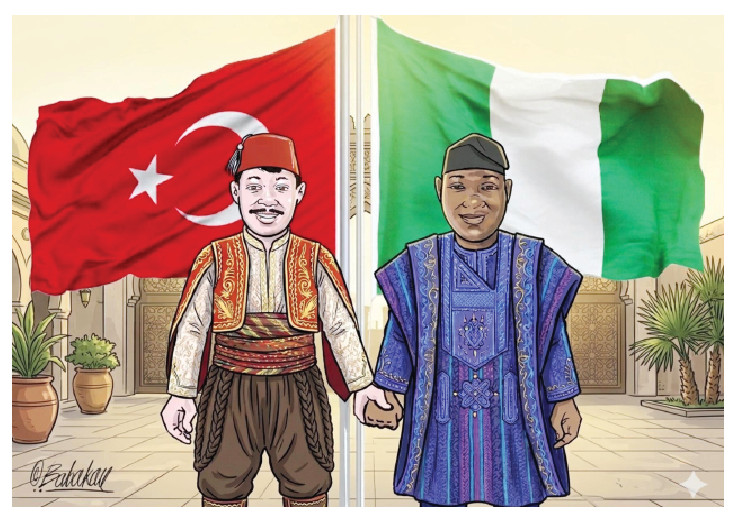
The Republic of Türkiye is a blend of Asia and Europe. Its history is rich in diversity. It is transcontinental. It has one of the best arrays of cuisines in the world. Nigeria is home to many Turkish businesses in very critical sectors of our economy. I know several Turks who married Nigerians, and their offspring represent a unique blend. Aside from this, Turks in Nigeria represent a burgeoning industrious population. Beyond these, its defence capabilities are rated top-tier globally. The government of Türkiye has not hidden its readiness to partner with Nigeria, especially in the critical defence sector. Türkiye has what we want, and we need what they have. It is a symbiotic relationship.
A journey of a thousand miles
The diplomatic relationship between the two countries dates back to 1962, when it opened its embassy in Nigeria, not long after we attained independence. Turkish interest in Nigeria manifested significantly in the early 2000s with improved Turkish presence in our educational sector. The Nigerian Tullip International Colleges (NTIC) was established in 1998, and it has remained one of the flagship educational institutions in Nigeria. Its annual National Mathematics Competition for primary and junior secondary schools across the country, in collaboration with the National Mathematical Centre, aims to identify talented individuals to represent Nigeria at the International Mathematics Olympiad.
The promoters of the NTIC also made tangible investments in a university and a hospital that have carved out niches in the education and healthcare sectors. The Turkish presence and interest in Nigeria are outstanding. It is a relationship that spans decades. And this relationship has recently expanded to the defence sector after a historic visit by President Bola Tinubu to Ankara at the behest of Turkish President Recep Erdogan in January, 2026. This precedes earlier visits by former president Muhammadu Buhari and reciprocal visits by the Turkish president to Nigeria in 2016 and 2021, where Nigeria signed a Defence Industry Cooperation (DIC) Agreement to help develop our defence manufacturing capabilities through military technology transfer. We have experienced tangibles in this regard with the recent military innovations by the Defence Industries Corporation of Nigeria (DICON).
President Bola Tinubu signed a record nine bilateral agreements. Top among them is the “Protocol on Military Cooperation” that covers military training, intelligence sharing, and counter-terrorism coordination. This is a good one. We stand to benefit from Türkiye’s defence capabilities. The Turks hold a strategic place in Europe and Asia. As a member of NATO, it serves as a vital security buffer between Europe and the Middle East. From available research, the Turks do not give commitments for the sake of it. They use these commitments to market themselves, and this is why it has continued to rank high in its defence capabilities. Türkiye is ranked as the 11th largest exporter of arms and military hardware in the world. This is an expression of the level of commitment that it has displayed over several decades.
It’s a military affair.
The Protocol on Military Cooperation is threefold. It touches on training, intelligence sharing and counter-terrorism coordination. The Minister of Defence, General Christopher Musa (rtd), recently announced that 200 Nigerian military personnel would be travelling to Türkiye for training on counter-insurgency operations as part of this pact. This is cheering. According to sources, Türkiye has honoured previous pacts with Nigeria with mutual respect and decorum. And this, in my opinion, won’t be any different. I used the example of NTIC and Nizamiye Hospital earlier because they speak a lot about commitment. It appears to be a cultural thing for Turks. It is called Vefa in Turkish culture. Vefa is a term that “blends loyalty, gratitude, and the honouring of old debts or ties.”
Vefa is Fidelity
In Turkish culture, Vefa is a highly regarded virtue. It implies that if you have a shared history or a common struggle, you do not abandon that cause or person when things get difficult. Both countries share a history dating back to the Kanem-Bornu Empire. During the reign of Mai Idris Alooma (1571–1603), the empire established a formal diplomatic alliance with Murad III, the Sultan of the Ottoman Empire (1574–1595). This partnership made Mai Idris Alooma the first ruler in Sub-Saharan Africa to maintain a standing army equipped with firearms and Ottoman-style tactical training. Ottoman military instructors, known as Solaks—traditionally the Sultan’s personal bodyguards, trained the Kanem-Bornu cavalry. Under their guidance, local fighters learned to synchronize infantry firepower with cavalry charges.
This is why, “culturally”, Türkiye is committed to assisting in the war against insurgency in Nigeria. This is Vefa. This has been exemplified by other Turkish interests in the country, especially Nizamiye Hospital, which is reputed as an efficient facility and is known for several medical breakthroughs. According to the International Medical Travel Journal (IMTJ), Turkey is ranked third in the global destination for medical tourism. The Nizamiye Hospital example in this piece is strategic. It has contributed to the reduction in medical tourism, and of course, health is as critical as security.
The love story
Nigeria and Türkiye are the latest “couple” in defence collaborations. This pact has been described by both nations as strategic. President Bola Tinubu described it as an alliance designed to deliver “tangible benefits” for the security and prosperity of Nigerians. President Recep Erdogan described it as a “manifestation of deep-rooted friendship and a commitment to shared stability.” The position of the Turkish president explains why Vefa is fidelity. And fidelity is a functional necessity of a marriage/alliance/partnership.
I can tell that this defence pact with Türkiye is different. It is an urgent need for Nigeria. This much the Minister of Defence, General Christopher Musa (rtd), highlighted at the 5th edition of the Antalya Diplomacy Forum (ADF2026) in Türkiye. In his recently published op-ed, “Nigeria-Turkey strategic alliance: The facts and the illusions”, he stated that “we are experiencing several layers of security threats across the country, and there are sustained efforts to address them. With Türkiye, we didn’t just sign a defence pact. We got a great partner in our efforts towards addressing the security situation in the country.” This is the “love story”. There is no doubt that the Nigerian-Turkish defence pact holds prospects beyond what is in the public space.
I think Türkiye is in love with Nigeria, given this history, and these must not be misconstrued to mean anything other than the good of the country. Military alliances are critical in addressing insecurity in whatever form or manner it presents itself. I have attempted to explain my position in this manner using a hospital example so it can resonate. Nizamiye Hospital is a Turkish organisation, and its impact is resounding in the health sector in Nigeria. Should we expect the same in the defence sector with this pact? I can vouch that this defence pact would succeed, given the history of Turkish interventions in Nigeria.
– Ocheja, PhD, an alumnus of the Nigerian Defence Academy, is a military historian and creative writer. He is the author of “Operation Akpabana” (2025)
We’ve got the edge. Get real-time reports, breaking scoops, and exclusive angles delivered straight to your phone. Don’t settle for stale news. Join LEADERSHIP NEWS on WhatsApp for 24/7 updates →
Join Our WhatsApp Channel