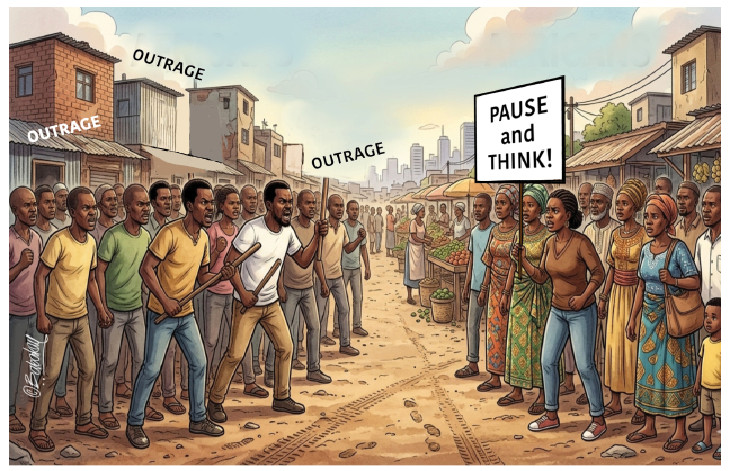
A society reveals itself, not only through the policies it announces or the infrastructure it commissions, but more quietly, and more honestly, through the kinds of conversations it repeatedly elevates in its public space, because attention functions as a form of developmental currency, and where that currency is misallocated, even well-meaning societies begin to drift in ways that resemble a ship that has not changed direction, yet slowly loses alignment with its compass while insisting it is still on course.
The recent public reaction to the renovation of the Kadawa Science and Mathematics Special Primary School in Ungogo Local Government Area of Kano State, completed by Dan Bello after six weeks of work in May 2026, offers a revealing entry point into this question of attention, especially when one considers that a more developmentally grounded society would ordinarily focus on the condition of public education, the implications of citizen-led infrastructure renewal, and the possibilities of scaling such interventions across a system still struggling with basic human capital formation.
Instead, discourse quickly shifted after a Jos-based third grade Kannywood actor known as General BMB circulated an interpretation suggesting that the school’s bright colours carried ideological symbolism, a claim that travelled faster than verification, and louder than context, as though interpretation had replaced evidence as the primary unit of public reasoning.
When Colour Becomes Evidence
At the centre of the controversy lies a revealing irony, namely that the colours used in the school renovation resemble widely adopted educational palettes associated with global learning frameworks, including the Sustainable Development Goals, where colour is not aesthetic excess but deliberate design, intended to support cognitive engagement, emotional orientation, and memory formation among children whose learning processes remain deeply shaped by visual environment.
Educational psychology has long established that classrooms are not neutral spaces, but active components of learning, much like how lighting affects photography or how acoustics shape music, because children at foundational stages respond not only to instruction but also to environment, and environments that are visually stimulating tend to improve attentiveness, curiosity, and emotional comfort in ways that directly influence learning outcomes.
Yet, instead of engaging with these empirical realities, public conversation drifted toward symbolic interpretation, treating colour as ideology and aesthetics as accusation, a shift that reflects not the school itself but the fragility of interpretive frameworks within segments of public discourse.
It is somewhat like a situation in which a hospital ward becomes the subject of debate over wall decorations while the discussion of medical equipment, staffing levels, and patient outcomes is quietly ignored, even though the latter determines survival while the former remains secondary.
Lagos, Kano, And Diverging Public Reason
Zainab Usman’s 2022 book Economic Diversification in Nigeria: The Politics of Building a Post-Oil Economy offers a useful analytical lens for understanding this divergence in public reasoning, particularly through her comparative reading of Lagos and Kano since 1999, where she illustrates how Lagos gradually embedded long-term planning, infrastructural investment, and institutional continuity into its governance logic, while Kano increasingly experienced a political environment where symbolic legitimacy and reactive public sentiment often overshadowed sustained developmental strategy.
The difference is not merely economic, but cognitive, because it reflects how each society organises its attention, and how consistently it prioritises structural questions over episodic controversies.
Lagos, like a city continuously upgrading its internal systems, has tended to focus on strengthening the mechanisms that produce outcomes, while Kano, at least in recurring moments, appears more vulnerable to debates that circulate at the level of symbols rather than systems, where interpretation often outruns analysis and emotional clarity substitutes for empirical depth.
The consequence of this divergence becomes visible not only in economic indicators, but in the texture of public discourse itself, where one environment increasingly rewards institutional thinking, while the other sometimes rewards immediacy of reaction over depth of understanding.
Industrial Memory and Displaced Debate
Kano’s historical identity as a commercial and industrial hub makes this shift in discourse even more striking, especially when one recalls the once vibrant industrial corridors of Sharada, Bompai, and Challawa, which for decades anchored textile production, manufacturing employment, and regional trade networks across West Africa, before gradually declining under the weight of policy inconsistency, infrastructural decay, and changing economic geography.
These corridors now function less as active economic spaces and more as physical reminders of interrupted industrial ambition, much like an abandoned railway station where the platforms remain intact but the trains no longer arrive, leaving behind architecture without movement and structure without function.
Yet public discourse rarely returns to these sites with the same intensity reserved for symbolic controversies, even though they represent far more consequential developmental questions, including employment generation, industrial policy, and economic diversification, all of which directly affect livelihoods in ways that aesthetic debates do not.
This imbalance reflects how attention itself becomes structured in societies where symbolic narratives travel faster than structural analysis, producing a public sphere that is more responsive to emotional clarity than to developmental complexity.
Morality, Institutions, And Economic Grounding
The tendency to privilege symbolic interpretation over structural reasoning is further illustrated by past controversies, including the framing of the World Bank supported AGILE programme in Kano as a cultural threat by some religious clerics, despite its clear developmental objective of expanding girls’ education and reducing the number of out-of-school children.
Such episodes highlight a broader pattern in which development interventions become absorbed into narratives of suspicion when public discourse lacks sufficient empirical grounding, thereby transforming relatively straightforward policy initiatives into contested moral symbols.
At the same time, institutions such as Hisbah, often positioned as guardians of public morality, operate within a wider socio-economic environment where unemployment, poverty, and educational deprivation exert far stronger influence on social outcomes than enforcement alone can realistically address.
Morality, in practical terms, is not self-sustaining; it depends on material conditions, because households under chronic economic pressure experience constraints that no regulatory framework can fully offset, much like attempting to maintain structural integrity in a building while ignoring cracks in its foundation.
Lagos’ comparative trajectory reinforces this point, as its governance logic has consistently recognised that economic architecture, including infrastructure, investment systems, and institutional continuity, forms the backbone of social stability.
The Discipline of Serious Conversation
The controversy surrounding the Kadawa school renovation ultimately reflects less a disagreement about aesthetics than a deeper condition of public reasoning, where a third-grade actor’s interpretation can generate widespread emotional mobilisation while questions of industrial revival, educational reform, and economic planning struggle to achieve comparable urgency.
A society, like a calibrated instrument, produces coherent outcomes only when its attention is directed toward the right frequencies, and when that calibration becomes distorted, even meaningful interventions begin to appear controversial simply because the interpretive framework has shifted away from evidence toward suspicion.
In that sense, the renovated school functions as more than a physical space; it becomes a mirror of public discourse itself, reflecting a moment in which the central challenge is not merely to improve institutions, but to recover the intellectual discipline required to distinguish between symbolic noise and structural signal in a society that urgently needs more of the latter, and far less of the former.
We’ve got the edge. Get real-time reports, breaking scoops, and exclusive angles delivered straight to your phone. Don’t settle for stale news. Join LEADERSHIP NEWS on WhatsApp for 24/7 updates →
Join Our WhatsApp Channel