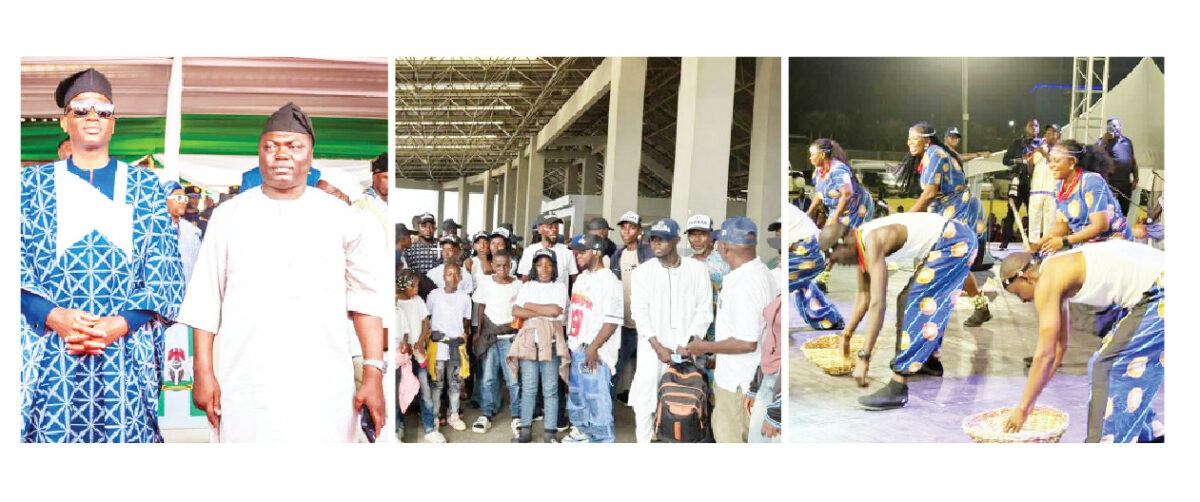
When Grenadian Prime Minister, Dickon Mitchell, publicly declared during one of his visits to Taraba State that Grenada would host Taraba people in the Caribbean nation, many dismissed the statement as another diplomatic pleasantry often associated with government engagements.
To skeptics, it sounded ambitious, unrealistic, and perhaps symbolic at best. But months later, what appeared improbable has now materialized into one of the most remarkable cultural diplomacy engagements involving a Nigerian sub-national government in recent times.
Today, young cultural ambassadors from Taraba State, led by the state‘s Commissioner of Heritage and Ecotourism, Joseph Titus Nagombe, are not only walking the streets of St. George’s, Grenada’s capital, they are performing on international stages, sharing African heritage with descendants of Africans in the Caribbean, and strengthening a growing bond between Taraba State and the island nation of Grenada.
The development has further underscored Governor Agbu Kefas’ expanding cultural diplomacy agenda, which is gradually positioning Taraba beyond the conventional boundaries of local governance into the arena of global cultural partnerships.
Prime Minister Mitchell’s connection with Taraba did not emerge overnight.
The Grenadian leader had visited Taraba on several occasions at the instance of the state government, where discussions with Governor Kefas centred on areas of mutual cooperation and development partnerships. Those engagements produced memoranda of understanding covering agriculture, tourism development, cultural exchange, mining cooperation, youth empowerment, investment promotion, education collaboration, and heritage preservation. For both governments, the partnership represented more than political symbolism. It reflected a shared historical consciousness rooted in Africa’s connection with the Caribbean, through the painful history of the transatlantic slave trade and the enduring resilience of Black identity across continents.
Observers say, the relationship also aligns with a broader Pan-African vision increasingly gaining attention globally, thereby reconnecting Africa with its diaspora communities through culture, history, trade, and tourism.
That vision became more visible when Governor Kefas sponsored a large Taraba delegation to participate in the 2026 African Liberation Festival in Grenada. The delegation departed Nigeria through the Nnamdi Azikiwe International Airport, Abuja, carrying with it not just costumes and musical instruments, but the cultural identity of Taraba’s diverse ethnic nationalities. The delegation comprised largely of young people, including members of indigenous cultural troupes, government officials, tourism experts, and cultural ambassadors tasked with projecting Taraba’s heritage on the global stage.
For many of the participants, the journey represented a life-changing experience.
Beyond performance and entertainment, the festival exposed them to African history, diaspora identity, and the wider conversation around Black consciousness and cultural renaissance. The participating contingents described the opportunity as rare and transformative, praising Governor Kefas for investing in youth exposure and international cultural exchange.
Upon arrival in Grenada, the Taraba delegation was officially received by Prime Minister Dickon Mitchell during a diplomatic engagement held at the Ministerial Complex in St. George’s.
The meeting drew top officials from both Nigeria and Grenada, including Nigeria’s Ambassador to Grenada, Commissioner for Heritage and Ecotourism in Taraba State, Dr. Nagombe, Hon. Jerry Manwe, and the Director of Protocol to the Governor, Nixon James Bature, among others. Discussions at the meeting mainly focused on strengthening cultural diplomacy, tourism collaboration, heritage preservation, and investment opportunities between Taraba State and Grenada.
The Taraba delegation also conveyed Governor Kefas’ goodwill to the people of Grenada and reaffirmed the state’s readiness to deepen international cooperation through culture and tourism.
Diplomatic observers say the meeting signalled an emerging model of sub-national diplomacy, where states within Nigeria increasingly pursue international partnerships capable of boosting tourism, trade, and cultural visibility.
However, the defining moment came during the African Liberation Festival itself, which held at Victoria Park in Grenville, St. Andrew Parish. The festival attracted Africans and descendants of Africans from across the Caribbean, Africa, Europe, and the Americas.
Yet among the numerous performances, the Taraba contingent quickly became one of the festival’s biggest attractions, with groups like the Taraba State Arts Council, Konawood Dancers, Destiny Kids of Mambilla Plateau, Goge performers, Bandawa troupe, Ndola cultural representatives, and other indigenous performers captivated audiences with energetic dances, traditional rhythms, dramatic storytelling and colourful displays of African identity (ies). Their performances transformed the festival grounds into a vivid display of Nigerian cultural richness.
For many Caribbean attendees, it was more than entertainment; it was an emotional reconnection with ancestral roots. The sounds of drums, the movement of dancers, and the symbolism embedded in the performances carried echoes of histories separated by oceans but united by heritage.
With over 220 performers and participants from Taraba and Delta states participating in the event, the festival became one of the largest gatherings celebrating African heritage ever witnessed in Grenada.
One of the festival’s most profound moments came when Prime Minister Mitchell spoke about reconnecting with African ancestry. The Grenadian leader revealed that DNA tracing helped him discover ancestral ties to the Akan people of Ghana, a revelation he described as deeply personal and transformative.
He stressed the need for Africans in the diaspora to deliberately preserve their history, identity, and culture through education and intergenerational transmission.
His remarks resonated strongly with participants from Nigeria, especially those from Taraba, many of whom saw the festival as a symbolic reunion between the Africans on the continent and descendants of Africans displaced centuries ago.
The Commissioner for Heritage and Ecotourism, Dr. Titus Joseph Nagombe, echoed similar sentiments while speaking on behalf of Governor Agbu Kefas.
According to Nagombe, the experience in Grenada represented more than cultural exhibition.
„It symbolises a reunion with descendants of Africans displaced during the transatlantic slave trade,” he said.
He added that, culture remains one of the strongest instruments for projecting the identity and value of any society.
“Nations are often remembered more for their cultural heritage than political activities,” he noted.
Analysts believes that, Taraba’s participation in the African Liberation Festival may carry long-term implications beyond cultural exchange alone.
Globally, nations increasingly deploy culture as an instrument of soft power; using music, tourism, film, arts and heritage to attract investment, strengthen international relations and influence global perception.
For Taraba State, often celebrated for attractions such as the Mambilla Plateau, Gashaka-Gumti National Park and its diverse ethnic cultures, the Grenada engagement presents an opportunity to market itself to international audiences. The exposure could potentially attract tourism partnerships, diaspora interest, creative collaborations and investment opportunities into the state’s hospitality and tourism sectors.
It also signals a deliberate attempt by the Governor Agbu Kefas‘s administration to redefine governance beyond infrastructure and politics by integrating culture into economic and diplomatic strategy.
In many ways, the images emerging from Grenada tell a deeper story of young Africans from Taraba dancing before Caribbean audiences; descendants of enslaved Africans reconnecting emotionally with traditions preserved on the African continent; government partnerships being driven not by politics alone, but by heritage and identity.
For a state often discussed mainly in relation to security challenges, agriculture, or politics, Taraba’s growing cultural footprint in the Caribbean offers a different narrative, one rooted in creativity, history, and global engagement.
And perhaps, for those who once dismissed Prime Minister Mitchell’s promise as mere rhetoric, the scenes and tales from Grenada now stand as a proof that diplomacy, when driven by cultural vision and political will, can indeed travel across oceans.
We’ve got the edge. Get real-time reports, breaking scoops, and exclusive angles delivered straight to your phone. Don’t settle for stale news. Join LEADERSHIP NEWS on WhatsApp for 24/7 updates →
Join Our WhatsApp Channel