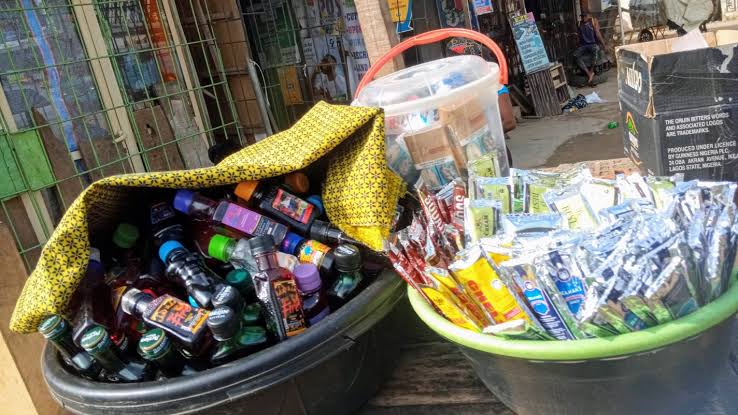
Seven months after the National Agency for Food and Drug Administration and Control (NAFDAC) began enforcing the ban on sachet alcohol and alcoholic drinks in plastic bottles below 200 millilitres, the products are still openly sold across markets and streets in the country.
Findings by LEADERSHIP revealed that rather than disappearing from circulation, the products have remained readily available in many parts of the country, while prices have increased significantly following the enforcement drive.
A sachet alcoholic drink that previously sold for about N100 now goes for between N200 and N250, depending on the location, while prices of PET bottled alcoholic drinks below 200ml have also risen sharply.
At Tejuosho under bridge in Yaba, Lagos, traders admitted that, although they were informed of the planned enforcement by NAFDAC, suppliers merely raised prices rather than halt distribution.
A trader, Obioma, who sells beverages including sachet and small pet bottled alcoholic drinks, said the enforcement had not stopped demand for the products.
“We were indeed informed by our suppliers about the planned enforcement by NAFDAC, but the development only made the suppliers increase prices,” she said.
She expressed doubts over the effectiveness of the ban in curbing alcohol abuse among young people, arguing that consumers may simply switch to larger bottles.
“Even if children and youths are discouraged from taking sachet alcohol, many of them may move to bigger bottles, which could even be more dangerous because they may consume larger quantities,” she added.
Industry unions had earlier warned against what they described as hasty implementation of the policy, citing fears of job losses, smuggling and revenue decline.
President of the Food, Beverage and Tobacco Senior Staff Association (FOBTOB), Comrade Jimoh Oyibo, had cautioned that weak border controls could worsen the situation by encouraging the influx of similar products from neighbouring countries.
According to Oyibo, the policy could discourage investment in the sector because companies that invested heavily in production facilities based on earlier government approvals are now facing abrupt policy reversals.
“If the planned ban is to prevent children and youths from accessing sachet alcohol, the government should know that policy inconsistency could discourage investors.
Some investors spent over N500 million establishing production facilities after receiving approvals,” he said.
Similarly, the president of the National Union of Food, Beverage and Tobacco Employees (NUFBTE), Comrade Ibrahim Garba, argued that enforcement alone would not solve the problem without stronger measures to restrict underage access to alcohol.
Garba warned that the continued availability of the products despite the ban could encourage smuggling and lead to revenue losses for the country.
“What we tried to explain to the authorities is that even if enforcement succeeds partially, it could open the door for smugglers to bring in similar products from outside the country. Nigeria would lose revenue and jobs in the process,” he stated
He urged the government to focus more on strict regulation and enforcement of age restrictions rather than outright prohibition.
NAFDAC had on November 10, 2025, announced plans to fully enforce the ban after granting manufacturers a five-month grace period to stop production of sachet alcohol and PET-bottled alcoholic drinks below 200ml.
The agency said the measure was aimed at reducing alcohol abuse, especially among youths and underage consumers.
However, checks in several markets and retail outlets indicate that the products remain in widespread circulation months after the enforcement commenced, raising fresh concerns over the effectiveness of the ban and the capacity of authorities to sustain compliance nationwide.
We’ve got the edge. Get real-time reports, breaking scoops, and exclusive angles delivered straight to your phone. Don’t settle for stale news. Join LEADERSHIP NEWS on WhatsApp for 24/7 updates →
Join Our WhatsApp Channel