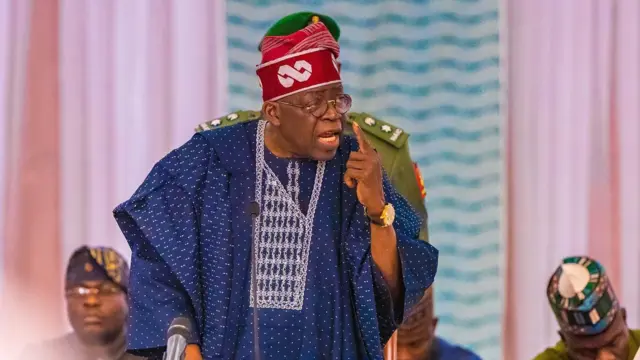
President Bola Tinubu has warned terrorists, bandits, kidnappers and their sponsors to surrender or face the full force of the Nigerian state, declaring that no mercy would be shown to those responsible for the killing and abduction of Nigerians.
In his Democracy Day address marking 27 years of uninterrupted democratic rule, Tinubu said that while the heroes of the June 12 struggle secured political freedom for Nigerians, the task of the present generation is to secure economic freedom and national prosperity.
Reflecting on Nigeria’s democratic journey since the return to civilian rule in 1999, the President said the country had experienced its longest period of uninterrupted democracy, with citizens choosing their leaders through the ballot box, witnessing peaceful transfers of power and resolving disputes through constitutional institutions rather than violence.
“Our democracy is not perfect, but it is ours, and we must continue to defend and strengthen it,” he said.
Ahead of the governorship elections in Ekiti and Osun states, Tinubu urged the Independent National Electoral Commission (INEC), security agencies and political parties to ensure peaceful and credible polls.
According to him, democracy weakens when citizens lose confidence in the electoral process.
The President also called on the National Assembly, the judiciary, the media and civil society organisations to continue playing their roles in safeguarding democratic governance.
“Criticise me, disagree with me, but never stop believing in Nigeria,” he said.
Addressing young Nigerians, Tinubu urged them to invest their talents and energy in building the country.
“Nigeria is your home and your future. Build here, code here, work here and vote here. Every great nation was built by those who stayed to solve problems, not by those who abandoned ship,” he said.
The President paid tribute to members of the armed forces, police and intelligence agencies for their sacrifices in protecting the nation. He also commended traditional rulers, religious leaders and community stakeholders for supporting peace-building efforts across the country.
According to him, government alone cannot secure the country without the cooperation of citizens and local communities.
Tinubu noted that this year’s Democracy Day celebration was overshadowed by the abduction of children in Oyo and Borno states, but expressed confidence that the victims would return safely.
“Democracy without security is a mirage,” he declared.
The President said his administration had treated insecurity as a national emergency since assuming office and had intensified efforts to strengthen the country’s security architecture.
He disclosed that more than 50,000 police officers and thousands of military recruits had been approved for recruitment, while the 2026 budget allocated N5.41 trillion to defence and security — the largest security allocation in Nigeria’s history.
According to him, the country has moved beyond routine military training exercises with international partners, including the United States, France and other European countries, to more sophisticated intelligence-led and precision-targeting operations against terrorist organisations.
Tinubu revealed that security forces had successfully degraded the command structure of the Islamic State West Africa Province (ISWAP) in Arege, Borno State.
He also cited improvements in the fight against insurgency and terrorism, stating that terror-related deaths had declined by 81 per cent since 2015.
According to him, more than 13,000 terrorists had been neutralised within the last year, while over 124,000 fighters and their dependants had surrendered through Operation Safe Corridor since 2023.
While reiterating that the government remained open to accepting repentant fighters willing to abandon violence, Tinubu warned that the opportunity would not remain available indefinitely.
“To bandits, kidnappers and sponsors of terror: Surrender or face the full force of the Nigerian State. These windows of surrender will not remain open forever. No mercy will be shown to those who trade in the blood of Nigerians,” he said.
The President urged Nigerians not to politicise insecurity or view criminality through ethnic or regional lenses.
“We must stand united and be assured that the enemies of our nation shall soon be history. We will triumph over terror and continue to build a more prosperous nation,” he added.
Tinubu used the occasion to pay tribute to the heroes of the June 12 struggle, describing the annulled June 12, 1993 presidential election as one of the defining moments in Nigeria’s democratic history.
He honoured the winner of the election, Chief MKO Abiola, and his wife, Alhaja Kudirat Abiola, for their sacrifices in the struggle for democratic rule.
The President also paid tribute to several prominent democracy activists and political figures, including Chief Gani Fawehinmi, Chief Bola Ige, Chief Alfred Rewane, Pa Abraham Adesanya, Chief Anthony Enahoro, Alhaji Balarabe Musa, Commodore Dan Suleiman, Dr Beko Ransome-Kuti, Frank Kokori, Arthur Nwankwo, Chima Ubani and Shehu Musa Yar’Adua.
He further recognised the contributions of labour leaders, journalists, students, women, professionals, politicians and members of the armed forces who faced imprisonment, harassment, exile and even death in the struggle to restore democratic governance.
According to Tinubu, the most fitting tribute to the heroes of June 12 would be the creation of a nation where freedom is protected, justice prevails, opportunities are available to all and public institutions remain accountable.
“June 12, 1993, revealed the possibility of a true Nigerian nation. The heroes of June 12 secured political freedom. Our challenge is to secure economic freedom,” he said.
The President defended the economic reforms undertaken by his administration, arguing that they were necessary to rescue the economy from years of fiscal instability and structural distortions.
He said the reforms had restored confidence in economic management, improved fiscal transparency, reduced leakages and increased revenues available to federal, state and local governments.
According to him, these gains have enabled sub-national governments to devote more resources to infrastructure, healthcare, education and security.
Tinubu also claimed that investor confidence had improved significantly, resulting in increased investments across key sectors including agriculture, energy, manufacturing, technology, mining, transportation and the creative industry.
He noted that domestic refining capacity had expanded, reducing the country’s dependence on imported petroleum products and strengthening energy security.
The President devoted considerable attention to the electricity sector, which he described as one of the major challenges inherited by his administration.
According to him, when he assumed office in 2023, the power sector was burdened by generation shortfalls, inadequate gas supply, weak transmission infrastructure, a metering deficit exceeding four million consumers and huge legacy debts.
He said the country was generating below its installed capacity of 13,500 megawatts, while inefficiencies in transmission and distribution further constrained electricity supply.
To address the situation, Tinubu highlighted the implementation of the Electricity Act, which grants states greater powers to generate, transmit and distribute electricity.
He said the reform was designed to encourage competition, attract investment and accelerate improvements in electricity supply.
The President disclosed that the Presidential Power Sector Task Force had been mandated to address the metering gap and authorised to raise a N4 trillion bond to settle verified legacy debts in the sector.
He also said the Rural Electrification Agency, working with support from the World Bank and the African Development Bank, had expanded off-grid and mini-grid projects to underserved communities, markets, universities and healthcare facilities across the country.
“Electricity is a democratic dividend we owe every Nigerian. We intend to deliver it,” he said.
On infrastructure and economic development, Tinubu said major projects being executed across the country were improving connectivity, opening up new economic opportunities and linking producers to markets.
He disclosed that the National Agricultural Development Fund was implementing a programme to deploy 10,000 tractors over a five-year period to boost mechanised farming and improve food production.
The President also announced that more than 1,000 small and medium-scale enterprises had been certified for export under government-supported programmes.
According to him, non-oil exports recorded a 21 per cent increase last year, reflecting growing diversification of the economy away from dependence on crude oil revenues.
Despite highlighting these achievements, Tinubu acknowledged the economic hardship still being experienced by many Nigerians.
He said his administration remained focused on reducing inflation, increasing food production, creating jobs and restoring confidence in the economy.
“We are moving from uncertainty to stability. The next phase is about accelerating growth and ensuring the benefits are felt in every home, every community and every region. Democracy must be felt in the pocket,” he said.
The President also defended his administration’s push for financial autonomy for the country’s 774 local government councils, arguing that weak grassroots governance had contributed significantly to insecurity and underdevelopment.
According to him, empowering local governments would improve service delivery, strengthen accountability and bring governance closer to the people.
“The generation of our founding fathers secured independence. The generation of June 12 secured democracy. Our generation must secure prosperity,” he said.
Tinubu urged Nigerians to reject division, cynicism and hopelessness and instead embrace unity, resilience and confidence in the future of the country.
As part of the Democracy Day celebrations, the President announced that the Institute of Petroleum Studies in Kaduna would be revitalised and renamed the General Shehu Musa Yar’Adua University of Geological Sciences and Engineering Technology in honour of the late military officer and democracy advocate.
He also announced national honours for dozens of journalists, pro-democracy activists, labour leaders and political figures who played significant roles during the struggle against military rule.
Among those recognised were Tunde Fagbenle, Oladele Alake, Olatunji Bello, Louis Odion, Segun Babatope, Sam Omatseye, Bola Bolawole, Femi Kusa, Debo Adeniran, Chief Ayo Opadokun, Prof. Sylvester Odion-Akhaine, Dr Joe Okei-Odumakin, Joe Igbokwe, Richard Akinnola, Dr Niran Malaolu, Major-General Ishola Williams (retd), Gbemiga Ogunleye, Muyiwa Adekeye, Babajide Kolade-Otitoju and Ike Okonta.
Arthur Nwankwo and Ben Charles-Obi were honoured posthumously.
The President also recognised members of the military who supported the pro-democracy movement during the June 12 struggle, including the late Brigadier-General Lawal Jaafaru Isa, Col. Sambo Dasuki, Col. Lawan Gwadabe, Brigadier Jonathan Ndam Temlong, Major-General Chris Eze, Major-General Harris Dzarma and Brigadier Yahaya Abubakar, the Etsu Nupe.
He said a comprehensive list of honourees would be released in the coming days.
Tinubu concluded his address with a call for national unity and renewed commitment to democratic values.
He noted that despite predictions by sceptics that Nigeria’s diversity would undermine democracy, the country had continued to demonstrate resilience and progress.
“The road ahead is steep. But June 12 reminds us: Nigerians do not break. We bend, we bleed, but we do not break,” he said.
The President urged citizens to renew their commitment to ensuring that the sacrifices of Nigeria’s democratic heroes were not in vain and that government of the people, by the people and for the people would continue to endure.
“Let us dedicate ourselves anew to building a nation that is secure, prosperous and just for all,” he said.
We’ve got the edge. Get real-time reports, breaking scoops, and exclusive angles delivered straight to your phone. Don’t settle for stale news. Join LEADERSHIP NEWS on WhatsApp for 24/7 updates →
Join Our WhatsApp Channel