At a time when Northern Nigeria is weighed down by insecurity, poverty, unemployment and growing social fragmentation, what the region needs most is not another cycle of rhetoric, but courageous leadership driven by practical solutions and collective action.
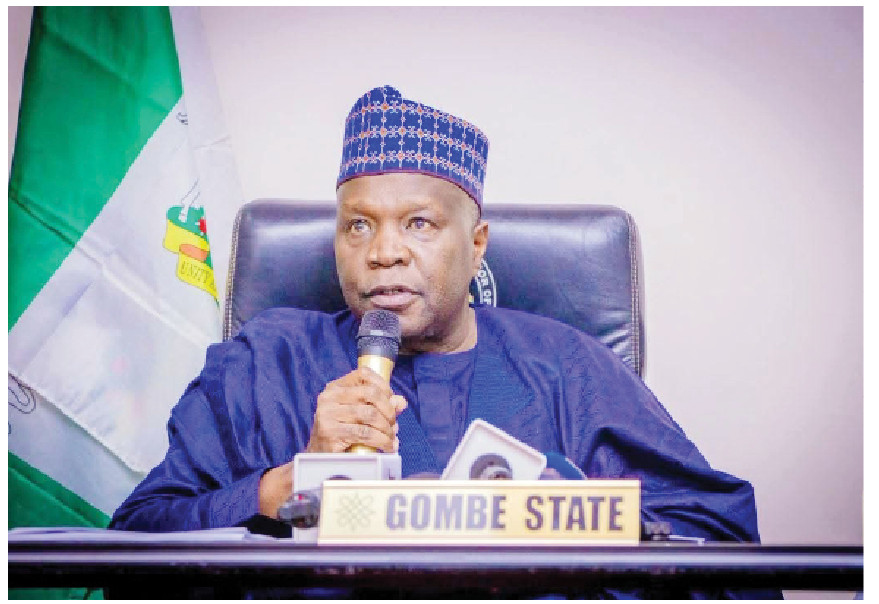
That is precisely the direction Governor Muhammadu Inuwa Yahaya of Gombe State appears determined to chart as Chairman of the Northern States Governors’ Forum (NSGF).
His recent address at the 8th Executive Committee meeting of the Northern Traditional Rulers Council in Dutse, Jigawa State, was a bold attempt to galvanize Northern leaders towards a new mindset anchored on responsibility, coordination, realism and measurable action.
For too long, conversations around the North’s challenges have often ended where they began: in lengthy speeches, ambitious communiqués and repeated promises that rarely translate into concrete outcomes. Inuwa Yahaya confronted that reality head-on.
“Enough of meetings that do not produce results. Enough of communiqués that are not implemented. Enough of promises that are not followed by action,” he declared.
Those words were not merely political rhetoric. They reflected growing public frustration across Northern Nigeria over worsening insecurity, shrinking economic opportunities and the seeming inability of leadership structures to respond with urgency.
But beyond diagnosing the problem, Governor Inuwa Yahaya also laid out what could best be described as a practical recipe for rebuilding Northern Nigeria.
First is the need for coordinated leadership. One of the recurring weaknesses in addressing Northern challenges has been fragmented responses among states and institutions. Insecurity does not respect state boundaries. Neither do poverty, unemployment or climate-related pressures.
As Chairman of the NSGF, Inuwa Yahaya is increasingly pushing the idea that Northern leaders must think and act collectively. His emphasis on a common Northern Security Framework suggests an understanding that isolated approaches can no longer solve regional problems.
This collaborative approach is gradually becoming one of the defining features of his leadership style. Whether engaging traditional rulers, security agencies, religious leaders or fellow governors, he always stresses that sustainable solutions require shared ownership and unified action.
Second is his insistence that insecurity must be tackled beyond military force alone.
While acknowledging the importance of kinetic operations, the Governor repeatedly emphasizes the deeper social and economic roots of violence. According to him, decades of poverty, poor education and youth unemployment have created fertile recruitment grounds for bandits, insurgents and criminal networks.
In essence, Governor Inuwa Yahaya is advancing a more holistic understanding of security that combines military action with investments in education, agriculture, job creation and youth empowerment.
This is perhaps one of the most important aspects of his message.
Northern Nigeria cannot sustainably defeat insecurity while millions of children remain out of school. It cannot build peace while rural economies collapse and young people are trapped in hopelessness. It cannot restore stability without rebuilding human capital.
That is why the Governor continues to advocate aggressive investment in education, skills acquisition and economic opportunities capable of restoring dignity and productivity to the region’s growing youth population.
Third is his recognition of the strategic role of traditional institutions.
In Northern communities, traditional rulers remain the closest link between government and the people. They possess local legitimacy, historical authority and community trust that modern institutions sometimes struggle to command.
By calling on royal fathers to strengthen intelligence gathering, community vigilance and early warning mechanisms, Inuwa Yahaya is repositioning traditional institutions as active partners in governance and security management rather than ceremonial observers.
This approach points to practical leadership that identifies existing strengths within society and mobilises them toward solving collective problems.
Perhaps even more significant is the example Governor Inuwa Yahaya is setting through purposeful governance in Gombe State itself.
Under his administration, Gombe has increasingly projected itself as a relatively stable and investment-friendly state despite the broader security challenges across parts of the North-East. The state’s emphasis on infrastructure development, education, healthcare, agriculture and fiscal reforms has become part of the governance model he now appears eager to encourage at the regional level.
In many ways, his broader Northern agenda mirrors the development philosophy he has pursued at home: security through inclusion, growth through infrastructure and stability through responsible governance.
Importantly, the Governor’s intervention also carries a moral undertone. He repeatedly stresses unity, tolerance and shared responsibility at a time when ethnic, religious and political divisions threaten to weaken the social fabric of the North.
“Without security, there can be no unity. Without security and unity, there can be no development,” he warned.
That message is particularly important because the North’s challenges are no longer merely security concerns; they are existential questions about the region’s future identity, cohesion and competitiveness within Nigeria.
Ultimately, Governor Inuwa Yahaya’s leadership of the Northern Governors’ Forum appears focused on shifting the conversation from lamentation to solutions, from blame to responsibility, and from isolated interventions to coordinated regional action.
Whether Northern leaders fully embrace this direction remains to be seen. But one thing is increasingly evident: solving the North’s problems will require exactly the kind of practical, courageous and collaborative leadership that Inuwa Yahaya is now advocating.
And perhaps, in a region searching desperately for direction, that may be the most important recipe of all.
We’ve got the edge. Get real-time reports, breaking scoops, and exclusive angles delivered straight to your phone. Don’t settle for stale news. Join LEADERSHIP NEWS on WhatsApp for 24/7 updates →
Join Our WhatsApp Channel