
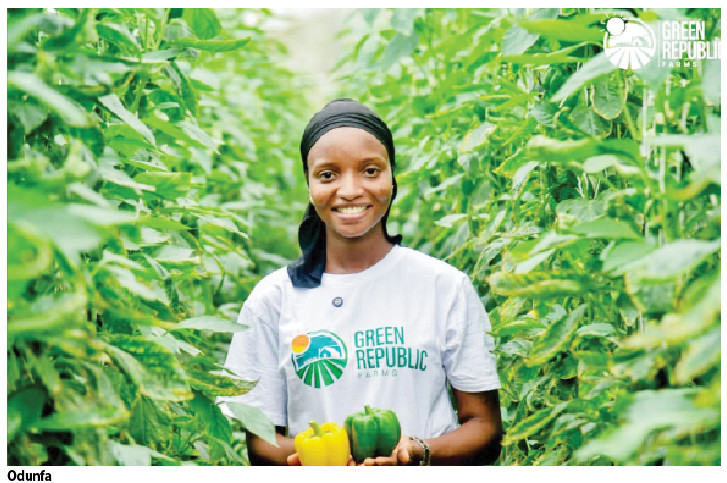
Baliqees Salaudeen-Ibrahim is the co-founder and CEO of Green Republic Farms, which leverages technology and innovation to cultivate high-quality produce like habaneros, bell peppers, and tomatoes. In this interview with ABIODUN SIVOWAKU, she reveals how using climate-smart agribusiness can end food insecurity and create jobs.
How did your journey into agribusiness begin?
My journey into agribusiness began as a climate activist and advocate. I was driven by a deep desire to solve real-world problems and create meaningful impact. This passion naturally led me to agriculture, where I saw a direct connection between climate change, food systems, and livelihoods.
I co-founded Green Republic Farms with my partners to contribute to building a more resilient food system, one that addresses food insecurity, unemployment, and the growing impact of climate change on agriculture. What started as curiosity quickly evolved into a purpose-driven mission.
Over time, I began to see agriculture not just as farming, but as a powerful tool for economic empowerment, especially for underserved communities. Today, we leverage climate-smart innovations such as solar-powered drip irrigation, controlled environment open-field farming, and greenhouse systems.
What were the early challenges, and how did you overcome them?
In the early stages of building Green Republic Farms, we faced several challenges, including limited access to funding, gaps in technical knowledge, a lack of reliable farming data, and inadequate infrastructure. There was also significant scepticism around adopting innovative farming methods such as greenhouse and soilless systems.
We overcame these challenges by prioritising continuous learning, building strategic partnerships, and starting small while reinvesting profits to grow sustainably. I actively sought mentorship, engaged with communities of practice, and embraced experimentation. These steps allowed us to refine our model and build resilience over time.
What was the turning point that changed the trajectory of your business?
A defining turning point for our business was gaining access to structured accelerator programs and funding opportunities at a critical stage of our growth. Beyond capital, these programs provided strategic direction, mentorship, and the systems thinking we needed to scale sustainably.
With this support, we were able to expand our operations, particularly by investing in climate-resilient greenhouse infrastructure, which significantly improved our productivity, consistency, and year-round production capacity.
This moment marked a clear shift from survival-driven, small-scale production to a more structured, commercially viable agribusiness. It positioned us not just for growth, but for scale, impact, and long-term sustainability.
How would you assess the impact of current government policies on MSMEs in agriculture?
Government policies in agriculture clearly aim to promote food security, youth participation, and economic growth. However, their real impact is often constrained by how well they translate into practical support for MSMEs.
One of the most critical gaps is in financing. It’s not just about access to funds, but access to the right type of financing. Agriculture requires patient, flexible, and affordable capital that aligns with production cycles, seasonality, and the inherent risks in farming. Unfortunately, many available financing options are short-term, high-interest, or structured like conventional business loans, making them unsuitable for agribusinesses.
As a result, many MSMEs are either excluded or forced into financial models that strain their operations. To truly support the sector, financing solutions must be tailored, accessible, and designed with a deep understanding of agricultural realities. Without this, even the best policies will struggle to achieve meaningful and lasting impact.
Beyond access to finance, barriers around land access, security, infrastructure, and market linkages persist. Many of these policies remain difficult to navigate, inconsistently executed, or inadequately communicated to the entrepreneurs they are meant to support.
For policies to deliver real impact, they must be practical, inclusive, and designed with the realities of agribusiness operators in mind, ensuring not just availability, but true accessibility and relevance.
Have you benefited from any government intervention programmes? What barriers exist?
Yes, we were recognised as one of the top 26 agrinnovators winners in the inaugural Lagos Agrithon Program, organised by the Lagos State Ministry of Agriculture and Food Systems in 2024.
While numerous intervention programs are available, access remains a major challenge due to bureaucracy, lack of transparency, and, at times, political influence. Many small-scale agribusinesses are either unaware of these opportunities or unable to meet the eligibility requirements.
Beyond benefiting from government initiatives, I have also contributed to shaping the ecosystem. A key highlight of my leadership journey was serving on the planning team for the 2-day National Youth Agribusiness Strategy Domestication Dialogue held in Abuja in February 2026. I contributed to designing and coordinating the dialogue, ensuring strong representation of youth and women, and aligning discussions with the realities of young agripreneurs across Nigeria.
The dialogue convened over 200 youth and women agripreneurs from all 37 states, alongside policymakers and key stakeholders. I also facilitated action-oriented conversations focused on youth-centred agricultural policies, inclusive financing, and the creation of enabling environments for young entrepreneurs to thrive.
What should the government do to better support entrepreneurs like you?
To better support agribusiness entrepreneurs, the government needs to simplify access to funding and invest heavily in rural security and infrastructure. This includes power supply, road networks, cold storage systems, drying facilities, affordable warehousing, and processing plants.
There is also an urgent need to subsidise farm inputs for primary producers. The rising cost of inputs, most of which are imported, has made farming increasingly unprofitable and discouraged many farmers. Reducing production costs is critical.
Additionally, the government should promote inter-state and intra-African trade while positioning Nigeria more competitively in the global agricultural export market. Policies around price stabilisation are also essential, as farmers often experience extreme fluctuations in income for the same produce within short periods.
Investing in local production of agricultural inputs and translating research from agricultural institutions into practical solutions will significantly strengthen the sector. Nigeria has the resources such as crude oil for fertilizer production and adaptable seed systems and must leverage them effectively, we also have a growing production of organic fertilizers which can be scaled.
What role do staff training, structure, and service delivery play in your business?
Staff training, organisational structure, and service delivery are critical to our success. Agriculture is both a science and a service-driven industry.
Our team must understand best practices, quality standards, and customer expectations. A well-trained workforce improves operational efficiency, reduces post-harvest losses, and ensures consistency in product quality and service delivery.
How do you ensure efficient logistics and timely supply, especially during peak periods?
Our farm is located within two hours of major markets in Southwest Nigeria, allowing us to reduce transportation time and emissions while maintaining freshness and nutritious value.
We also forecast demand ahead of peak periods and align our production cycles accordingly. By building strong relationships with logistics partners and maintaining a flexible supply chain, we can respond quickly and efficiently to large orders.
How do you manage costs while maintaining quality?
Managing cost without compromising quality requires a deliberate balance of efficiency, innovation, and discipline. At Green Republic Farms, we focus on optimising every stage of production, from input sourcing to post-harvest handling.
We minimise waste through precise resource management, make data-driven decisions to optimise input use, and leverage climate-smart technologies, such as controlled environment farming, to reduce losses and ensure consistent output.
This approach not only improves yield quality but also protects us from the unpredictability of weather and market fluctuations.
Ultimately, our goal is to build a system where efficiency drives cost reduction, while innovation safeguards quality, ensuring that neither is sacrificed for the other.
Is agribusiness profitable in today’s economy?
Have you eaten today? Whether or not you know the farmer who grew your food or the processor who handled it, they exist, and that alone tells you something important: agribusiness is not just essential, it is profitable.
However, profitability depends heavily on structure, scale, and strategy. While informal systems may survive, it is the structured agribusinesses, those that embrace innovation, value addition, and market intelligence, that are best positioned to achieve sustainable and long-term profitability.
Agriculture will always be in demand because food is a basic human need, but turning that demand into consistent profit requires intentional planning, operational efficiency, and a deep understanding of the market, the risks and how to strategically mitigate them.
How has your business evolved over time?
We have evolved from a small-scale farming operation into a structured, impact-driven agribusiness.
Today, without sacrificing the beauty and heritage of agriculture, we integrate climate-smart agriculture, technology, and innovation into our operations while prioritising community empowerment. We are not just producing food, we are building systems that create livelihoods and support environmental sustainability.
What advice can you give small business operators who want to stand out?
Clarity and consistency are key. Understand your value proposition, tell your story effectively, have a structured system and consistently deliver quality.
Also, invest in branding and customer experience. People don’t just buy products; they buy trust, reliability, and the experience associated with your brand.
How do you leverage technology to grow your business?
We leverage technology for farm monitoring, data tracking, and storytelling. Tools such as drones, digital platforms, and data systems enable us to improve efficiency, make informed decisions, and connect with our markets and audience more effectively.
Lastly, what advice would you give someone interested in this field?
Start with purpose, but build with knowledge. Agriculture requires patience, resilience, and a commitment to continuous learning.
It’s important not only to romanticise the field, but also to understand both the technical and business aspects, and to remember that agribusiness spans an entire value chain. Remain open to innovation, partnerships, and collaboration, as these are key drivers of long-term success in agribusiness.
We’ve got the edge. Get real-time reports, breaking scoops, and exclusive angles delivered straight to your phone. Don’t settle for stale news. Join LEADERSHIP NEWS on WhatsApp for 24/7 updates →
Join Our WhatsApp Channel