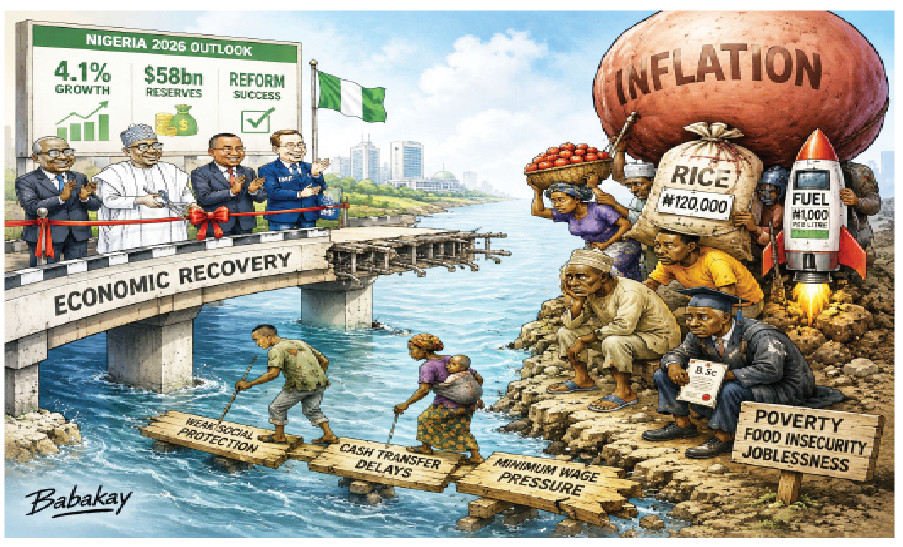
A bridge is only useful when it connects two sides of a river. If engineers complete one end while the other remains untouched, what exists is not infrastructure but symbolism. It may be praised for its design and ambition, yet it does not move people, goods, or opportunities across the divide.
This image captures the essence of Nigeria’s current economic moment as reflected in the 2026 Article IV Consultation of the International Monetary Fund International Monetary Fund. On one side, Nigeria presents a narrative of reform: subsidy removal, exchange rate unification, fiscal tightening, and rising external reserves projected at 58 billion dollars. On the other side, however, sits a population facing intensifying economic strain, weakened purchasing power, and deepening food insecurity.
Growth is projected at 4.1 percent in 2026, yet this expansion coexists with widespread hardship. The bridge of reform is being constructed, but it remains incomplete, uneven, and socially disconnected.
Stability Without Cushion
Nigeria’s reform programme is anchored in orthodox macroeconomic stabilisation. The removal of fuel subsidies, liberalisation of the exchange rate, and tighter monetary policy are intended to correct long-standing distortions and restore fiscal credibility.
However, the social absorption capacity of these reforms has been limited. The IMF estimates that 63 percent of Nigerians now live below the national poverty line, while approximately 27 million people face acute food insecurity. Inflation averaging 16 percent continues to erode real incomes across both urban and rural households.
The removal of fuel subsidies has amplified transport costs, increased food prices, and raised the cost of production across the economy. In the absence of strong social protection systems, adjustment costs have been borne disproportionately by low-income groups. The outcome is a stabilisation process that is technically coherent but socially incomplete.
Revenue Expansion Debate
A central recommendation of the IMF report is the need to expand Nigeria’s fiscal revenue base. This includes broadening the value-added tax system and introducing excise duties on petroleum products and telecommunications services.
On paper, these measures are consistent with Nigeria’s low tax-to-GDP ratio and the need for fiscal consolidation. In practice, however, they raise important questions about timing, structure, and equity.
Telecommunications services are not luxury consumption items in Nigeria. They are essential infrastructure for banking, education, commerce, and information access. Fuel is similarly foundational, powering transport systems, electricity generation, and small-scale enterprise.
Taxing these inputs without corresponding improvements in public service delivery risks increasing the cost of productivity while weakening household resilience. Revenue reform, therefore, cannot be separated from governance reform.
Fiscal Gaps and Leakages
Nigeria’s fiscal position reveals deeper structural challenges. The consolidated fiscal deficit widened to 4.4 percent of GDP, while a 2.7 percent discrepancy in fiscal reporting signals significant weaknesses in transparency and expenditure control.
A critical concern is the failure of subsidy removal savings to translate fully into fiscal space. These savings were estimated at approximately 2 percent of GDP, yet they have not been clearly reflected in improved public investment outcomes.
Instead, portions of these resources appear to have been absorbed through off-budget channels, unverified expenditures, or administrative leakages. This creates a structural disconnect between fiscal sacrifice and fiscal benefit.
Citizens experience the cost of reform immediately through higher prices, but the state struggles to demonstrate visible and measurable gains in public goods delivery. This undermines trust in the reform process and weakens policy legitimacy.
Financial Engineering Risks
Nigeria’s fiscal challenges have encouraged increasing reliance on complex financial arrangements. A notable example is the 5-billion-dollar total return swap, structured with 133 percent collateralisation in domestic sovereign securities.
While such instruments provide short-term liquidity relief, they introduce significant vulnerabilities. With debt servicing already consuming 53.2 percent of federal revenues, fiscal space is extremely constrained.
These arrangements expose the economy to exchange rate volatility, global interest rate shifts, and margin call risks. Rather than reducing fiscal stress, they often repackage it in more complex and less transparent forms.
This reflects a broader tendency toward short-term financial engineering rather than structural fiscal reform.
Currency Exit Behaviour
One of the most striking developments highlighted indirectly by the IMF data is the rapid adoption of stablecoins. Nigeria now accounts for approximately 60 percent of stablecoin inflows in Sub-Saharan Africa.
This is not primarily a speculative trend. It is a behavioural response to macroeconomic instability. Households, traders, and freelancers are increasingly using dollar-pegged digital assets as a store of value and medium of exchange.
The rise of stablecoins reflects declining confidence in the domestic currency’s ability to preserve purchasing power. When citizens begin to systematically opt out of the formal monetary system, it signals not innovation alone but institutional stress.
Monetary trust, once eroded, is difficult to rebuild without sustained macroeconomic discipline and credible policy coordination.
Structural Bottlenecks Persist
Beyond fiscal and monetary issues, Nigeria continues to face deep structural constraints. The electricity sector remains burdened by arrears equivalent to 0.75 percent of GDP, with additional liabilities expected in 2026.
Banks allocate about 22 percent of their assets to government securities, while a 45 percent cash reserve requirement significantly restricts private sector credit expansion. This crowding-out effect limits financing for manufacturing, agriculture, and small businesses.
Trade logistics remain inefficient due to port congestion, regulatory duplication, and informal costs. Agricultural production is repeatedly disrupted by insecurity, which affects supply chains, reduces output, and contributes to rising food prices.
These structural weaknesses ensure that macroeconomic stabilisation does not automatically translate into real-sector transformation.
Policy Prescriptions for Nigeria
First, fiscal reform must prioritise transparency before expansion. Nigeria should close the 2.7 percent GDP fiscal reporting gap by strengthening audit institutions, enforcing real-time expenditure tracking, and ensuring that all revenues flow transparently through the Federation Account. Without credibility in public financial management, new taxation measures will deepen public resistance and reduce compliance.
Second, subsidy savings must be legally ring-fenced for visible social investment. A defined proportion of revenues saved from subsidy removal should be allocated to targeted programmes in health, education, infrastructure, and inflation-indexed cash transfers. These allocations must be transparently published and independently audited to rebuild trust in the reform process.
Third, inflation management must combine monetary policy with supply-side interventions. Addressing food inflation requires urgent investment in agricultural security, rural infrastructure, storage systems, and logistics corridors. Without restoring production and distribution capacity, monetary tightening alone will remain insufficient.
Fourth, electricity sector reform must shift from fiscal bailouts to structural efficiency. This includes implementing cost-reflective tariffs, enforcing full metering, strengthening regulatory oversight, and holding distribution companies accountable for collection losses. Persistent arrears must be eliminated through structural reform, not repeated fiscal injections.
Fifth, the financial sector must be rebalanced to support productive credit. Nigeria should gradually reduce excessive sovereign exposure in bank balance sheets and ease restrictive cash reserve requirements in a targeted manner that unlocks lending to manufacturing, agriculture, and small and medium enterprises.
Finally, social protection must be scaled up into a genuine stabilisation tool. Cash transfer programmes must be inflation-indexed, regularly disbursed, and large enough to meaningfully offset the impact of reforms on vulnerable households. Social policy must be treated as an integral component of macroeconomic stability, not an afterthought.
Only through these measures can Nigeria begin to transform reform from a technical exercise into a socially sustainable process of economic reconstruction.
We’ve got the edge. Get real-time reports, breaking scoops, and exclusive angles delivered straight to your phone. Don’t settle for stale news. Join LEADERSHIP NEWS on WhatsApp for 24/7 updates →
Join Our WhatsApp Channel