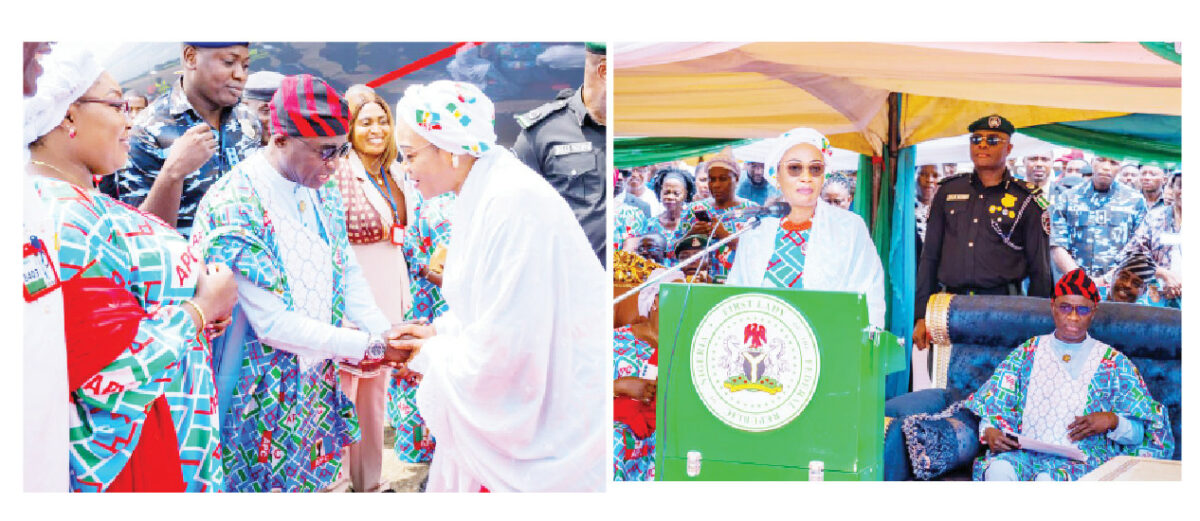
The relationship between the First Lady of the Federal Republic of Nigeria, Senator Oluremi Tinubu, and the people of Benue State has steadily evolved beyond official engagements into a bond strengthened by empathy, intervention, and shared history.
Her recent visit to the state, which marked her third official appearance in Benue, further reinforced this growing relationship. The visit was not merely ceremonial; it represented a blend of infrastructure development, digital empowerment, and social intervention under the Renewed Hope Initiative (RHI).
In Makurdi, the First Lady commissioned ten strategic intra-city roads spanning approximately 11.5 kilometres, executed under the Phase One Urban Renewal Programme of the administration of Governor Hyacinth Alia. The roads are expected to improve transportation, enhance security, stimulate economic activities, and contribute to the overall transformation of the Benue capital. The visit also witnessed the commissioning of a Community ICT Centre in Ihugh, Vandeikya Local Government Area, established through a collaboration between the Renewed Hope Initiative, the National Information Technology Development Agency (NITDA), and the Benue State Government to promote digital literacy, innovation, and economic opportunities, particularly for young people and women.
Beyond infrastructure, Senator Tinubu’s imprint in Benue has been significantly felt through numerous humanitarian and empowerment programmes targeted at women, children, the elderly, and vulnerable groups. Through the Renewed Hope Initiative and the coordinated efforts of its Benue leadership under Hon. Scholastica Ben-Sor, interventions have reached various categories of beneficiaries, including the distribution of sanitary products to schoolgirls, support packages for women, assistance to elderly citizens, and economic empowerment initiatives.
During her latest visit, the First Lady also extended further support to grassroots commerce through the empowerment of 1,000 women petty traders with a ₦100 million grant, a gesture aimed at strengthening small businesses, improving household incomes, and increasing women’s economic participation.
For many Benue women, these interventions represent more than material assistance. They signify inclusion, recognition, and a direct connection with the highest levels of national leadership. The programmes have created platforms where women across political, ethnic, and religious divides can gather around common developmental interests, fostering stronger social networks and encouraging greater participation in public affairs.
Politically, the visibility of these interventions has also strengthened the relationship between grassroots communities and the administrations of President Bola Ahmed Tinubu and Governor Hyacinth Alia. Supporters of the All Progressives Congress (APC) view the collaboration between the Presidency, the Office of the First Lady, and the Benue State Government as a practical demonstration of the Renewed Hope Agenda reaching ordinary citizens. Such initiatives can contribute to increased goodwill, political mobilisation, and public support, particularly among beneficiaries who perceive tangible improvements in their daily lives.
The First Lady’s affection for Benue has also been expressed on a personal level. She has publicly recalled her family’s connection to the state through her late uncle, popularly known as Dele Bookshop, who lived much of his life in Benue, married a Benue woman, and raised his family there. This personal history has added an emotional dimension to her engagements with the state and has been warmly received by many residents.
Her previous visits to Benue have equally reflected moments of solidarity — from accompanying President Bola Ahmed Tinubu on a post-election appreciation visit to returning during periods of grief to identify with the people over tragic incidents, including the Yelwata attacks.
As Benue continues its quest for development, the continued partnership between the First Lady’s Renewed Hope Initiative and the state government presents opportunities for expanding social welfare, digital inclusion, and women-centred economic programmes.
Ultimately, the legacy of these interventions may be measured not only by the roads built, the grants distributed, or the facilities commissioned, but by the confidence they inspire among women and communities who feel seen, supported, and included in the broader national development process.
– Isaac Uzaan is Principal Special Assistant (PSA) to the Governor of Benue State on Media and Content Creation and he writes from Makurdi.
We’ve got the edge. Get real-time reports, breaking scoops, and exclusive angles delivered straight to your phone. Don’t settle for stale news. Join LEADERSHIP NEWS on WhatsApp for 24/7 updates →
Join Our WhatsApp Channel