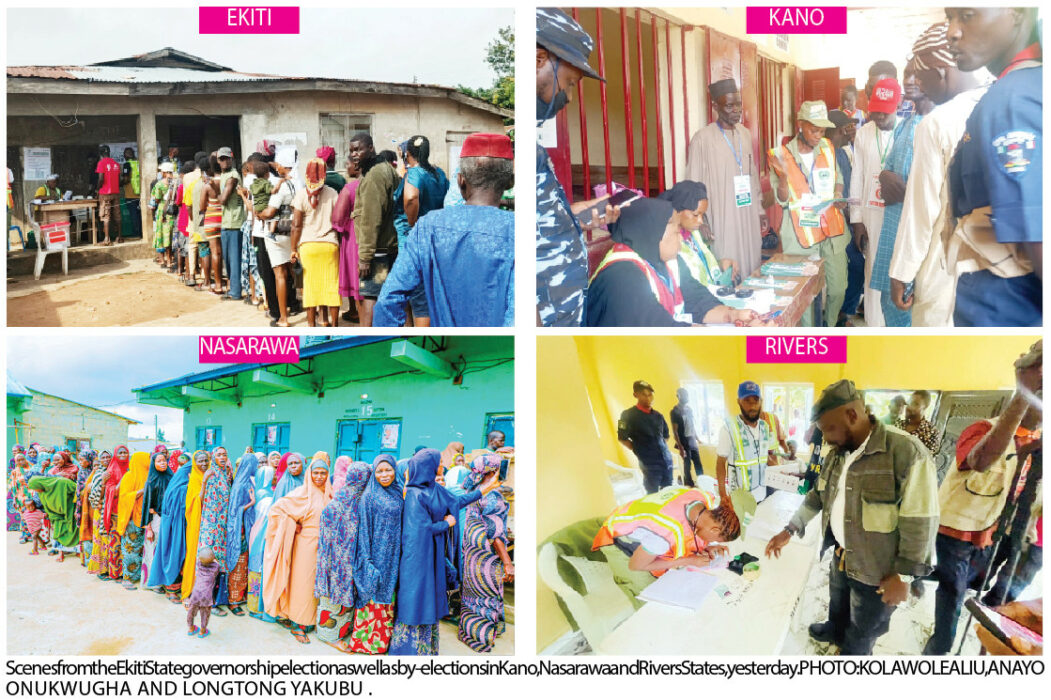
After every off-cycle election, I make it a habit to sit down and do a proper post-mortem. Not the kind where you pretend everything was fine or the kind where you cry foul because your preferred candidate lost, but an honest, eyes-wide-open assessment of what happened and what it tells us about where we are as a political people. The Ekiti governorship election has been won and lost, and like I promised myself, here are the lessons.
Let me start with what is, by any fair measure, a historic achievement. Governor Biodun Oyebanji of the All Progressives Congress made history in Ekiti State last Saturday. He became the first incumbent executive governor in the state’s history to secure back-to-back re-election since the return of democracy in 1999. He swept all 16 local government areas, polling 319,224 votes. That is not a small thing. In a state that has spent the better part of its democratic history chewing up and spitting out its own governors after sometimes midway through a first term, this is a significant political milestone.
You can argue about the margin, about logistics, about the process. But you cannot deny that Oyebanji got his politics right. He had his predecessors behind him. He consolidated. He won convincingly.
Now, was anyone genuinely surprised? I wasn’t. Not for one minute. When you have a governor who has managed to keep every major political stakeholder, including former governors who rarely agree on the colour of the sky, all rowing in the same direction, a landslide is not a prediction; it’s a mathematical certainty. Ekiti has had a turbulent democratic history. Fayemi, Fayose, back and forth, the state became almost synonymous with dramatic political reversals.
Oyebanji broke that pattern, and credit must be given where it is due. The only real question going into Saturday was the margin, and even that did not hold too many surprises.
So let’s talk about the things that did happen, or rather, the things that always happen and that we keep pretending shock us.
Vote buying. There it is. The elephant that walked into the polling booth, sat down, collected its N15,000 and voted. Every major party engaged in it. Let me repeat that for the people at the back who like to play innocent when their side wins: every major party engaged in it. The APC did it. The PDP did it. The smaller parties did whatever they could afford. The only difference between them was the size of the war chest. At the end of the day, the highest bidder carried the day, and that is now, whether we admit it or not, as much a feature of Nigerian elections as Independent National Electoral Commission (INEC )officials and ballot boxes.
Can we stop the pretence? Can we just accept, as a country, that vote buying has become a permanent fixture of our electoral process, at least at the governorship and presidential levels? I am not endorsing it. I am not celebrating it. But I am done watching politicians who funded cash-for-vote operations turn around and issue solemn press releases about the sanctity of democracy. The hypocrisy is staggering. People even went on social media proudly displaying the money they collected, though I will grant that some of that content is just people catching cruise and making content for their monetised pages. Not all of it should be taken at face value. But enough of it is real to tell us something important about where we are.
The Independent National Electoral Commission and civil society groups have been saying for years that vote buying is the cancer eating at the foundation of our democracy. They are right. But saying it and stopping it are two different things. Until we have consistent, high-profile prosecutions of vote buyers, not small-time distributors, but the principals who give the orders and fund the operations, this will continue. The Electoral Act 2022 has provisions against vote buying. Section 121 prescribes fines and imprisonment. But how many convictions have we seen? How many party chieftains have done a single day in Kuje over this? The law exists. Enforcement does not. And even where enforcement is attempted, given the poverty levels across the country, I am not sure a fine of any amount is going to frighten a man who just bought 30,000 votes at N5,000 apiece. The deeper fix is economic: when people are not desperate, their votes become less negotiable. We are a long way from that yet.
The other story that came out of Ekiti was the usual cocktail of BVAS malfunctions and allegations of thumb-printing. I expected every single one of those stories. Any Nigerian who went into Saturday expecting a seamless, controversy-free election is living in a very comfortable kind of delusion. Our political class wants to win at all costs. That is not a north thing or a south thing; it is a Nigerian political class thing, full stop. The BVAS technology has significantly improved the process, and anyone who was around for elections before 2023 knows that. But technology alone cannot fix a culture of impunity that goes back decades. Where the machines work, determined people find workarounds. Where they don’t work, the absence becomes suspicious. That is the loop we are stuck in, and no single technology will break it without the political will to prosecute those who subvert it.
One thing I want to flag, though, is the People’s Democratic Party’s performance. They came second. Some people found that surprising. I did not. Say what you want about the PDP, and there is plenty to say, but that party still has structures in virtually every state in the country. They are battered, they are faction-ridden, and their national leadership has not exactly distinguished itself lately. But they have local networks that don’t disappear just because the party is going through a rough patch at the top. I would not be too quick to write them off in the run-up to the 2027 general elections. Don’t be surprised if they outperform both the ADC and the NNPP in terms of National Assembly seats when that time comes.
And that brings me to what I think is the most important lesson from Ekiti, the one we keep learning and then promptly forgetting. In Nigerian politics, perception and narrative are almost everything until the votes are counted, and then it all collapses back to structure, money, and incumbency. All the commentary about Ekiti being a referendum on the APC federal government, all the talk about what a strong opposition showing would signal for 2027, most of that was noise generated by people who spend too much time on X and not enough time understanding how votes actually move in places like Ado-Ekiti, Ikere, and Ijero. What determined Saturday’s result was, in order: Oyebanji’s consolidation of stakeholders, the ruling party’s financial firepower, the opposition’s weakness on the ground, and vote buying. That was the election. Everything else was commentary.
The lesson for the opposition going into 2027 is stark and not particularly complicated. You cannot beat structure with press releases. You cannot beat money with moral outrage on social media. You need to build at the ward level, you need credible candidates with genuine local followings, and you need to start that work now not six months before the governorship primaries. Any party that thinks a charismatic presidential candidate alone can overcome the machine that incumbency provides in this country is making the same mistake opposition parties have been making for the better part of two decades. The APC went into 2015 with structure, resources, and a coalition of grievances. That is the template. Sentiment without structure is a slogan, not a strategy.
As for the electorate, and this is the part that is hardest to say, because nobody likes to hear it, we are not entirely victims here. The moment we collectively decide, across the country, that N5,000 is not worth four years of bad governance, elections in this country will begin to change. Not overnight, but they will change. That decision has to come from us, from the voters, community by community, ward by ward. The politicians will not volunteer it. The money will always be on the table. The question is whether we keep picking it up.
We’ve got the edge. Get real-time reports, breaking scoops, and exclusive angles delivered straight to your phone. Don’t settle for stale news. Join LEADERSHIP NEWS on WhatsApp for 24/7 updates →
Join Our WhatsApp Channel