Nigeria can expand energy production and cut greenhouse-gas emissions at the same time, if projects are designed with decarbonisation and the right technology from the start.
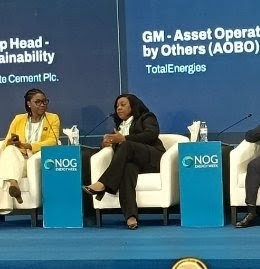
This was one of the key points highlighted at the ongoing 2026 Nigeria Oil and Gas Energy Week, in Abuja.
Speaking during a strategic panel general manager, Assets Operated by Others, at TotalEnergies, Ogogome Epecham, argued that Nigeria’s energy transition must be aligned with its development priorities.
Any decarbonisation plan, she said, should prioritise three goals: expanding access to energy, keeping it affordable and supporting industrialisation.
Epecham rejected the notion that development and emissions reduction are mutually exclusive. “We can develop an equitable pathway that integrates decarbonisation into our growth strategy,” she said.
She pointed to the Ubeta gas project as an example.
Scheduled to deliver first gas in 2027, the project is expected to supply about 300 million standard cubic feet of gas per day to domestic and export markets.
Epecham said Ubeta was designed with emissions-reduction measures from the outset, including eliminating routine flaring, using solar-powered systems to cut fuel-gas emissions and electrifying drilling operations.
She also said the Petroleum Industry Act provides a strong policy framework to help Nigeria meet climate and energy targets.
On methane, she argued that cutting leaks is affordable when monitoring and measurement are done properly.
TotalEnergies uses a proprietary drone system called AUSEA to detect and quantify methane emissions and supplements that with permanent methane sensors for continuous monitoring. The dual approach, she said, allows rapid detection of fugitive emissions so operators can act before losses grow.
TotalEnergies recently renewed its collaboration with the Nigerian National Petroleum Company Limited to deploy the drone technology and has shared lessons learned with other industry players.
Epecham added that TotalEnergies removed routine flaring across all its operated Nigerian assets in 2023, making it among the first operators in the country to reach that milestone. She urged that future oil and gas projects embed decarbonisation measures at the design stage, rather than treating them as afterthoughts.
Also on the panel, country sales director for Process Automation, Sub-Saharan Africa at Schneider Electric, Elijah Daniel, said that digital technologies had removed many of the traditional barriers to decarbonisation.
He noted that artificial intelligence, infrared methane detection cameras, predictive maintenance systems and automation now allow operators to continuously monitor facilities, reduce emissions and prevent equipment failures.
Daniel said that the falling cost of cloud computing and AI has made these technologies accessible even to indigenous operators.
Unlike international oil companies, he added, local operators have shorter decision-making processes and can implement innovations more quickly.
He argued that Africa’s infrastructure gap presents an opportunity to leapfrog directly into digitally enabled energy systems, much like the continent did with mobile telecommunications and financial technology.
To achieve that, he called for stable government policies, greater investment in digital infrastructure such as data centres and stronger development of digital skills among young professionals.
Another panelist, Umesh Amarnani of Pacegate Energy & Resources Limited, who spoke on local manufacturing, said that producing oilfield chemicals in Nigeria has strengthened supply chains while reducing dependence on imports.
He explained that production of chemicals are essential to maintaining oil and gas operations by preventing corrosion and scale formation.
According to him, local manufacturing has enhanced energy security by ensuring products are readily available while promoting technology transfer and creating employment.
Amarnani, however, urged stricter enforcement of Nigeria’s local content law, arguing that contracts should be awarded based on technical capability and product performance rather than other interests.
He also highlighted his company’s investment in staff development, profit-sharing and education programmes, including the adoption of 50 government schools to help develop future talent.
Methane Finance Advisor at the Environmental Defense Fund, Paul Boeffard, said Nigeria has emerged as a leader in regulatory innovation through the Nigerian Gas Flare Commercialisation Programme.
He explained that the programme separates flare gas from operators’ balance sheets, enabling independent developers to recover gas that would otherwise be flared and convert it into commercial products such as compressed natural gas, liquefied petroleum gas and liquefied natural gas.
According to him, this structure allows climate-focused investors to finance projects that reduce emissions while creating new commercial opportunities.
Although 28 flare gas recovery licences have already been issued, he said many developers still face challenges moving from permits to final investment decisions.
The Environmental Defense Fund, he added, is supporting developers through technical advisory services and feasibility studies.
Returning to methane reduction, Epecham said effective methane management depends on accurate detection, monitoring and measurement rather than expensive technology.
She disclosed that TotalEnergies has deployed drone-based methane detection systems alongside permanent monitoring sensors across its facilities and recently renewed collaboration with NNPC on the technology.
She added that the company eliminated routine flaring across all its operated assets in Nigeria in 2023, describing the achievement as a major milestone in its decarbonisation strategy.
The panellists agreed that decarbonisation should not be viewed as an obstacle to energy security but as an opportunity to improve operational efficiency, attract investment and support sustainable economic growth.
We’ve got the edge. Get real-time reports, breaking scoops, and exclusive angles delivered straight to your phone. Don’t settle for stale news. Join LEADERSHIP NEWS on WhatsApp for 24/7 updates →
Join Our WhatsApp Channel