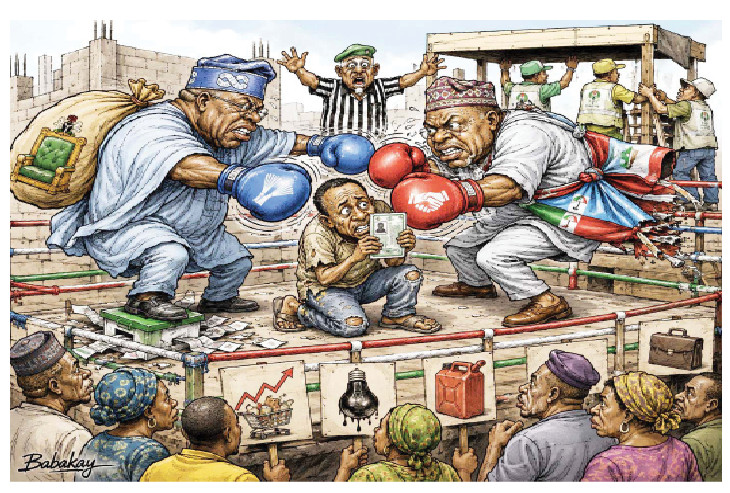
By the time Nigerians file into polling units in 2027, the most consequential battle for the nation’s democracy may already have been fought—and perhaps won or lost. Elections are democracy’s public ceremony: the visible conclusion of choices, pressures and institutional conduct shaped long before the first ballot is cast. The deeper test lies elsewhere—in the independence of institutions, the behaviour of political actors, the protection of dissent, the resilience of the rule of law and the willingness of those entrusted with power to submit to the same constitutional restraints they demand of others.
It is in these quieter arenas, not merely on election day, that democracies flourish or unravel. Nigeria can rightly take pride in sustaining uninterrupted civilian rule since 1999. On a continent repeatedly shaken by coups and constitutional reversals, regular elections are a significant achievement. Governments have changed through the ballot box, opposition parties have defeated incumbents, and democratic institutions have accumulated experience. Yet longevity must not be mistaken for consolidation.
A country may become increasingly skilled at organising elections while growing less faithful to the principles that make elections meaningful. Democracy is not measured only by the frequency of voting, but by the openness of political competition, the neutrality of institutions, the protection of fundamental freedoms and citizens’ confidence that every contender plays by the same constitutional rules.
Institutions, Trust and the Slow Erosion of Democracy
Across Nigeria’s political landscape, internal crises have become almost routine. Leadership disputes, factional struggles and prolonged litigation have weakened several opposition parties, while the ruling party has not been immune to its own tensions. Political contestation is normal. What should trouble every democrat, however, is the growing perception that institutions created to arbitrate political disputes are increasingly viewed through partisan lenses.
Whether every suspicion is justified is, in one sense, secondary. Democracy depends not only on constitutional procedure, but also on public confidence. Institutions derive legitimacy from both the authority granted by law and the trust citizens place in their neutrality. Once that confidence erodes, democratic stability becomes fragile even when formal processes remain intact. Trust is far harder to rebuild than to preserve.
History offers a sobering warning. Democracies rarely collapse in one dramatic moment. More often, they weaken gradually: through the erosion of checks and balances, the selective application of laws, the shrinking of political space, unequal competition and the normalisation of practices once considered unacceptable. The danger lies precisely in the incremental nature of decline. Each abuse appears survivable until the accumulated damage becomes difficult to reverse.
The deterioration of political discourse deepens this risk. Public debate increasingly rewards outrage over reason, suspicion over dialogue and personal attack over policy alternatives. Social media accelerates misinformation, hardens polarisation and spreads narratives designed more to inflame than to inform. Opponents are too often treated not as legitimate competitors but as enemies whose participation in national life must be resisted.
Such a culture impoverishes democracy. Pluralism is not democracy’s weakness; it is its defining strength. The freedom to disagree peacefully, challenge authority and offer alternative visions of national development is not a threat to constitutional order. It is the mechanism through which democracy renews itself. Nations do not become weaker because citizens disagree; they become weaker when disagreement itself is made dangerous.
The Discipline of Power and the Duties of Political Actors
The months ahead demand democratic restraint, beginning with the use of public power. State resources must never become instruments of partisan advantage. The separation between government and the governing party is one of democracy’s essential guardrails. Governments administer the state on behalf of all citizens; political parties campaign on their own behalf. Blurring that distinction damages public trust and electoral legitimacy.
Every naira appropriated from the treasury belongs to the Nigerian people, not to any party. Government property, public institutions, official communication platforms and state infrastructure exist to serve the Republic, not those temporarily entrusted with its administration. The temptation to convert incumbency into entitlement must therefore be resisted.
The greatness of democratic leadership lies not in the unfettered exercise of power, but in the discipline to restrain it. History remembers leaders not only for the authority they wielded, but for the constitutional limits they respected while wielding it.
The responsibility for safeguarding democracy, however, does not rest with government alone. Opposition parties cannot demand stronger institutions while neglecting democracy within their own ranks. Persistent factionalism, opaque candidate selection, unstable leadership and organisational indiscipline undermine public confidence. Political parties are the training grounds of democratic leadership; when internal democracy collapses, national democracy is weakened.
The media and civil society also carry an immense burden. Journalism fulfils its highest calling when it scrutinises power rigorously while remaining faithful to facts rather than partisan preference. Civil society must defend constitutional principles consistently, resisting selective outrage based on which political interest is affected. Principles acquire moral authority only when applied impartially.
Citizens, too, are not spectators. The 2023 general election revealed an electorate increasingly determined to demand transparency, accountability and credible processes. That civic awakening remains one of Nigeria’s greatest democratic assets. Yet no electoral commission can compensate for citizens who normalise vote-buying. No constitutional amendment can eliminate ethnic or religious prejudice from political choices. No judicial pronouncement can substitute for civic responsibility.
The Choice Before Nigeria
Democracy ultimately reflects the political culture of its people. Citizens who reward competence, integrity and ideas strengthen institutions. Those who elevate ethnicity, patronage, misinformation or immediate material inducement above national interest weaken the system on which their freedoms depend.
As 2027 approaches, Nigeria must resist reducing political debate to the question of who will win. The larger question is what kind of democracy will remain after victory has been declared. Every administration eventually leaves office. Every governing party eventually confronts the possibility of opposition. Every election becomes history.
What endures are institutions, constitutional conventions and democratic norms. These foundations deserve greater protection than the ambitions of any leader, party or generation. Nigeria has repeatedly demonstrated remarkable resilience, surviving military dictatorship, constitutional crises, economic upheaval and profound national uncertainty. But resilience must not become an excuse for complacency. Democracy survives not because it is indestructible, but because each generation consciously chooses to defend it.
That choice confronts Nigeria again. The months before the 2027 elections will reveal more about the nation’s democratic maturity than election day itself. They will show whether political actors value constitutional restraint above partisan expediency; whether institutions remain loyal to the Republic rather than political interests; whether leadership is exercised with humility rather than entitlement; and whether citizens understand that democracy is sustained not by perpetual victory, but by the certainty that power can change hands peacefully, fairly and legitimately.
The battle before the ballots is therefore not fundamentally between parties, personalities or regions. It is a contest between principle and expediency, institutional integrity and institutional capture, democratic restraint and democratic excess. Nigeria must decide which side it will stand on.
The election will last only a day. The character of Nigeria’s democracy will endure long after the final votes are counted. History will remember not only who won in 2027, but whether the nation preserved the values that made victory worth having for citizens now and generations yet unborn.
– Dr Dakuku Peterside is a renowned author of two bestselling books, Leading in a Storm and Beneath the Surface.
We’ve got the edge. Get real-time reports, breaking scoops, and exclusive angles delivered straight to your phone. Don’t settle for stale news. Join LEADERSHIP NEWS on WhatsApp for 24/7 updates →
Join Our WhatsApp Channel